Axios Macro
August 29, 2022

⛰️ We're back from Jackson Hole and here to offer you our takeaways.
- Turns out, there was a rather vivid omen of the hawkish speech that Fed chair Jerome Powell delivered at the economic symposium: The day before central bankers gathered, there were actual live hawks in the lobby of the lodge, part of a weekly summer program from the Teton Raptor Center. 🦅
- Today, we report on the grim consensus that emerged from the gathering. Plus, on a lighter note, if you make it to the end you'll get an inside look at our Jackson Hole adventure. 📷
Today's newsletter, edited by Javier E. David, is 673 words, a 2½-minute read
1 big thing: A more volatile world is here to stay

Fed chair Jerome Powell, vice chair Lael Brainard, and New York Fed president John Williams at the Jackson Hole economic symposium. Photo: David Paul Morris/Bloomberg via Getty Images
Over the last few days at Jackson Hole, Wyoming, a recurring — and disturbing — theme emerged from the proceedings.
- The world's most powerful policymakers believe that the extraordinary economic volatility of the last few years — with whipsawing growth, supply disruptions and inflation — are likely to persist for many years to come.
Why it matters: We may be entering a more inherently volatile period in the world economy. Geopolitics, pandemics and climate change are making the (mostly) steady growth and low inflation of recent decades a thing of the past.
- That would make the task of managing macroeconomic policy — tweaking interest rates, taxes and spending to keep the economy on an even keel — dramatically more difficult.
Driving the news: The headlines out of the Kansas City Fed's annual symposium, which concluded Saturday, focused on Fed chair Jerome Powell's Friday speech that presaged more interest rate increases to fight inflation.
- But there was a broader consensus of shifts in the fundamentals of the world economy evident at the gathering, where top global economic leaders convene each August to take stock of things and exchange ideas.
- Isabel Schnabel, a member of the European Central Bank executive board, called it the "Great Volatility" in a talk delivered Saturday. That contrasted with the "Great Moderation" of global growth and inflation era of the 1980s to 2007.
State of play: Through the 2010s, the central economic challenge worldwide was inadequate demand: not enough spending, jobs or investment.
- So far in the 2020s, the predominant challenge has been one of inadequate supply.
- The pandemic created wide-scale rolling shutdowns of commerce around the globe.
- War in Europe is disrupting global energy and food markets, and the geopolitical outlook, including with China, is ominous.
- A warming climate and the more volatile weather patterns it fuels can also translate into supply shocks, as evidenced in recent weeks with factory shutdowns in China stemming from a heat-induced shortage of hydropower.
What they're saying: "The challenges we are facing are likely to bring about larger, more frequent and more persistent shocks in the years ahead," the ECB's Schnabel said.
2. Part II: The huge question facing policymakers
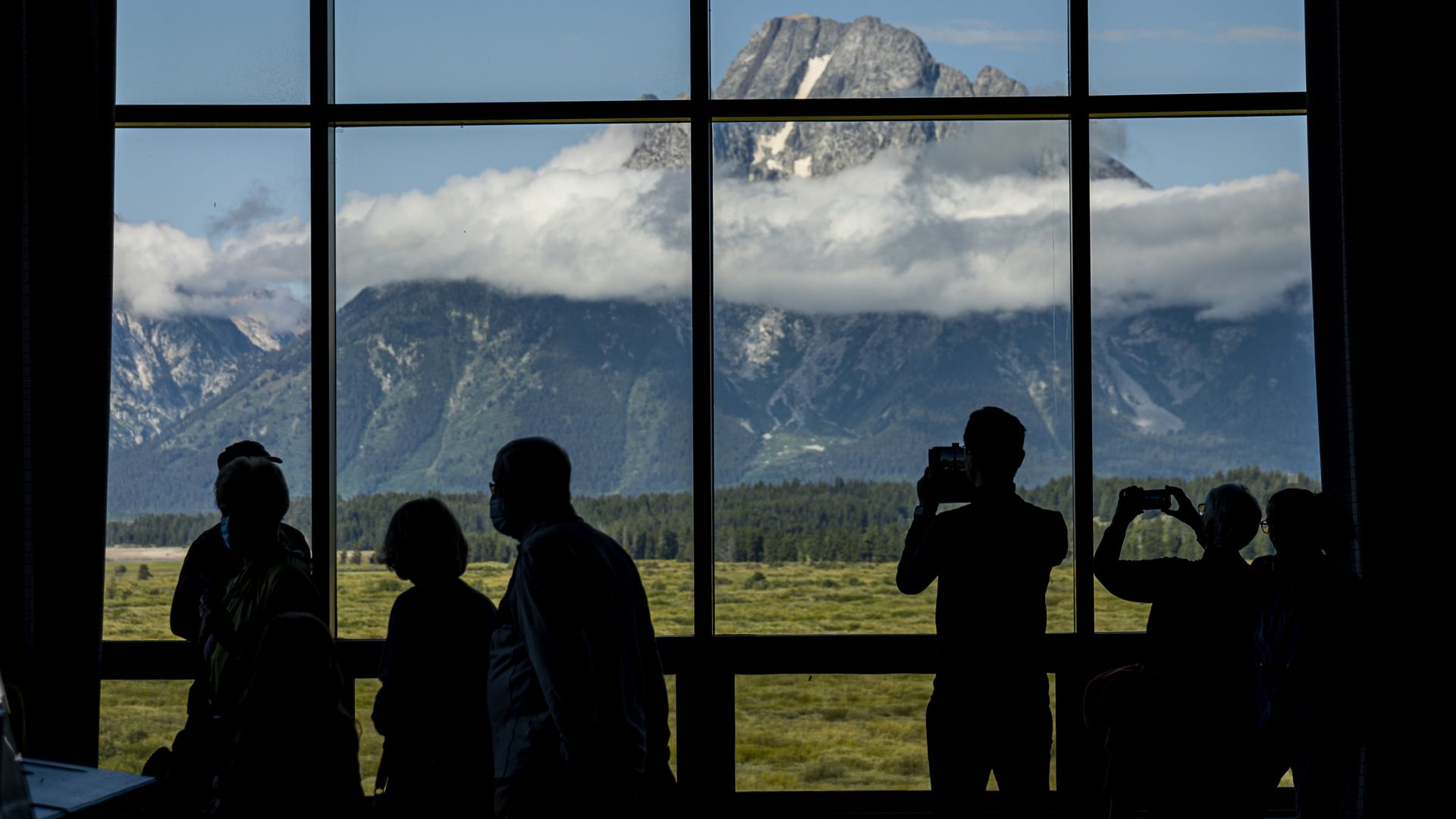
Visitors take photos of the Grand Teton National Park mountain range from Jackson Lake Lodge during the Jackson Hole economic symposium. Photo: David Paul Morris/Bloomberg via Getty Images
Less certain, however, is how these economic policy technocrats ought to react to this more volatile world. After all, central bankers are not the ones who can make peace in Ukraine, fight pandemics or slow climate change.
- Rather, they have to take the world as it is and try to manipulate the dials to keep inflation from becoming permanently high while cushioning the economic pain of crises, where possible.
Reading the room: The overwhelming tone at Jackson Hole was one of monetary hawkishness. There was an overarching sense that central banks must act to prevent a new norm of high inflation from taking root.
Yes, but: It can be argued that more volatile supply and inflation will mean central banks shouldn't be too reactive to new outbreaks related to war, disease or climate.
What they're saying: "If there are going to be many more of these meaningful shocks, you have to rethink what your monetary policy strategy will be," Adam S. Posen, president of the Peterson Institute for International Economics and a former Bank of England official, tells Axios.
- "If you want to stick with an inflation targeting regime, you have to think about a higher or different kind of inflation target, or one that sections off some of these shocks," he adds.
Central banks may be gun-shy about changing their approach to policy, in part because they did so just a couple of years ago. The new policy framework proved ill-suited for the inflationary pressures of the pandemic.
- "There's a feeling of once burned, twice shy," Posen says. "Nobody wants to announce a new strategy for a while."
The bottom line: There is consensus that we have entered a more volatile era, with rolling supply disruptions likely to be the norm. There is less consensus in what economic policymakers should do about it.

Sign up for Axios Macro
Stay ahead of the curve on the most important economic developments with reporting and analysis on how business, policy, and markets collide.