Axios Macro
November 28, 2023

How many Americans are doing gig work? We look at a new paper that says government data may be undercounting these workers, which has huge implications for the U.S. labor market.
- Plus, we parse speeches this morning from two top Fed officials. 💭
Situational awareness: Consumer confidence edged up for the first time in three months, due to rising optimism about the outlook for incomes and job market prospects, the Conference Board said.
Today's newsletter, edited by Javier E. David and copy edited by Katie Lewis, is 655 words, a 2½-minute read.
1 big thing: America's hidden gig workers

Illustration: Annelise Capossela/Axios
Millions of Americans are doing casual work while not counting as employed for the purposes of the government's official statistics, based on new research that sheds light on the true prevalence of informal gig work.
Why it matters: If more Americans are open to working than is implied by traditional economic data, the job market may be less tight than it seems — with more people open to opportunities for higher-paying, more stable work.
The details: The share of adults who are counted as employed would be higher by up to 5.1 percentage points (using generous estimates) if the people doing causal gig work properly reported doing so in the Current Population Survey, on which the jobless rate is based.
- That's from a paper by Anat Bracha of Hebrew University Business School and Mary A. Burke of the Federal Reserve Bank of Bost0n, presented earlier this month at a conference.
- Using more conservative estimates, the employment-to-population ratio would have been 0.25 to 1.1 percentage point higher from 2015 to 2022.
State of play: Uncounted gig workers are disproportionately older, more likely to be disabled and less likely to be doing casual work as a primary source of income, the authors found.
Yes, but: Bracha and Burke took a novel approach to probing just how many of the people who say they aren't working in that survey actually are not.
- Using a separate survey, the New York Fed's Survey of Consumer Expectations, they first ask the same questions as the CPS to identify people who would be classified as either unemployed or out of the labor force in the official statistics.
- They then asked those people about specific paid activities they may have undertaken — house cleaning, driving for Uber and so on.
- Those answers revealed uncounted Americans who are earning money in exchange for work but do not answer as such when first asked.
What they're saying: "There are reasons for thinking about gig work differently with respect to labor market slack," Bracha and Burke write, "because it points to a hidden labor supply that could be tapped by traditional employers."
The bottom line: The uncounted gig workers may be an untapped source of new labor supply, as their side jobs indicate some desire to earn more money.
2. This morning's Fedspeak
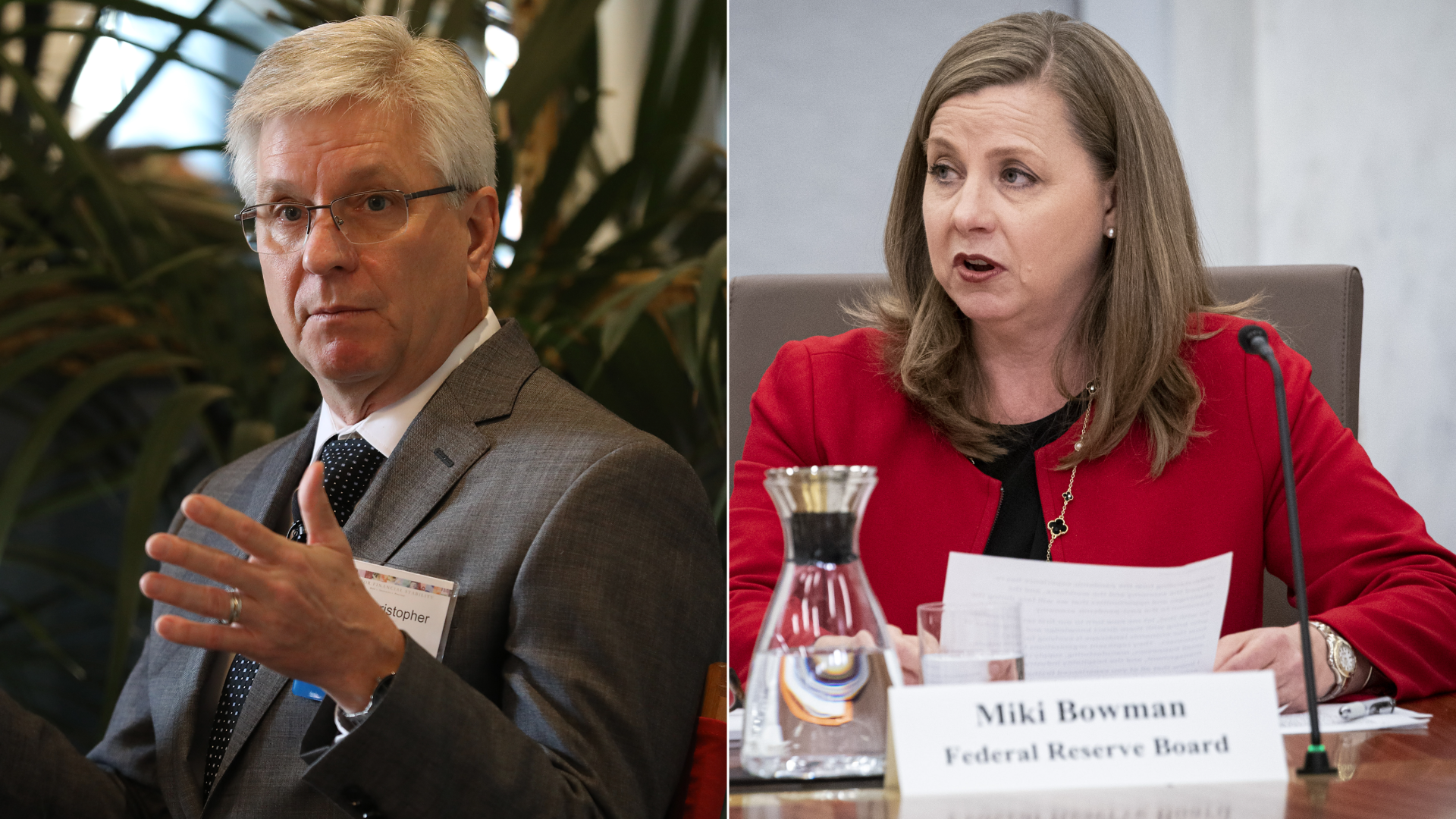
Federal Reserve governor Christopher Waller (L) speaking in New York in 2021, and Fed governor Michelle Bowman speaking in Washington, D.C., in 2022. Photos: Bess Adler/Bloomberg and Al Drago/Bloomberg via Getty Images
Two top Federal Reserve officials have intriguing speeches out this morning. One expresses optimism about how the economy is evolving while the other is much more cautious.
Driving the news: Fed governor Christopher Waller is feeling good about growth, made apparent by the title of his talk this morning: "Something Appears to Be Giving."
- That's a contrast from his last policy speech just over a month ago called "Something's Got to Give." At the time, he cautioned booming economic growth alongside moderating inflation could not continue.
What they're saying: "I am encouraged by what we have learned in the past few weeks—something appears to be giving, and it's the pace of the economy," Waller said at the American Enterprise Institute.
- "All in all, it seems like output growth is moderating as I had hoped it would, supporting continued progress on inflation."
The other side: Fed governor Michelle Bowman was a bit more cautious, flagging a slew of risks that could keep price pressures elevated.
- "My baseline economic outlook continues to expect that we will need to increase the federal funds rate further to keep policy sufficiently restrictive to bring inflation down to our 2 percent target in a timely way," Bowman said at a banker's breakfast in Salt Lake City.
- Waller said he was "increasingly confident" that policy was "well-positioned to slow the economy and get inflation back to 2 percent."
The intrigue: In a subsequent Q&A, Waller said that rate cuts could be possible as inflation continues to drift lower.
- If progress on inflation continues for "several more months," he said, "you could then start lowering the policy rate just because inflation is lower."
Sign up for Axios Macro
Stay ahead of the curve on the most important economic developments with reporting and analysis on how business, policy, and markets collide.