Axios Macro

September 19, 2025


Today, we look at the central contradiction in the U.S. economy right now — that between robust AI-fueled investment growth and a weakening job market.
- It may not be as big a mystery as it seems.
- Plus, new Trump-appointed Federal Reserve governor Stephen Miran is hot out of the gates with a TV interview explaining his dissent at this week's meeting.
Today's newsletter, edited by Ben Berkowitz and copy edited by Katie Lewis, is 968 words, a 3½-minute read.
1 big thing: Booming investment, slumping jobs

Companies aren't adding many jobs or giving out big raises. But they are aggressively investing in what they see as an AI-powered future that promises great returns to shareholders — with financial markets cheering them on.
The big picture: That's the central reality of the U.S. economy right now. It explains some of the curious juxtapositions, including steeply negative public opinion on the economy paired with record highs in the stock market.
- Much of the economy is treading water, barely growing but for AI-related investments. Those require compute power, high-end software engineering, and electricity — but not great masses of workers.
- As a result, the paradox of solid topline economic growth and booming financial markets paired with a weak job market may not be much of a paradox at all.
What they're saying: "While it takes a lot of people to build a new data center, it takes relatively few to operate one," wrote Minneapolis Fed president Neel Kashkari in a new essay.
- "Thus the labor market and the stock market could both be right: Technology is driving rapid growth of industries that don't require as much labor, resulting in a booming stock market and sluggish hiring environment," he added.
By the numbers: The U.S. labor market isn't in full-on recession mode — the 4.3% unemployment rate is low by historical standards and has only ticked up slightly this year. But under the hood, warning signs abound.
- Employers added only 27,000 jobs a month between May and August, far below the 168,000 a month last year.
- Average hourly earnings are up 3.7% over the last year — but that's down from 4.2% in the 12 months ended last November.
- Workers see only a 45% chance of finding a new job within a year if they lose their job, the lowest on record in a New York Fed survey conducted since 2013.
- A survey of big-company CEOs by the Business Roundtable showed 38% plan to cut their employment over the next six months — but 89% see stable or increased capital spending in that time.
State of play: Meanwhile, spending on information processing equipment and software added more to GDP growth in the first half of the year than consumer spending, as Renaissance Macro's Neil Dutta first flagged.
- The S&P 500 is on track to reach its 27th new all-time high of the year today.
Between the lines: If AI investment generates the productivity gains that its enthusiasts expect, it would be expected to generate higher real incomes over time and more prosperity.
- But that process of reallocating labor — moving people from the jobs available now toward those needed by an AI-for-everything future — could turn out to be extraordinarily painful.
- See, for example, the China shock of the early 2000s that generated higher real incomes for Americans on average, but decimated many manufacturing-heavy communities.
Yes, but: It's not certain how much of the job market softness is a direct consequence of AI-driven productivity gains versus general economic weakness.
- "It may be that companies or other institutions that have been hiring younger people right out of college are able to use AI more than they had in the past," Fed chair Jerome Powell told us this week.
- "It's also part of the story, though, that ... job creation more broadly has slowed down. The economy has slowed down."
2. Fed governor Miran defends dissent
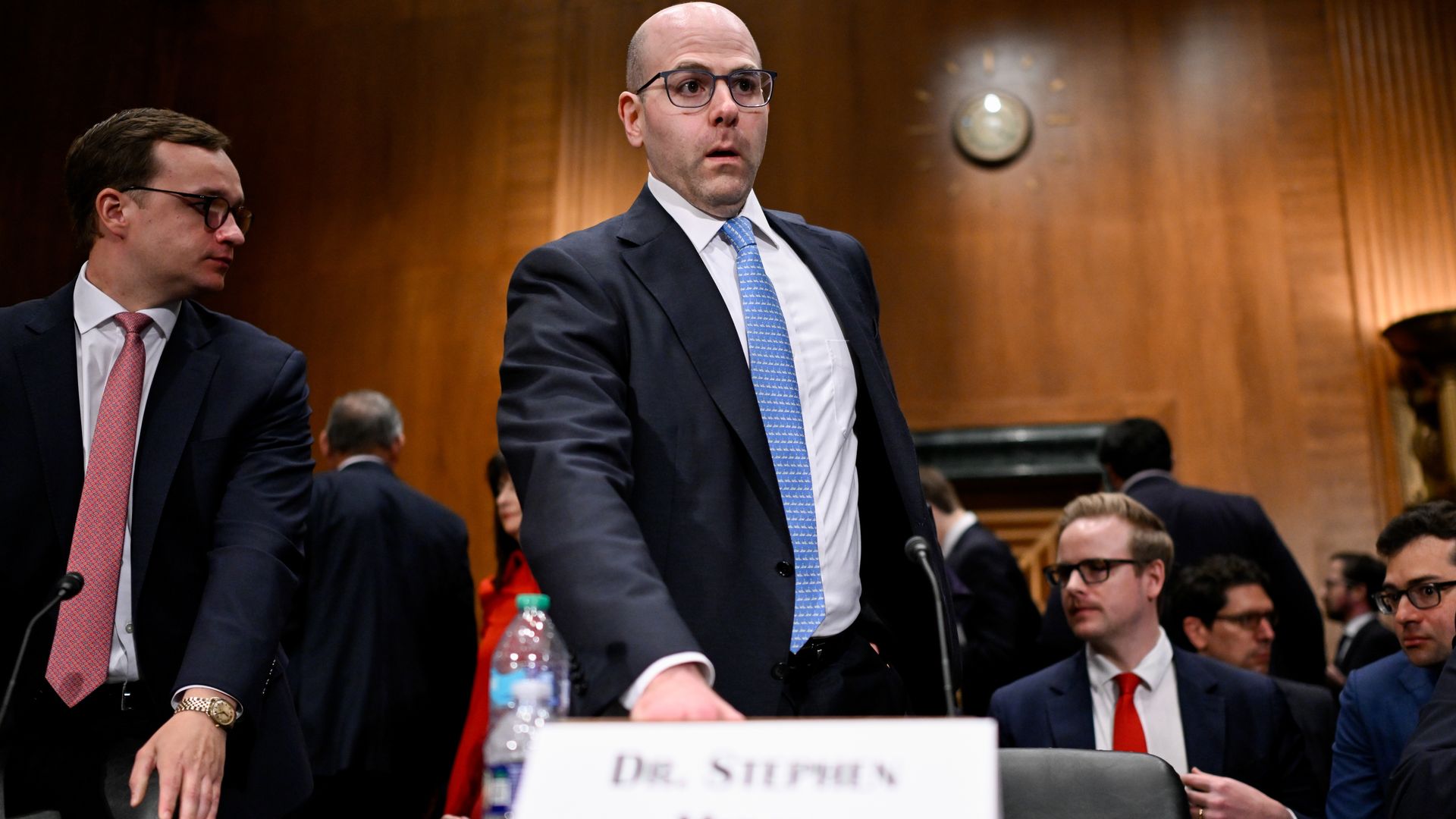
Less than one week in the job, Fed governor Miran is making the rounds on television to explain his rationale for a half-percentage point interest rate cut.
- Miran confirmed that he was the outlier among the Fed officials with a projection of another 1.25 percentage point worth of cuts by year-end.
Why it matters: In an interview this morning with CNBC, Miran — who said he was sworn in just one hour before the Fed's two-day policy meeting began — said his decision was a result of "independent analysis," not politics.
- Miran said President Trump called him on Tuesday before the policy meeting began, though he said that he did not talk to the president about how he would vote.
- He also said it was not the Fed's job to slash interest rates to brighten the nation's fiscal situation — a key argument Trump has pushed in his calls for rate cuts.
What they're saying: Miran said he was less concerned about inflation, because strong immigration in recent years has contributed to booming housing prices.
- "If you add millions of new immigrants into a country in a short period of time, it's going to drive shelter prices up," Miran said.
- "Then if you close that border and then you have negative net migration ... that's going to have a very disinflationary effect," he added.
- "I'm clearly in the minority in not being concerned about inflation from tariffs," he said.
The intrigue: Powell said there was not widespread support for a half-percentage point cut.
- "I'll be making the argument in coming weeks and months — and I hope that I'll be able to persuade some of my colleagues as we go along," Miran said.
- Asked about any awkwardness with Fed governor Lisa Cook, whom the White House is seeking to fire, Miran said: "Everybody was extremely welcoming and extremely cordial ... and that includes governor Cook."
What to watch: Miran said he plans to offer a "full accounting" of his economic views during a speech at The Economic Club of New York on Monday.
Sign up for Axios Macro