
Axios Macro

April 03, 2025

Today, we have a supersized edition of Macro to match the supersized importance of the last 24 hours in global economics.
- Below, a look at how the Trump administration's rapidly escalating trade war looks likely to fuel a rewriting of global economic ties.
- Plus, the clues for the future contained in the (strikingly simple) arithmetic of Trump's new reciprocal tariffs. 🧮
👀 Situational awareness: The services sector slowed markedly in March, the Institute for Supply Management reports. Its index of activity fell to 50.8, from 53.5 in February. ISM reported particularly steep drops in employment and new export orders. 🤔
Today's newsletter, edited by Ben Berkowitz and copy edited by Katie Lewis, is 1,084 words, a 4-minute read.
1 big thing: It's the end of the world order as we know it
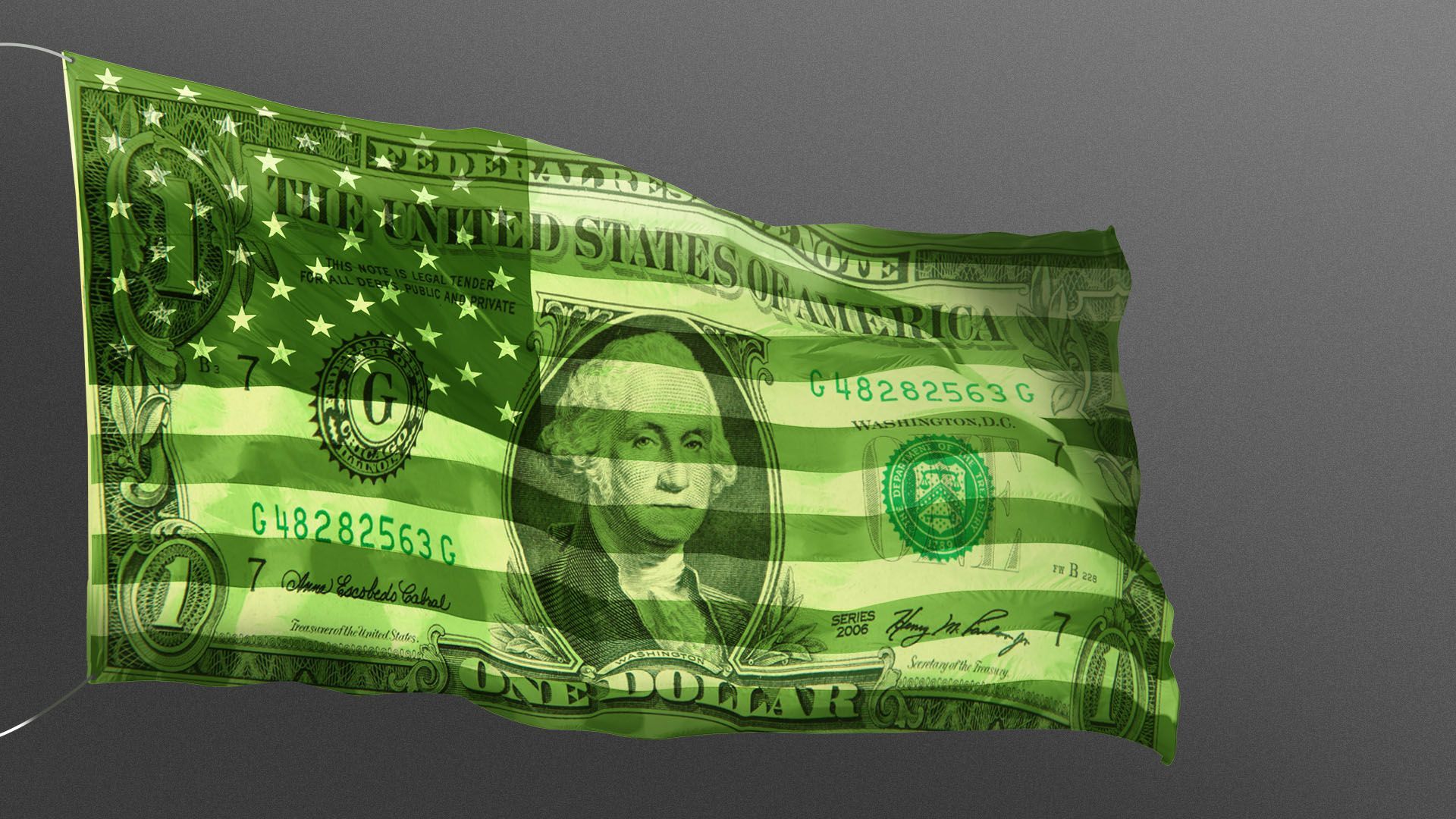
The world economic order is shifting beneath our feet, as historic allies look to America-proof their economies. President Trump's latest tariff announcement will accelerate the shift.
Why it matters: Global leaders and corporate executives alike are trying to figure out how to rejigger their economies to be less reliant on the U.S. in the longer run, even as they contemplate near-term retaliatory measures in hopes of lessening the tariff pain.
- Any economic delinking won't happen overnight. But the sense in Canada, Europe, and beyond is that their relationship with the U.S. has irreparably changed for the worse.
What they're saying: "Investors will be shocked how much things are going to move away from the US in standards, networks, and infrastructure — as well as services — in coming years," said Adam Posen, the president of the Peterson Institute for International Economics and a former Bank of England official.
- "The breach of trust and evident short-sighted self-dealing by the Trump Administration with regard to NATO and to trade reinforce each other," Posen, who just returned from a trip to Ottawa and has been speaking with European officials, added.
- "They make it more likely that Europe and the US will increasingly diverge in coming years economically as well as in security."
Driving the news: Top European Union official Ursula von der Leyen said the bloc was in the process of finalizing retaliatory measures for steel and aluminum tariffs.
- Next comes a potential response to the 20% across-the-board tariffs on European goods.
- "We are now preparing for further countermeasures, to protect our interests and our businesses if negotiations fail," von der Leyen said.
What to watch: In Europe and Canada — two of America's largest trading partners — officials have been blunt about the realities of a global system where the United States is less prominent.
- Germany has ditched its debt-averse mindset and ramped up borrowing for mega-investments in its defense sector in the wake of U.S. threats to back out of NATO.
- Canadian Prime Minister Mark Carney said last week that the country's U.S. relationship "based on deepening integration of our economies and tight security and military cooperation is over."
- He added that Canada would "fundamentally reimagine our economy" in a way that might make it less reliant on America.
That sentiment was echoed in a recent conversation with one of Canada's leading business trade groups.
- "A lot of Canadians feel hurt and upset," Doug Griffiths, head of the Edmonton Chamber of Commerce, tells Axios. "We are looking at investments that make us less dependent on the U.S.," he added. "I think we will ultimately be stronger, but I worry about you guys."
The intrigue: The value of the U.S. dollar has fallen sharply against other major currencies in the last 24 hours — in contrast to economic theory that predicts higher tariffs would drive a currency up.
- Analysts attribute the move to a sense that the U.S. may no longer serve its unique role in the global economy.
- Thierry Wizman, a foreign exchange strategist at Macquarie, writes that the role of the dollar as a safe haven "was already attenuating" in the first quarter, amid a "loss of American exceptionalism under the push for a more 'autarkic" trade regime."
The bottom line: In the short term, economists anticipate higher global inflation and slower world economic growth from Trump's tariff suite.
- But the potential economic delinking that plays out alongside those conditions might be more daunting.
2. Trump's surprisingly simple tariff math


One of the surprises out of yesterday's big announcement was that the Trump administration used a surprisingly simplistic approach to calculating these much-hyped reciprocal tariffs.
Why it matters: This was not a finely tuned set of import taxes calibrated to exert pressure on trading partners to adjust specific policies with which the U.S. has grievances.
- Rather, it was some simple arithmetic, based on overall trade data, that became the justification for the most sweeping U.S. duties in generations — a trade-weighted 22.5% tariff, per the Yale Budget Lab, up from around 2.4% last year.
- It implies fewer off-ramps for countries that seek tariff relief, and thus less potential for de-escalation. If tariffs are applied without regard to the details of each country's economic policies and circumstances, what is there to negotiate?
State of play: Yesterday, some social media sleuths figured out, and the administration confirmed, that there was a simple formula behind the reason, say, Vietnam was slapped with a 46% tariff while Norway faces 15%.
- The formula is to divide the U.S. trade deficit with each country by that country's exports to the U.S. The final reciprocal tariff was then divided by 2, with a minimum of 10% (which applies even to those countries with which the U.S. has a trade surplus).
- "While individually computing the trade deficit effects of tens of thousands of tariff, regulatory, tax and other policies in each country is complex, if not impossible, their combined effects can be proxied by computing the tariff level consistent with driving bilateral trade deficits to zero," per the U.S. Trade Representative's explainer.
Between the lines: This logic implies that any country with which the United States experiences a trade deficit, regardless of the reason, is in some way a bad actor and requires tariffs as payback.
- But even if you believe that it's not good for the U.S. to run large, persistent overall trade deficits (which can contribute to financial imbalances and under-investment in key industries), it doesn't imply that there needs to be balanced trade with every individual country.
- Depending on U.S. consumer demand for a given country's exports, whether it seeks to buy U.S. financial assets, and myriad other factors, even in a world where there is balanced U.S. trade, some countries would be expected to run surpluses and others deficits.
- Moreover, the 10% minimum tariff — even on countries with which the U.S. runs a surplus — implies that tariffs of more than 4x their previous levels are a new minimum that will apply to the rest of the world, no matter how a given country tries to respond to U.S. concerns.
What they're saying: Tobin Marcus and Chutong Zhu of Wolfe Research write in a new note that "since these 'reciprocal' numbers are driven not by actual tariffs but by the simple fact of trade deficits, they will be very challenging to negotiate away, and policy changes may do nothing to alleviate them."
The bottom line: The calculation method used for this round of tariffs implies they won't be negotiated away quickly or easily.
Sign up for Axios Macro