Axios Macro

November 03, 2023

Appropriately enough, fall's arrival has brought a bit of a chill to the U.S. labor market. We tease apart the October jobs report — and look at what it means for markets and the Federal Reserve — below.
🚨 Situational awareness: The Institute for Supply Management index of activity at service businesses fell to 51.8 in October, from 53.6.
- While numbers above 50 do indicate continued expansion, it follows the ISM's manufacturing index earlier in the week that also showed a sharp pullback in activity.
Today's newsletter, edited by Javier E. David and copy edited by Katie Lewis, is 701 words, a 2½-minute read.
1 big thing: The data is catching up with the vibes

Illustration: Aïda Amer/Axios
For months, the "vibes" — anecdata, CEO surveys and the like — have pointed to a cooldown underway in the U.S. labor market. The official data, especially on growth in employers' payrolls, has mostly not.
Why it matters: In October, they finally converged. With the new jobs numbers, there's little doubt that the labor market is shifting into a lower gear. That should diminish inflation pressures and make the Fed more confident it is done raising interest rates.
- It's particularly notable that the evidence of a slowdown was present across all facets of the report — job gains, revisions to previous months, the survey of households, wage growth, the average workweek and more.
By the numbers: Employers added 150,000 jobs, down from a revised 297,000 in September. That number was pulled down by a decline of 33,000 auto manufacturing jobs due to a UAW strike that now appears to be resolved.
- The unemployment rate ticked up to 3.9%, the highest in 21 months. The rate has now risen half a percentage point from its multi-decade low of 3.4% earlier this year.
- A broader measure of unemployment that counts people working part-time who want full-time work, and those who have given up looking for a job out of frustration, rose to 7.2% from 7% in September, and 6.5% at the end of last year.
- Revisions to August's and September's numbers reduced those counts by a combined 101,000, suggesting job creation in late summer was not as rip-roaring as earlier estimated.
What they're saying: "All of the key indicators … suggest that the economy is cooling and the labor market is slackening," wrote Julia Pollak, chief economist at ZipRecruiter, in a note.
- "The decline in these topline indicators partly explains why job seekers and new hires are feeling more stressed out than they have in over a year," she wrote.
- "The decline in real disposable income last month suggests that consumer spending could cool further in the coming months, putting yet more downward pressure on the labor market."
Of note: If the jobless rate rises just another couple of ticks and stays elevated, it will invoke the Sahm Rule, a useful rule-of-thumb indicator that a recession is underway.
- When the three-month average of the jobless rate is 0.5 percentage point above its recent low, it has been a clear-cut recession signal in the past. That indicator now stands at 0.33.
2. How the Fed will read it
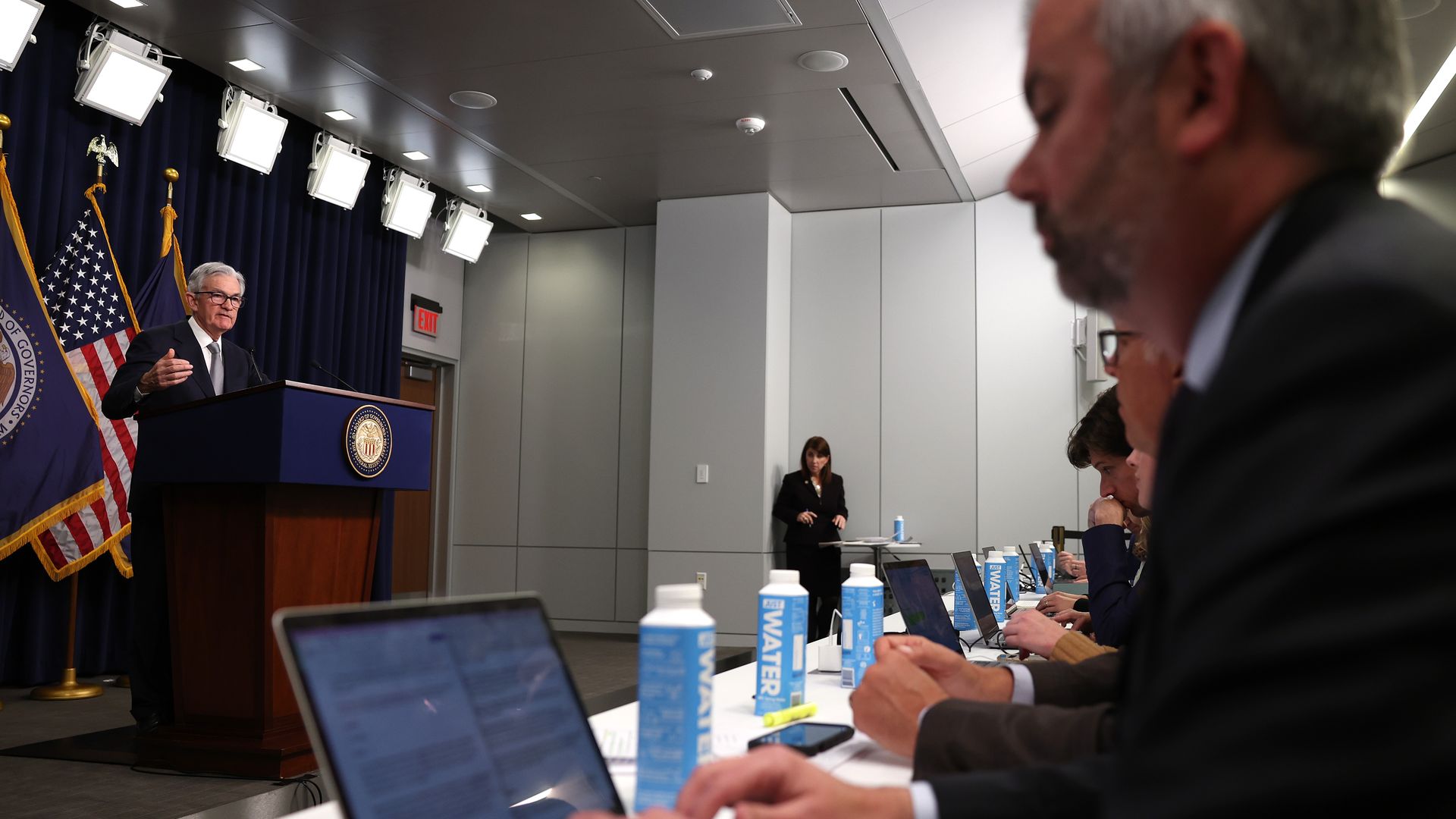
Federal Reserve chair Jerome Powell at his press conference Wednesday. Your newsletter writer in the foreground. Photo: Kevin Dietsch/Getty Images
The numbers add up to a sweet spot for the Fed. If data like this keeps coming in, the central bank will likely be done with interest rate increases.
The big picture: The numbers all point to the labor market remaining strong by most historical standards yet not in a zone that would necessarily fuel inflation.
- Average hourly earnings rose a mere 0.2% and were up 4.1% over the last 12 months — the lowest since May of 2021. Over the last three months, earnings have risen at a 3.2% annual rate, well within the range consistent with the Fed's 2% inflation target.
State of play: Financial markets reacted to the jobs report accordingly, with two-year Treasury yields plunging as traders priced in lower odds of further rate hikes and higher odds of rate cuts in 2024.
- The 10-year yield plunged even more, to 4.54% in early trading, continuing a reversal of the rates surge that had pushed that rate to 5% last month.
Yes, but: In a less welcome turn of events for the Fed, the labor force shrunk 201,000. Fed chair Jerome Powell emphasized this week that an expanding labor force created supply-side improvement that was helping keep inflation in check despite strong growth.
- One month's move could be statistical noise, but for October at least, it went in the wrong direction.
- "We think policymakers will be paying close attention to the supply-side aspects of next month's report in order to help determine whether supply side expansion will continue to be a disinflationary driver," wrote Tiffany Wilding, an economist at Pimco, in a note.
The bottom line: The vibes were right, and the earlier data was wrong. This is a job market that has lost steam — with the open question being whether there is significantly more damage yet to come.
Sign up for Axios Macro

Stay ahead of the curve on the most important economic developments with reporting and analysis on how business, policy, and markets collide.