Axios Macro

February 18, 2025


❄️ It's cold outside where we are, but not as icy as America's relationship with Europe. Below, we look at what a brittle economic relationship between historic allies means for the global economy.
👀 Situational awareness: Federal Reserve governor Christopher Waller said in a speech in Australia that his "baseline view is that any imposition of tariffs will only modestly increase prices and in a non-persistent manner."
- He favors "looking through these effects when setting monetary policy to the best of our ability."
Today's newsletter, edited by Ben Berkowitz and copy edited by Katie Lewis, is 702 words, a 2½-minute read.
1 big thing: Europe's U.S. overdependence
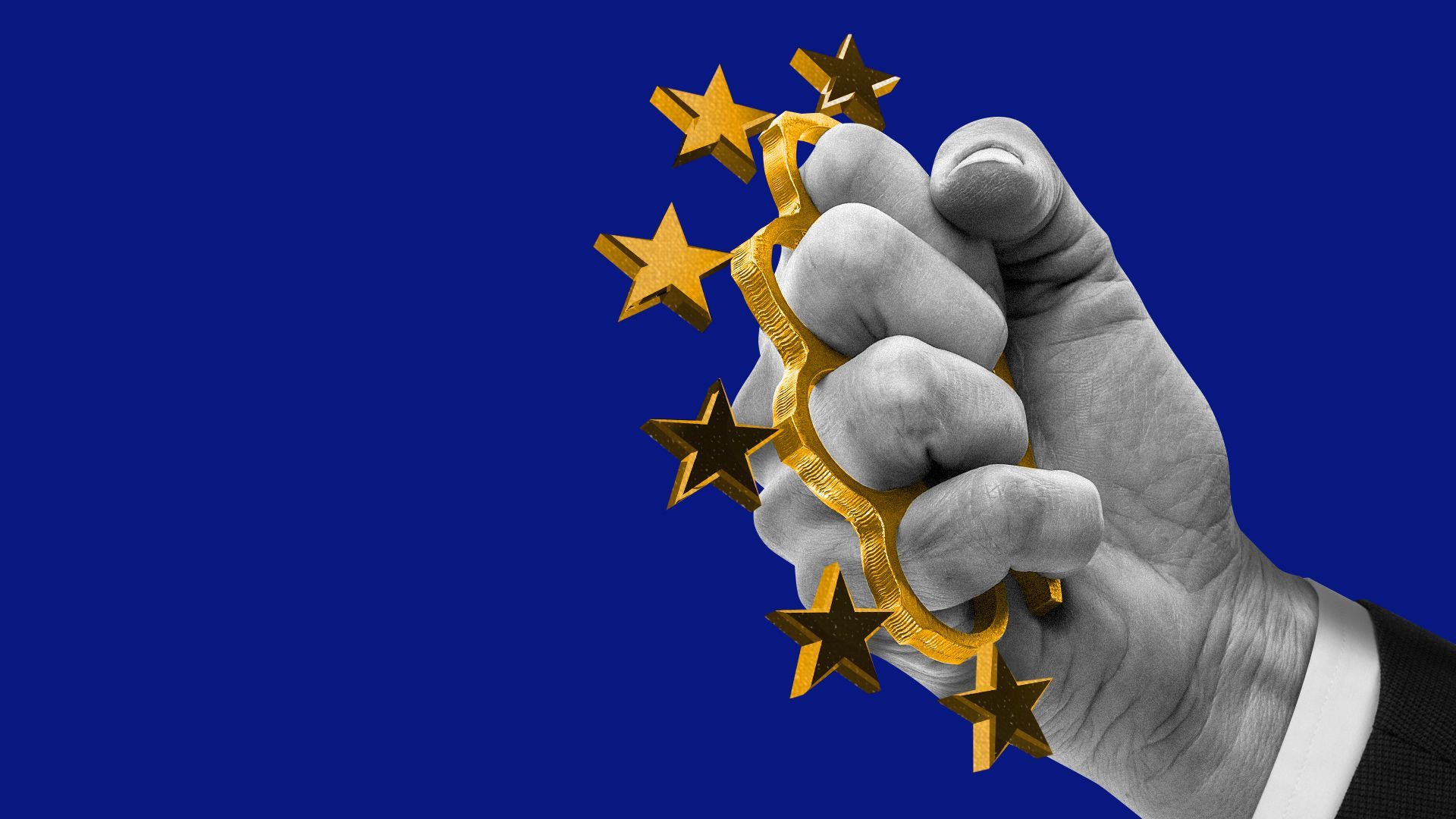
Europe faces two great crises — in the economic and security spheres — that are, ultimately, two sides of the same coin.
Why it matters: Europe has experienced subpar economic growth for a generation, and has underinvested in its own defense. Both problems are coming to a head, with the Trump administration's hostility as the catalyst.
- After decades of underinvestment and sluggish productivity, Europe faces receding U.S. security commitments, new tariffs on its exports, and a regulatory environment that puts domestic companies in a regulatory straightjacket.
- European elites are increasingly acknowledging that a lack of competitive fire, in both the economic and national security arenas, has resulted in overdependence both on U.S. companies to drive innovation and the U.S. government to defend Europe from Russia.
The intrigue: In a high-profile speech in Munich, European Commission president Ursula von der Leyen described a new world — one in which there is a heightened focus on geopolitical conflict and economic security.
- Von der Leyen proposed loosening the continent's fiscal rules to boost defense spending and protect member countries from possible threats from Russia — a rare move, last exercised at the COVID-19 pandemic's onset.
- "I believe we are now in another period of crisis which warrants a similar approach," Von der Leyen said.
Mario Draghi, the former European Central Bank president and Italian prime minister, said EU policies have strangled the economy more than the U.S. tariffs could.
- In an op-ed in the Financial Times on Friday, Draghi wrote that the EU has failed to address supply and demand issues caused by tough regulatory policy and depressed government investment. "Both these shortcomings — supply and demand — are largely of Europe's own making. They are therefore within its power to change."
- "Up to now, Europe has focused on either single or national goals without counting their collective cost," Draghi wrote.
- "But it is now clear that acting in this way has delivered neither welfare for Europeans, nor healthy public finances, nor even national autonomy, which is threatened by pressure from abroad," he continued. "That is why radical change is needed."
What to watch: In an extensive report on the EU's troubles, Draghi backed the idea of the continent borrowing as a whole for economic investment.
- "There are two very large systemic challenges coming down the pike," Heidi Crebo-Rediker, a senior fellow at the Council on Foreign Relations and former State Department chief economist, tells Axios.
- "It might be easier for Europe to negotiate on tariffs than to agree on a collective borrowing mechanism for the sheer amount of spending they need for their national security in as short an amount of time as possible," she adds.
2. The U.S.-Europe breakup
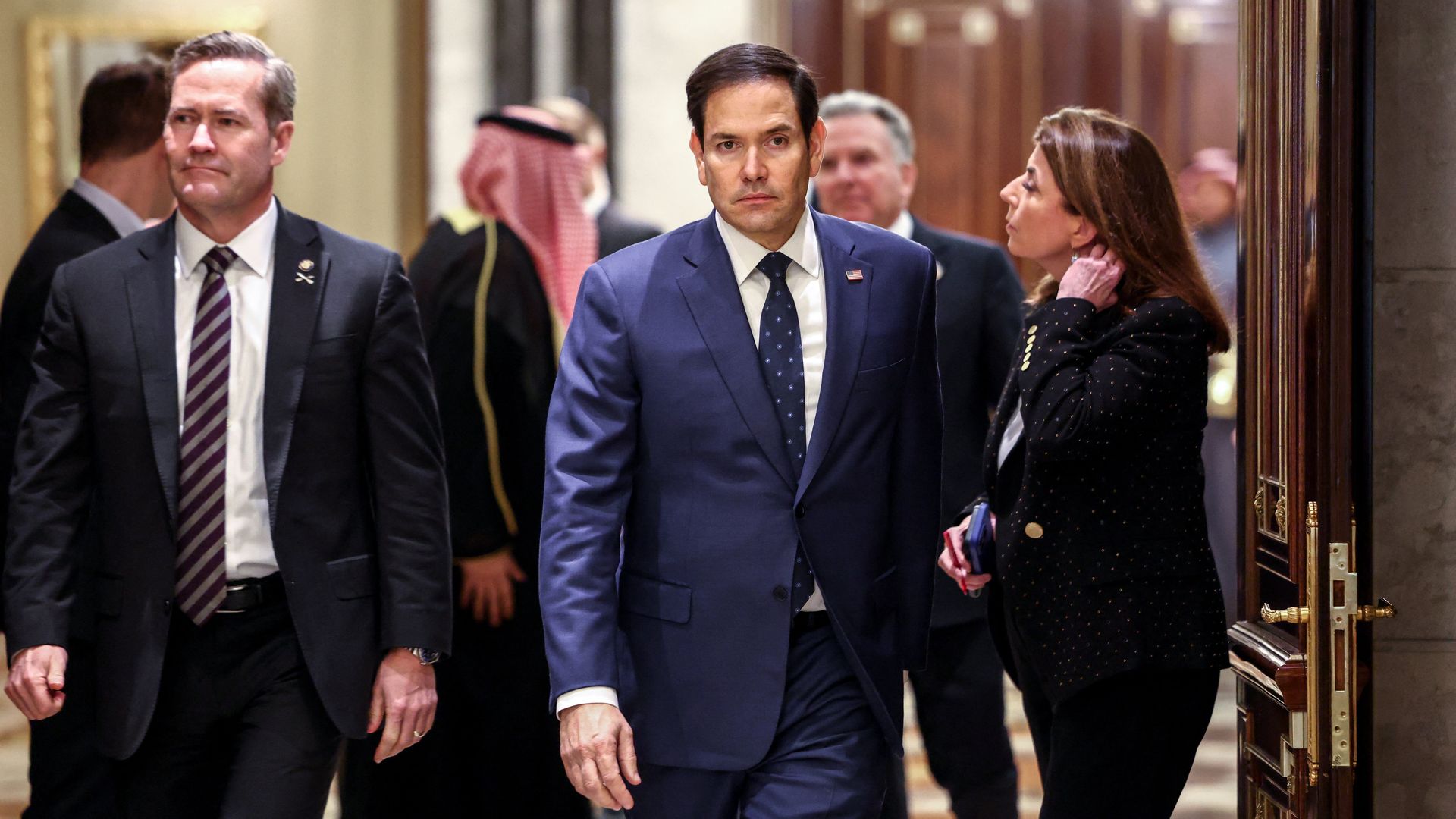
A breakdown in the relationship between Europe and the United States, which has moved with breathtaking speed, is accelerating the recognition of long-developing economic problems.
Catch up quick: U.S. officials — including Secretary of State Marco Rubio — are in Riyadh, Saudi Arabia, to meet with Russian officials about the future of Ukraine. These are the first such talks since Russia's 2022 invasion.
- Absent from the talks over the continent's future are Ukrainian and European leaders, the latest blow in a recent series of events that dented U.S.-EU relations.
- President Trump has long claimed that the U.S. carried too much of the NATO burden in relation to EU countries. Last week, the administration all but said EU countries should not count on America for security.
Between the lines: In recent months, Europe's economic powerhouses have been in the midst of political chaos over budget disputes that, at least in one case, spooked the bond market.
- Germany, its largest economy, will hold an election in the coming days after different visions of how to ignite growth led to a government collapse.
- It is symbolic of Europe's already dismal economic reality — aging populations that will lead to a shortfall of workers, for instance — that now needs to adjust to higher defense spending demands.
The bottom line: "You're looking at a world where there is more uncertainty and the distance between peace and war is shorter," Claus Vistesen, chief eurozone economist at Pantheon Macroeconomics, tells Axios.
- "Europe needs a completely different industrial model but that takes time," Vistesen adds.
Sign up for Axios Macro