Axios Macro
June 17, 2026


1 big thing: CEO confidence is on the rise
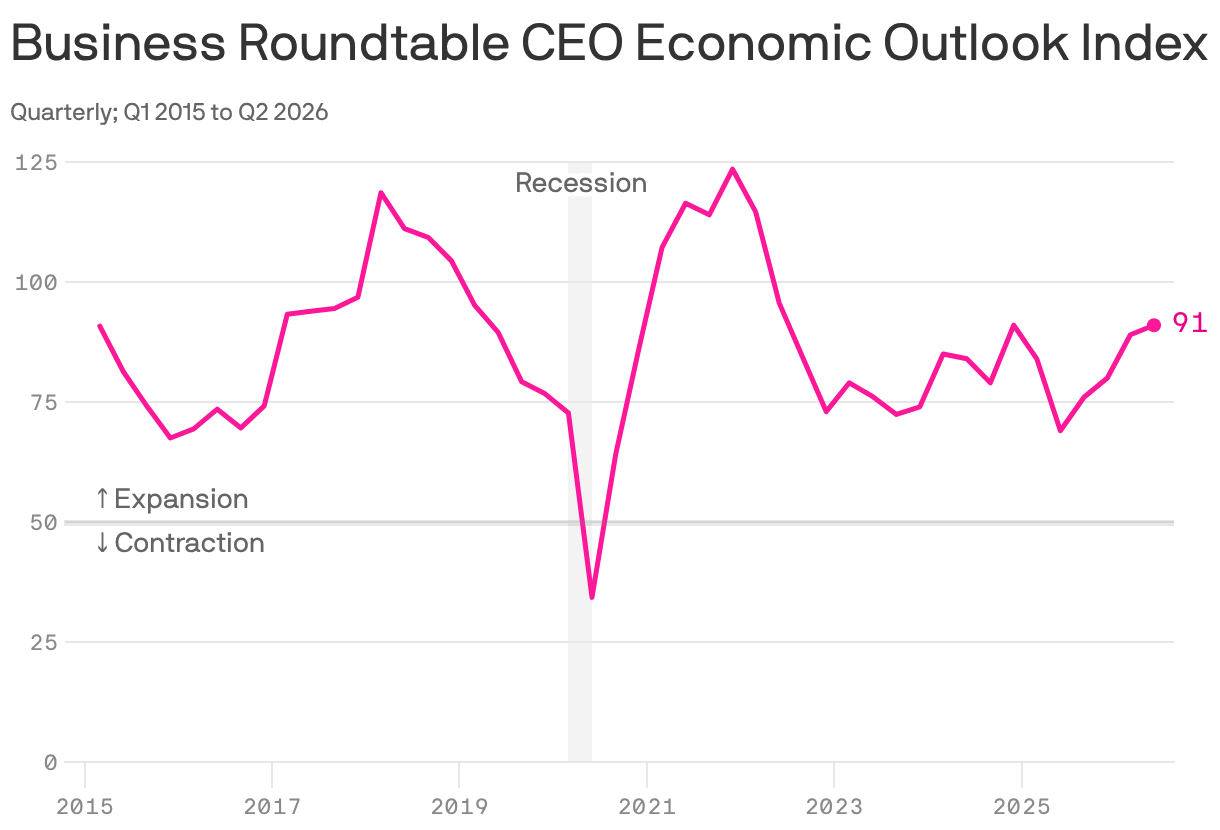
Leaders of America's biggest companies are the most optimistic they have been in 18 months — but see much stronger growth in capital spending and sales ahead than in hiring.
The big picture: That's the takeaway from the Business Roundtable's quarterly CEO survey, set to be released today. It points to continued bumpy conditions in the job market even as business conditions broadly improve.
- At the same time, the results don't point to the kind of AI-pocalypse scenario of massive job losses that some technologists have predicted, at least for the remainder of this year.
By the numbers: The overall outlook index rose 2 points, to 91. That's well above the long-run average of 83 and the highest since Q4 of 2024. The last time it was higher was four years ago, in mid-2022.
- There was a 3-point surge in CEOs' expectations for the change in sales over the next six months and a 2-point rise in expected capital spending — with both numbers in rapid expansion territory.
- Respondents, however, were balanced on expectations of employment, with an equal share of participants expecting to increase payrolls and decrease them over the next six months.
- The employment index ticked up to 51; the line between expansion and contraction is 50, and historically that sub-index has averaged 61.
The intrigue: Usually the three sub-indexes move in tandem, rising together in booms and falling together in downturns. Right now, there is much more buoyancy in CEO attitudes toward capital spending than in adding to headcount.
- The 42-point gap between expectations for capital spending and employment is the widest since 2005.
Between the lines: Companies are investing heavily in capital spending to take advantage of the AI boom — most prominently hyperscalers and the builders of the computing infrastructure to support them.
- For now, it's not resulting in mass job losses, but it does translate into an absence of the kind of job creation you would normally expect to see when business conditions are so strong.
What they're saying: "Over the past year, the survey has showed ongoing divergence between capital spending and hiring plans," Joshua Bolten, CEO of the Business Roundtable, said in the survey release.
- "As AI and other forces reshape the workforce, Business Roundtable member companies are investing in training programs to help employees succeed," he added. "It is increasingly important for policymakers to support that work by modernizing the federal workforce development system."
- Strong readings on sales and capital investment plans reflect "the continued resilience of the economy," said Cisco Systems CEO Chuck Robbins, the chairman of the BRT.
- "However, consumers and businesses continue to face some headwinds," he added, which Washington can help address by extending the U.S.-Mexico-Canada trade agreement, modernizing permitting and "adopting a federal framework for AI regulation that protects U.S. technology leadership."
The bottom line: These are boom times for U.S. business — but not for job creation.
2. Spring spending boost


Inflation is surging. American consumers appear to keep spending anyway.
Driving the news: Retail sales rose 0.9% in May, the Commerce Department said this morning.
- The data is not adjusted for inflation, so stronger spending is a function of higher prices, at least in part. For instance, spending at gasoline stations gained 3.4% last month alone, following a 2.4% jump in April.
- Spending increased across most major retail categories, including furniture stores and e-commerce. Consumers pulled back on electronics shops and dining out.
- The control group — which excludes volatile categories like gasoline, autos and building materials — rose by a stronger-than-expected 0.7%. That narrower measure will feed into the consumer spending calculations for second-quarter GDP.
Between the lines: A robust tax refund season has helped consumer spending, along with support from stronger job gains and stock market-related wealth gains for higher-income households.
What they're saying: "Consumption regained some momentum over the spring, but the sugar rush from bigger-than-usual tax refunds will wear off soon," Samuel Tombs, chief U.S. economist at Pantheon Macro, wrote in a client note.
- Tombs estimated that households' real spending — that is, adjusted for inflation — increased 0.3% last month, including broader services expenditures that are not captured in the report.
The bottom line: "There does not appear to be any consumer demand destruction from higher gas prices during the first three months of the war," Brean Capital's John Ryding wrote this morning.
Axios Macro