Axios Macro

November 03, 2025

Neil is coming to you from sunny Florida, where shortly after this newsletter is sent, he'll interview San Francisco Federal Reserve president Mary Daly at the Forum Club of the Palm Beaches. We'll have more on what she has to say in tomorrow's edition. 🏝
- Today, we dive into the Supreme Court case being heard this week, which will decide the future of President Trump's tariff-setting authority.
- Plus, making sense of the not-so-scary inflation numbers amid the trade war.
👀 Situational awareness: The Institute for Supply Management said the manufacturing sector contracted at a faster rate, alongside slower price gains, in October. Its purchasing managers' index fell 0.4 percentage point to 48.7%.
Today's newsletter, edited by Ben Berkowitz and copy edited by Katie Lewis, is 900 words, a 3.5-minute read.
1 big thing: Trump's tariff test at the Supreme Court
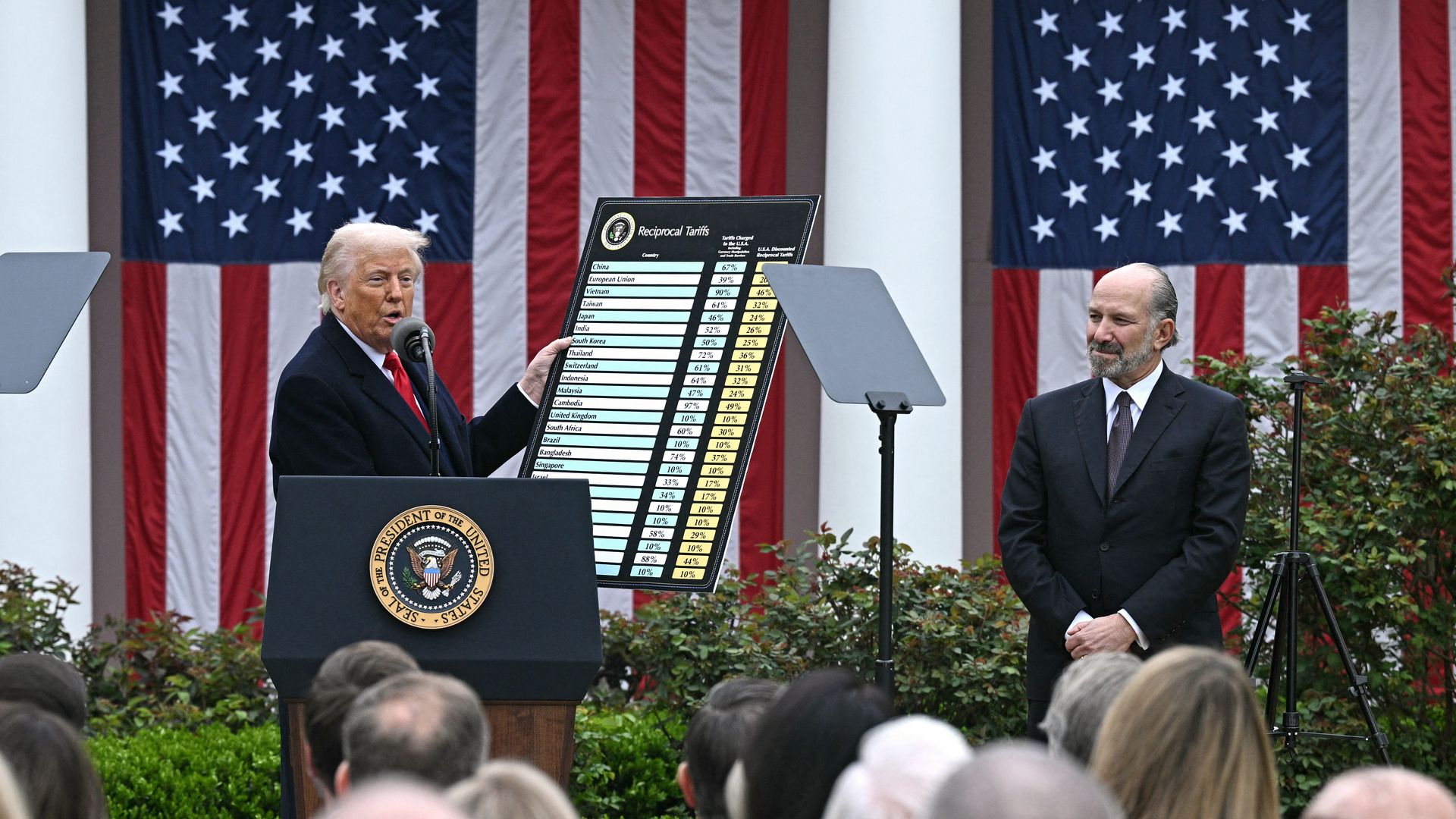
The Supreme Court will hear a case on Wednesday that will decide the fate of Trump's signature economic policy: the tariffs he has leveraged to reshape the global order.
Why it matters: A win for Trump in what he calls the "most important case ever" could set the stage for a huge expansion of a president's economic power for decades to come.
- How the decision lands will carry consequences for global financial markets, which have been unsettled both by the tariffs and by the prospect that they could be overturned.
The big picture: A loss could set off a potentially chaotic tariff refund process, result in a loss of revenue that has somewhat brightened the nation's fiscal outlook, and possibly undermine key trade deals.
Catch up quick: The lion's share of Trump's global tariffs were imposed under the International Emergency Economic Powers Act.
- At issue is whether the nearly 50-year-old law, which has never been used to impose import taxes, justifies the levies.
State of play: Plaintiffs say IEEPA does not grant tariff authority. Even if it did, they argue, the emergencies cited by Trump to impose them fall short: A trade deficit cannot be considered an emergency, since such an imbalance has persisted for years.
The other side: Department of Justice lawyers argue the courts should not question what Trump says constitutes a national emergency.
- At a lower court hearing this summer, the lawyers said trade deficit had "reached a tipping point" and the tariffs give the "president leverage to address the emergency."
What they're saying: An amicus brief filed by a bipartisan group of leading economists, including former Fed chairs Ben Bernanke and Janet Yellen, makes the economic argument to the Supreme Court in favor of the plaintiffs.
- The group says they know of "no 'tipping point theory' of trade deficits, or a clear causal pathway from persistent trade deficits to an undefined 'national security catastrophe,' and the government has not identified any."
The intrigue: The economists say that the IEEPA tariffs do not "meaningfully reduce trade deficits and hence do not 'deal with' the deficits as IEEPA requires," according to the brief.
- "Tariffs unambiguously reduce total trade flows. But they generally do so in both directions—both in and out," they write.
What to watch: Trump claims the nation will fall into ruin if IEEPA tariffs are struck down, even as the White House says it will replace the levies using more process-heavy trade authorities.
"There's a reason Trump didn't use these other authorities in the first place. None of them provide the sweeping power or rapid on-and-off switch capabilities of IEEPA," the Atlantic Council's Josh Lipsky wrote last night.
- "[W]hile Trump may be exaggerating about a disaster — especially since no president before him ever used IEEPA in this way — he's not wrong to think it is going to be a problem," Lipsky added.
2. A case of missing inflation surge


The economy has surprised with a smaller-than-expected rise in inflation despite the slew of tariffs imposed under IEEPA and other trade authorities.
Why it matters: Goods prices have risen in recent months, though not in ways that suggest a tariff-fueled inflation surge is ahead.
- The relatively smaller rise in inflation is because the extremely high tariffs Trump threatened have not come to pass. Tariffs have been lowered for goods from Europe, Japan and other nations that notched trade deals.
The intrigue: Businesses are not passing along all tariff costs to consumers, instead taking a hit to profits that might be recouped in other ways — like smaller workforces.
- "We continue to assume distributors will absorb 30% of the costs," Samuel Tombs, an economist at Pantheon Macro, wrote in a recent client note.
By the numbers: Pantheon Macro estimates tariffs will boost the Fed's go-to inflation gauge by 0.7 percentage point this year, down from its previous estimate of nearly 1 percentage point.
- The economists say that downgrade is rooted in lower tariff revenues last month, which might be — at least in small part — a result of some foreign goods being substituted for domestically produced items.
- They anticipate the Personal Consumption Expenditures price index, excluding food and energy costs, will peak at 3.1% in December before falling to 2.5% by the end of next year.
- That estimated peak is slightly above the 2.9% increase in the 12 months through August, according to data released before the government shutdown.
The other side: "We do expect that the coming next stage of the tariff pass-through process will be more gradual than in our earlier forecasts, with a lower peak but a more protracted period of elevated inflation into next year," J.P. Morgan economist Michael S. Hanson wrote in a note.
Sign up for Axios Macro