Axios Macro

January 18, 2024

Neil's latest dispatch from Davos, Switzerland, takes us inside what he's hearing from top executives about how 2022's financial market upheaval — and the Fed's actions that triggered it — helped bring about a soft landing.
- Plus, a look at the anecdotes helping inform Fed officials' view of the economy.
Today's newsletter, edited by Kate Marino and copy edited by Katie Lewis, is 727 words, a 3-minute read.
1 big thing: How corporate belt-tightening helped the soft landing cause

Illustration: Aïda Amer/Axios
This time a year ago, talk of recession was on the lips of corporate chieftains and economists alike. This year, conventional wisdom is that a recession has been averted and 2024 will be a solid year.
What happened: It appears that the Fed's aggressive interest rate increases in 2022 — and the financial market selloff they triggered — jolted corporate executives into belt-tightening action, helping restrain demand in the economy.
Why it matters: The proactive response by companies looks, for the moment at least, to have helped achieve a soft landing.
- It speaks to an important yet hard-to-quantify channel through which Fed policy influences inflation and growth.
State of play: There is an active debate over just how much the Fed's rate increases — which started in March 2022 and look to have concluded in July 2023 — actually affected the economy.
- After all, there hasn't been the kind of mass job losses or contraction in spending that are part of many traditional theories of how tighter money fights inflation.
- Meanwhile, much of the disinflation over the last year has come about because of improvement in the supply side of the economy — pandemic disruptions unsnarling and the labor force growing.
Yes, but: Many corporate executives see it a little differently. There really was a change in attitudes in the C-suite 12-18 months ago, as they altered the trajectory of their spending plans in reaction to a slumping stock market and higher borrowing costs.
What they're saying: "CEOs were more willing to make the harder calls that in the past might have been delayed," Tim Ryan, senior partner at PwC, told Axios on the sidelines of the World Economic Forum.
- "It was good old-fashioned belt-tightening to reduce hiring" and trim operating expenses, he said.
- "The pressure became so intense in 2023 ... with capital markets and companies' valuations," Ryan said. "Because of a lot of the heavy lifting over the last 18 to 24 months, companies are relatively well-poised now."
Between the lines: This is essentially one of the channels through which tighter money can flow to real economic activity.
- When central bankers talk about "tighter financial conditions," they are really talking about the kinds of market moves that force CEOs to take the kinds of actions Ryan described.
The bottom line: The Fed's actions in 2022 created worry in the C-suite, which in turn has helped bring the economy off its 2022 high boil without mass unemployment or a collapse in demand.
2. What the latest Beige Book says about the economy
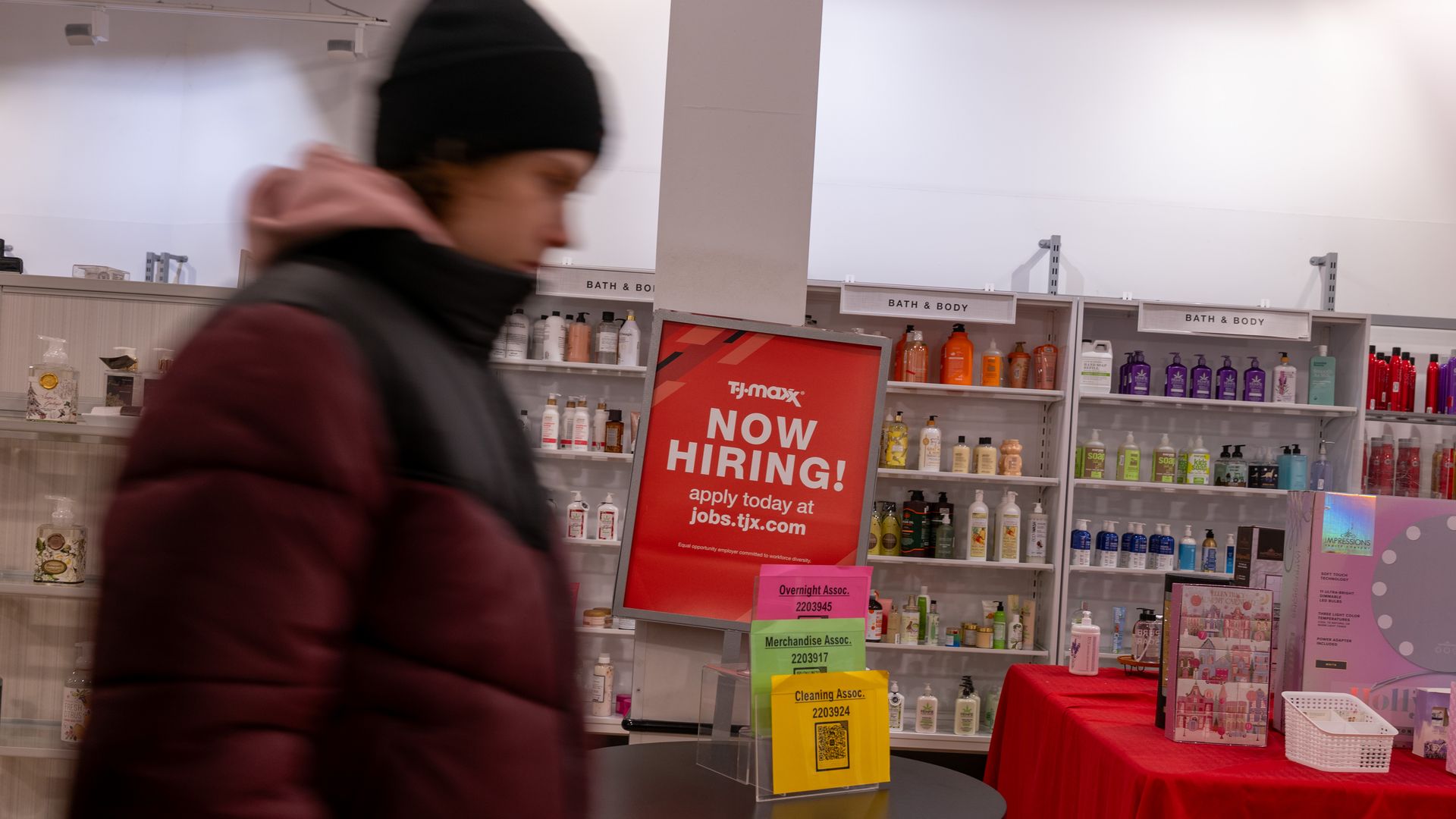
A hiring sign at a retail store in Manhattan earlier this month. Photo: Spencer Platt via Getty Images
Steady hiring, moderate economic activity and easing inflation: That's how most businesses would describe conditions in their communities.
- These are the takeaways from the latest Beige Book, a collection of anecdotes from each of the 12 Fed districts that plays a role in how top officials see the economy.
Why it matters: The anecdotes line up with recent economic data that provides some comfort to Fed officials that they might be able to lower interest rates this year.
- Nearly all Fed districts reported cooler labor market conditions, with signs of "larger applicant pools, lower turnover rates, more selective hiring by firms, and easing wage pressures."
Of note: There are fewer reports of widespread worker shortages across the job market. Instead, anecdotes only show shortages of specialty workers in specific industries.
- For instance, firms covered by the Boston Fed's region said "labor scarcity persisted for auto mechanics and some highly skilled manufacturing workers."
- The San Francisco Fed reported that some employers found it difficult to find mid-level managers and engineers, while a firm in the Richmond district said it hired engineers "with no work experience and spent time training them."
What to watch: There is evidence that higher interest rates continue to weigh on activity, especially in the auto and housing sectors.
- But some cited the prospect of lower interest rates as a reason for economic optimism — and in some cases, the reason for rebounding activity.
- The Chicago Fed said one auto dealership proceeded with a project to "increase service-center capacity" partly because it expected interest rates to begin falling soon.
The intrigue: The latest Beige Book includes, by our count, the first mention of generative AI — anecdotal evidence of adoption in the labor force.
- One firm in Atlanta reported keeping positions open and "'slow walking' new hires" as it looked to "supplement productivity with Generative A.I. across all business lines and functions."
Sign up for Axios Macro

Stay ahead of the curve on the most important economic developments with reporting and analysis on how business, policy, and markets collide.