Axios Macro

June 26, 2024


Corporate America is facing dual pressures to restrain prices — both from customers and the Biden administration.
- We unpack how the combination may contribute to lower inflation.
Today's newsletter, edited by Kate Marino and copy edited by Katie Lewis, is 775 words, a 3-minute read.
1 big thing: The next inflation-cooling force
A new force is emerging that may bring inflation down further in the coming months: Americans are increasingly intolerant of price hikes.
Why it matters: Anecdotes from corporations suggest that consumers who were once unfazed by price hikes are now resisting them — and businesses have to do more to entice shoppers in a way not seen since before the pandemic.
- Top Fed officials say this might be a key source of disinflation that will help normalize price increases.
What they're saying: "Several national retailers have announced plans to lower prices on certain items, and there is increasing evidence that higher-income shoppers are trading down to discount stores," Fed governor Lisa Cook said in a speech yesterday.
- "My forecast," Cook said, is that inflation "will continue to move lower on a bumpy path, as consumers' resistance to price increases is reflected in the inflation data."
- "I have gleaned from recent earnings reports by publicly traded companies that lower-income consumers are pulling back from their purchasing and that firms are responding by moderating price increases or, in some cases, actually cutting prices," Fed governor Adriana Kugler said last week.
The big picture: The resurgence of fast food price wars tells the story of a more price-sensitive consumer.
- For value meals, it's a race to the bottom: McDonald's has a $5 value meal. Wendy's announced a $3 breakfast meal. Sandwich chain Subway launched a $3 "sandwich dipper."
A top McDonald's executive appeared on "Today" to promote the chain's offering: "I've zigzagged the country. I've been in our restaurants. I've sat in focus groups. Our customers are telling us that they are really stretched," said Joe Erlinger, president of McDonald's USA.
- "They felt the stress of the inflation of the last few years, and so this is a great opportunity for McDonald's to bring value," Erlinger said.
What to watch: Similar pressures are evident in the travel industry.
- "Competition for the price-sensitive leisure traveler is gaining steam," analysts at Bank of America wrote in a note this week, pointing out that some airlines recently eliminated change fees and JetBlue added more benefits to its basic economy offering.
Yes, but: The consumer pushback on high prices might be an early warning sign that they're facing financial stress, which could spread into broad economic weakness.
- Demand is slowing alongside early signs that consumers are falling behind on credit card payments and the labor market is losing steam.
2. Inside the Biden team's push on prices
The Biden administration has been making a not-so-subtle push to encourage companies to exercise pricing restraint, using both carrots and sticks.
- Companies that announce splashy price reductions can expect public praise from the highest levels of government — and those that don't, attacks on sky-high profit margins, so-called junk fees, and the like.
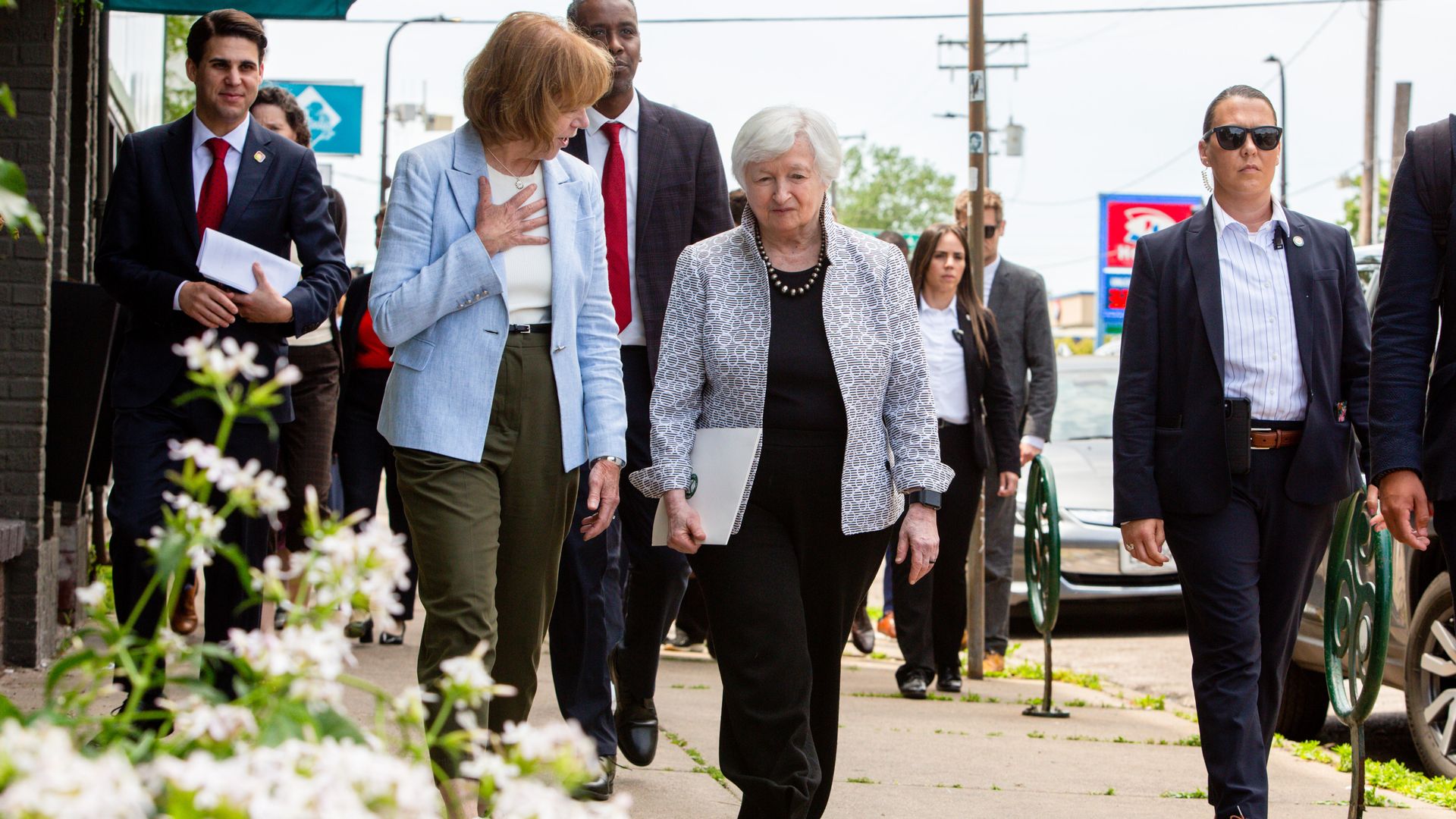
Driving the news: Treasury Secretary Janet Yellen had lunch with Target CEO Brian Cornell yesterday and "recognized actions" by Target and others to cut prices for milk, bread and diapers, according to the meeting's readout.
- In recent weeks, the administration has applauded Target, Walmart and other grocery chains for beginning to "answer the President's call to lower prices for household goods."
In a speech last week, top White House economist Lael Brainard said grocery store margins, for one, remain elevated relative to pre-pandemic times.
- "Some grocery stores are answering the President's call and lowering prices on thousands of items," Brainard said. "This is a start, but corporations have to do more to bring their prices down."
Between the lines: The price cuts highlighted by the White House alone are not enough to bring down the monthly inflation figures closely watched by economists.
- But the Biden camp is elevating these announcements, hoping that there is an effect at the micro level and that inflation-weary American voters take notice.
The other side: Some companies are pushing back on the Biden administration's "greed-flation" narrative.
- "Companies have been absorbing the economic realities of inflation, including cost of ingredients, packaging and other input costs like labor and transportation," David Chavern, head of the Consumer Brands Association, tells Axios. "It's critical that we get the economic facts right and avoid political rhetoric."
- "Brands are leaning into the fact that times are tough for some consumers," says Stephen Wyss, a partner at accounting firm CohnReznick who works with consumer brands.
- "I think it's reading the room and building a promotional strategy around it. I don't think it's a result of a politician saying, 'You have to lower your prices,'" Wyss said.
The bottom line: Businesses in a range of industries are facing pressure from their own customers and the White House to curtail price increases — which may provide inflation relief heading into the election.
Sign up for Axios Macro