Axios Macro

November 20, 2024


1 big thing: Trump counties' disproportionate dependence on federal cash
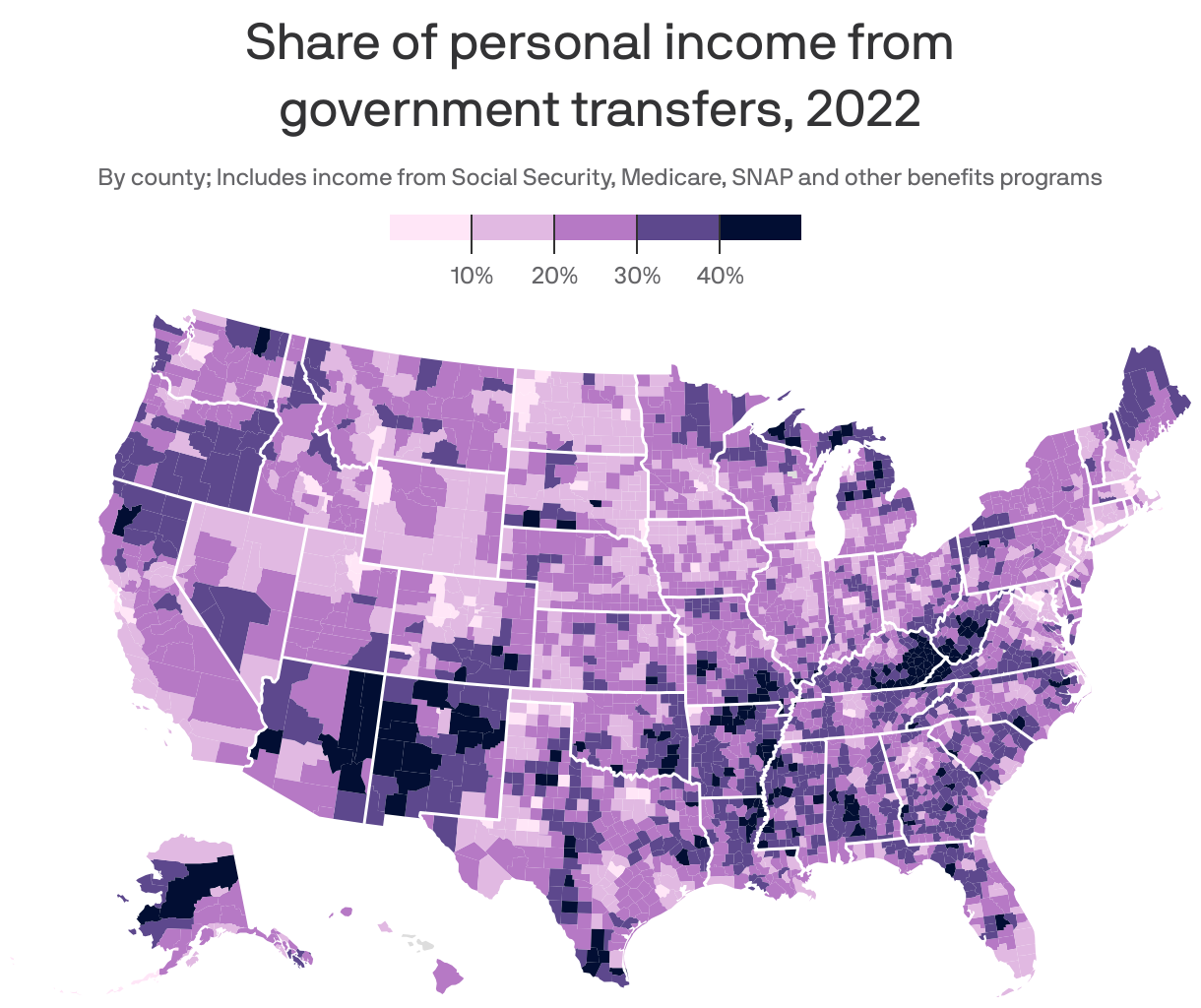
The incoming administration will face stark fiscal arithmetic: Most federal dollars go to direct transfers to Americans, disproportionately located in the very places that propelled Trump back to the White House.
Why it matters: If the Elon Musk/Vivek Ramaswany-led Department of Government Efficiency is to achieve anything approaching the $2 trillion in annual cost savings they've floated, slashing bureaucrats from the federal payroll or payments to well-heeled contractors wouldn't be enough.
- Rather, it would require cuts to programs on which the counties that backed Trump heavily depend.
- Big-ticket transfer programs operated by the federal government include Social Security ($1.3 trillion in outlays in 2023), Medicare ($1 trillion), Medicaid ($616 billion), income security programs like unemployment benefits and food stamps ($448 billion), and federal employee pensions ($197 billion).
- Mandatory programs like those added up to 69% of non-interest federal spending in 2023. Their combined $3.75 trillion in spending was more than twice as much as defense and non-defense discretionary spending combined ($1.7 trillion).
By the numbers: Researchers at the Economic Innovation Group analyzed county-level data on how much personal income was driven by those federal transfer programs in 2022, as opposed to income earned from wages, investments, and the like.
- In the counties most reliant on transfer payments — where they account for more than 25% of all income — Trump won 63% of the vote.
- In those counties least reliant on transfers, accounting for 15% or less of total income, Vice President Harris won 56% of the vote, according to analysis by Sarah Eckhardt, Connor O'Brien and Ben Glasner of EIG.
Zoom in: There are multiple types of counties with high rates of transfer payments. Some, for example, are prosperous places that are popular among retirees receiving Social Security and Medicare.
- Others are more economically distressed, resulting in a greater reliance on Medicaid and income support benefits. In some of these communities, federal transfers account for a massive share of all income.
- Owsley County in Kentucky led the nation with 63% of personal income from transfer payments, and it topped 50% in 13 other Kentucky counties. Trump carried the state by almost 31 points.
Of note: The administrative cost of these programs tends to be a small fraction of the money spent; the overwhelming cost is the benefits themselves. For Social Security, for example, administrative overhead is about 0.5% of total spending.
- That added up to $7.2 billion in 2023 — meaning even if you replaced federal employees with AI customer service bots, the savings would be trivial in the scheme of the whole federal budget.
The bottom line: "The primary drivers of greater transfer spending are an aging society and rising healthcare costs, not wasteful programs or a radically more generous welfare state," EIG president John Lettieri tells Axios.
- "Therefore, if we want to reverse this trend, we need the nation as a whole to look more like the places that are relatively less dependent on transfers today — areas with strong population and economic growth alike."
2. What state data shows about the labor market

Axios Macro