Axios Macro
July 16, 2025


President Trump is likely to attempt to fire Federal Reserve chair Jerome Powell soon, a White House official told Bloomberg. CBS News reports that Trump aired the idea with receptive Congressional Republicans yesterday.
- What's at stake? Something much bigger than where interest rates should be set or how much the Fed should have spent on its headquarters. More below, plus an exclusive on Powell's unlikeliest new defender.
👀 Situational awareness: Wholesale prices were flat in June, per Producer Price Index data out this morning, undershooting analysts' expectations of a 0.2% rise and pointing to benign underlying inflation.
Today's newsletter, edited by Ben Berkowitz and copy edited by Katie Lewis, is 840 words, a 3-minute read.
1 big thing: Real talk about Trump vs. Powell
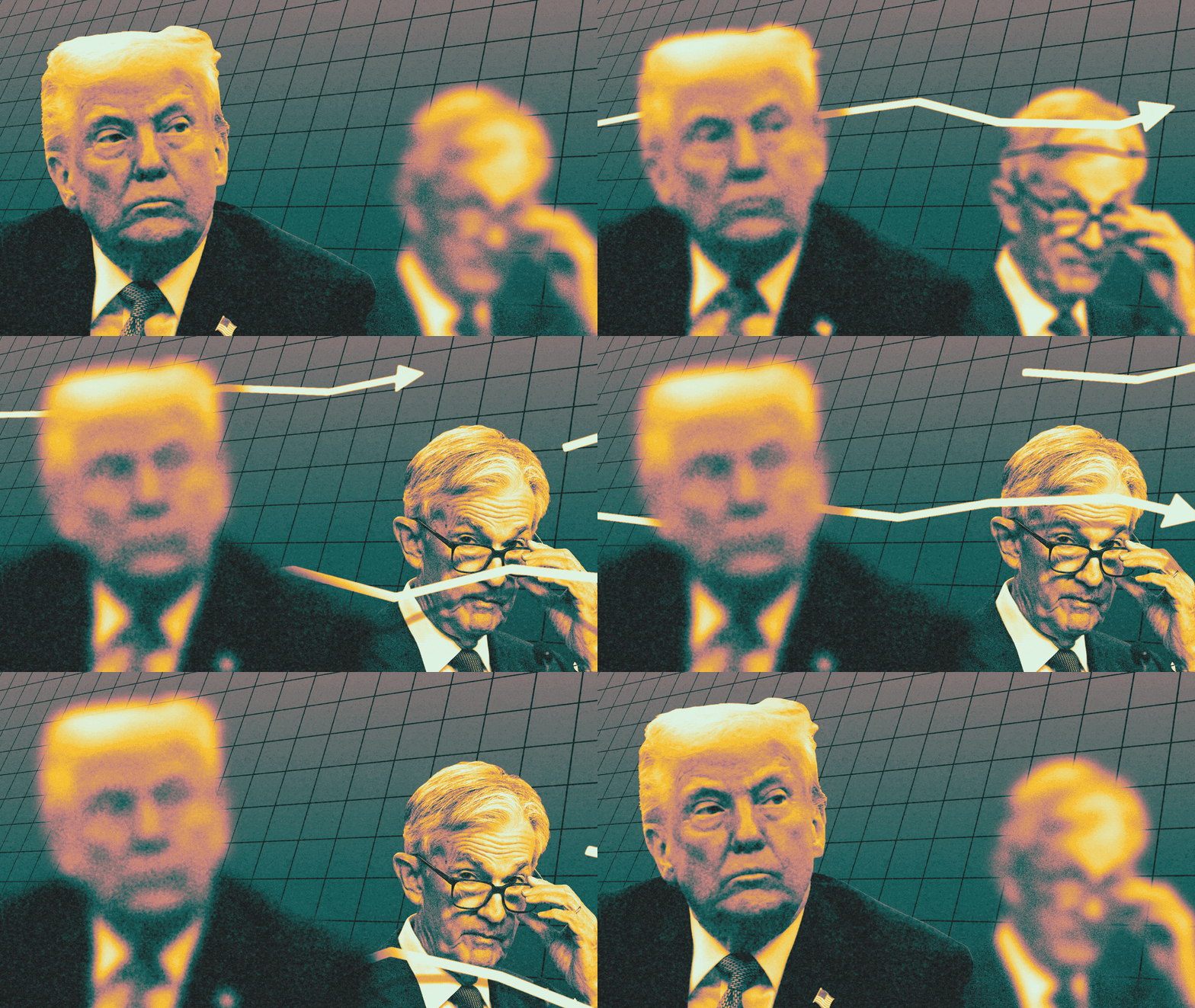
Three things can simultaneously be true: that it would be reasonable for the Fed to cut interest rates; that its headquarters renovation is too expensive; and that the Trump administration's attacks show why central banks are designed to be independent in the first place.
The big picture: The whole reason the U.S. and other advanced economies grant their central banks a measure of independence is to instill confidence that they won't make policy based on what's most convenient in the near-term for elected leaders — such as cutting rates to save the fiscal authorities cash.
- Yet that is exactly the grounds President Trump has repeatedly invoked as the reason he believes the Fed should cut rates drastically.
- The 3-percentage-point rate cut Trump has called for would put the Fed's policy in ultra-stimulative mode at a moment when unemployment is low, inflation remains elevated, and tariffs threaten a new price surge in the months ahead.
Yes, but: That doesn't mean that the Fed is getting things exactly right, either in its monetary policy or its real estate decisions.
- There is a pretty solid case for interest rate cuts right now, even if not the one Trump makes, and $2.5 billion truly is a massive amount of money to spend on renovating a couple of historic buildings.
Between the lines: The argument for rate cuts that could persuade independent-minded technocrats isn't tied to Trump's calls to save the federal government money on borrowing costs, but rather something rooted in current economic conditions.
- The argument would hold that the Fed's current target interest rate, around 4.4%, is still in territory that officials consider "restrictive," deliberately slowing economic activity to try to bring down inflation.
- But inflation has been mostly on a gradual downward path for three years now and is not far from the Fed's 2% target. Tariffs might create a price surge, but that should be a one-time event that policymakers ought to look past.
- Moreover, there are growing signs of weakness in the labor market, including low hiring rates and weak job creation in cyclical sectors.
Zoom out: The Fed's renovation — fueled by overhauling its historic 1935 headquarters building on the National Mall and a second historic building next door, with a tunnel connecting the two — really is costing a lot of money, ultimately borne by taxpayers.
- But it's also the case that the Federal Reserve Act gives the Board of Governors independent authority over its real estate precisely to insulate it from political pressure.
- And the Trump administration has left little doubt that the president's discontent over rates is driving the new scrutiny of the project.
What they're saying: "If the Fed were to lower interest rates this month to 1%, White House officials would stop talking about beehives and fancy elevators," Sarah Binder, a political scientist at George Washington University who has studied Fed governance, tells Axios.
- If Trump attempts to remove Powell from his job for cause before the chair's term expires 10 months from now, it would set up a legal battle — very likely ending up before the Supreme Court — with long-term consequences for how U.S. economic policy is run.
The bottom line: "How far would the Court be willing to go to insulate the Fed if Powell were charged with 'neglect of duty?'" Binder asks. "Remains to be seen!"
2. Exclusive: Warren defends Powell
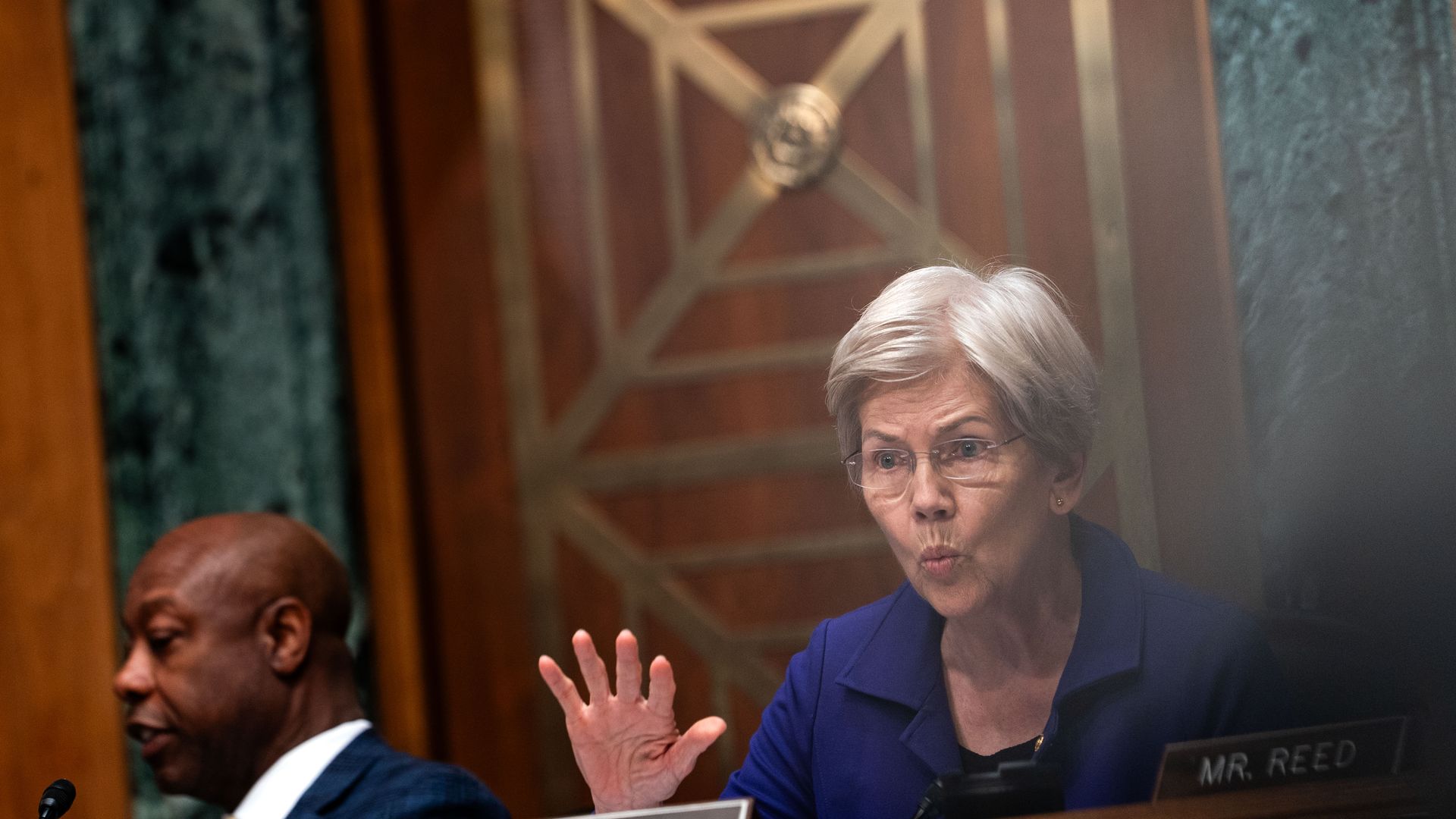
Sen. Elizabeth Warren (D-Mass.), a frequent critic of Powell and the Fed, will defend the central bank in a speech this afternoon, according to prepared remarks first seen by Axios.
Why it matters: Warren is among the central bank's most consistent critics. The rare support from the influential lawmaker, who is the top Democrat on the Senate Banking Committee, shows how the party will hit back at White House pressure to oust Powell.
What they're saying: "When [Trump's] initial attempts to bully Powell failed, Trump and Republicans in Congress suddenly decided to look into how much the Fed is spending on building renovations," Warren will tell a group of financial policymakers and economists at the Exchequer Club of Washington, D.C.
- In the remarks, Warren acknowledges the topsy-turvy world in which she defends the institution that she has slammed for years.
- "Independence does not mean impunity and I have long pushed for more transparency and accountability at the Fed. But give me a break," Warren will say. "[N]obody is fooled by this pretext to fire Chair Powell. And markets will tank if he does."
Flashback: Just a few weeks ago, Warren co-sponsored legislation with Sen. Rick Scott (R-Fla.) that would force the Fed's watchdog to be Senate-confirmed — a move aimed at stepping up oversight of the central bank.
- Warren has called Powell a "dangerous man." She is among the few lawmakers who voted against his confirmation in 2017; she did so again when former President Biden renominated Powell in 2021.
- Just two years ago, Warren told Meet the Press: "Look, I don't think [Powell] should be chairman of the Federal Reserve. I have said it as publicly as I know how to say it. I've said it to everyone."
Sign up for Axios Macro