Axios Macro

January 31, 2024

1 big thing: Why the U.S. economy is beating the world
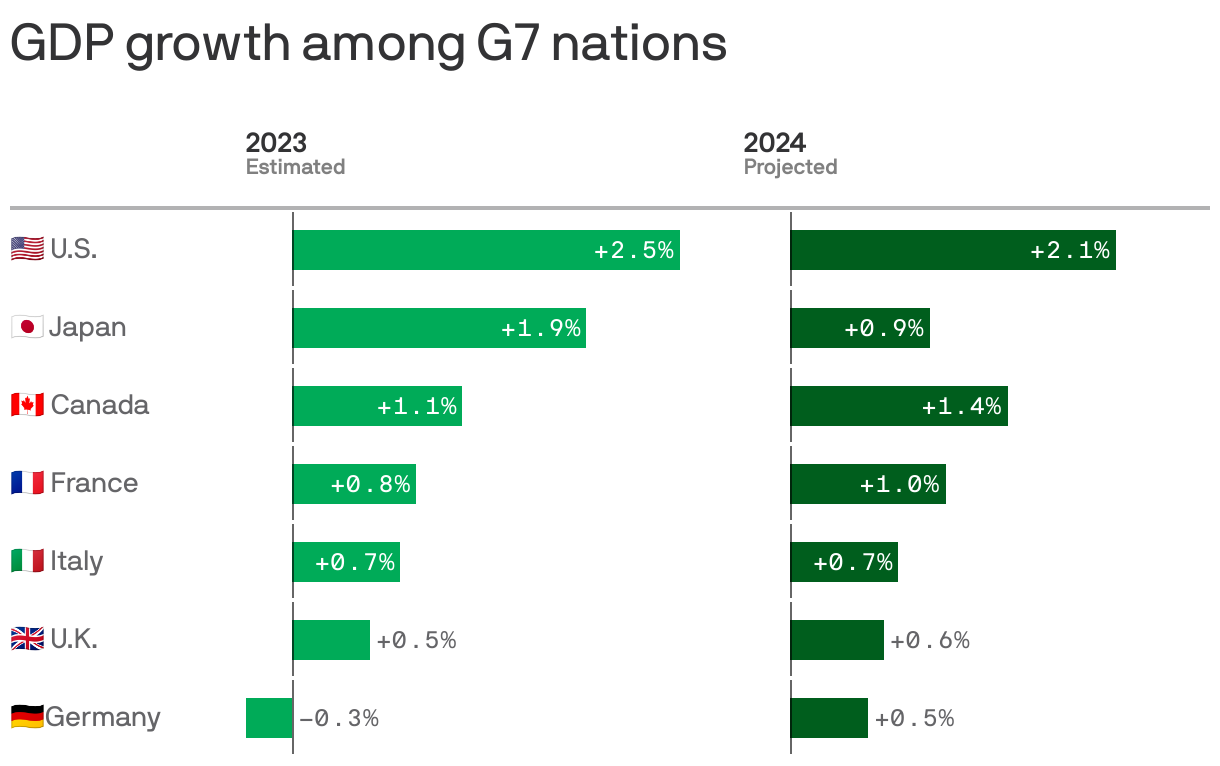
As we reported in this morning's Axios AM newsletter, the United States grew faster than other major advanced economies last year and looks poised to do so again in 2024. Here, we go a bit deeper on some of the potential factors for why.
Why it matters: The details shed light on some underlying strengths of the U.S. economy and reflect good policy choices and good luck.
State of play: Strong GDP growth in 2023 was driven by a combination of growth in both the labor force and productivity.
- But that's essentially a tautological statement — the open question is why the U.S. had both more people working and delivered more economic output for each hour worked.
- A significant part of the gain can be explained simply by there being more workers; the U.S. labor force expanded by 2.5 million people over the course of 2023, reflecting both immigration and native-born Americans joining the workforce.
The big picture: Adam Posen, president of the Peterson Institute for International Economics, argues that another important part of the story is a massive shift during the pandemic and its aftermath in which American workers shifted en masse toward higher-wage, higher-productivity work.
- In contrast, Europe and Japan remained tied to their pre-COVID jobs, as government policies incentivized keeping people on existing payrolls rather than offsetting lost income with unemployment benefits and cash payments.
Yes, but: This wasn't due to any grand design. "In a sense this was plain good luck, since the massive U.S. churn of people through unemployment and renegotiating job terms was the result of our politics and institutions, not of deliberate design," Posen tells Axios.
Between the lines: In a note out this morning, Skanda Amarnath of Employ America argues that strong 2023 U.S. productivity gains reflect federal investment in manufacturing capacity — a view also advanced by Biden administration officials.
- That also helps account for the superior growth results in the U.S. versus the rest of the G7.
- Amarnath also emphasizes the benefits of a full-employment economy, which may incentivize companies to be more creative and aggressive in finding new ways to make their workers more productive.
- He flags the possibility of "time to train" effects, meaning that the millions of workers employers added to their payrolls in 2021 and 2022 may not have hit high levels of productivity until 2023.
2. No wage-price spiral here


There's more evidence the labor market is cooling down — this time, from a key measure of compensation watched closely by the Fed.
Driving the news: Pay growth kept slowing in the final months of 2023, according to the Employment Cost Index released this morning.
- Wages and salaries grew 0.9% in the three months ending in December for all workers, compared to 1.2% in the previous three months.
Why it matters: The final data point before this afternoon's Fed decision is good news for officials who want more proof disinflation is underway and that an upward spiral of wages and prices isn't setting in.
- For American workers, the slowdown in inflation means that wages are still growing in real terms.
- For instance, inflation-adjusted wages and salaries among private sector workers rose 0.9% in the 12 months ending in December, up from 0.8% through September.
The big picture: The slowdown in nominal wage growth comes alongside other signs suggesting less frantic job-switching and demand for workers.
- "[I]f new jobs aren't offering good enough pay, there is less incentive for employers to pay up so much to retain staff, and you get this cycle of slowing pay and benefits," James Knightley, chief international economist at ING Bank, wrote in a note.
Of note: The ADP report this morning showed the private sector added 107,000 workers in January, down from the 158,000 added the prior month.
- ADP also showed slower pay growth: Wages for job-stayers rose 5.2% in January compared to a year earlier, down from 5.4% the prior month. For job-switchers, it rose 7.2%.
- "Across industries, you're still seeing solid pay growth, but not supercharged," ADP chief economist Nela Richardson told reporters. "We think that's over."
Axios Macro

Stay ahead of the curve on the most important economic developments with reporting and analysis on how business, policy, and markets collide.