Axios Macro

April 09, 2025

President Trump's "reciprocal tariffs" went into effect overnight, including a whopping 104% tax on Chinese imports. The global economy may never be the same.
- This morning, we spoke with Richmond Fed president Tom Barkin, who discussed how the shift in trade policy is likely to affect inflation, jobs, Fed policy and more.
- More below, plus our colleague Felix Salmon on worrying developments in the bond market.
Today's newsletter, edited by Ben Berkowitz and copy edited by Katie Lewis, is 780 words, a 3-minute read.
1 big thing: Tariff price hit could come in June
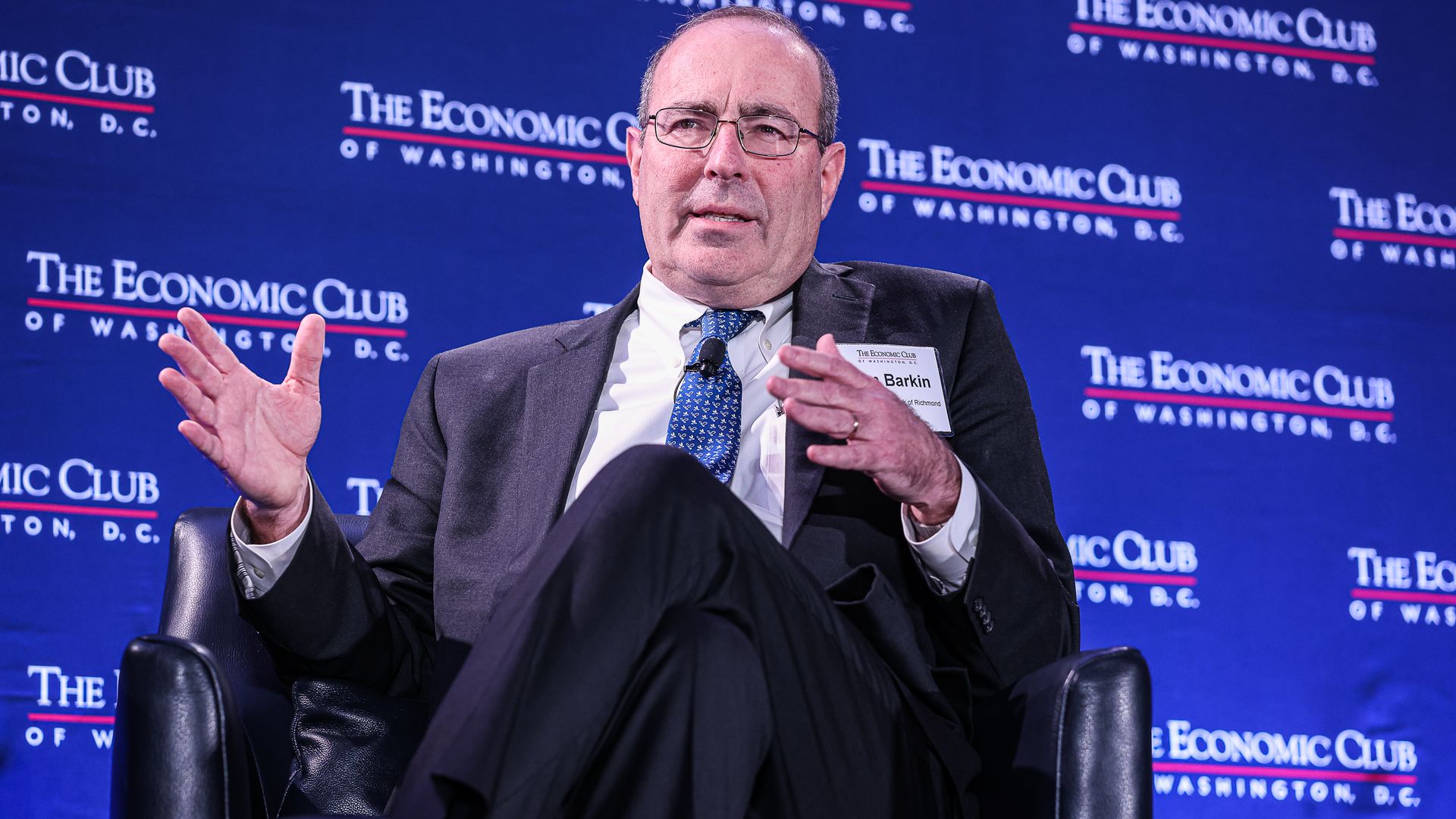
The trade war is likely to cause fewer jobs and higher prices, a top Federal Reserve official tells Axios. But price hikes may not show up until the summer, as companies work through pre-tariff inventories.
Why it matters: Barkin, in an exclusive interview, described a deep-seated uncertainty among businesses that is likely to slow activity — along with a surge in prices that requires the Fed to act cautiously in responding.
What they're saying: "As I've talked to business people, they're still struggling to have confidence in where this lands," Barkin said this morning, in the first interview with a Federal Reserve official since the tariffs went into effect.
- "The direction is clear ... it's just the destination that people are challenged with," Barkin told Axios in advance of a speech to the Economic Club of Washington, D.C.
Zoom in: Barkin describes a push-and-pull over who will absorb the cost of tariffs.
- "For the most part, there is enough inventory that we're talking about June prices more than we're talking about April prices," he said, as companies typically have 30 to 60 days' worth of pre-tariff inventory to work through.
- "I was talking to a home improvement manufacturer who said they're not going to do the Memorial Day promotion that they normally do because you've only got so much inventory at [a] lower cost. So why would you put it on promotion?"
Companies are determined to pass along higher tariff costs by way of higher prices, but they'll face resistance from consumers who are drained by the high inflation of the last few years.
- "You've got an emboldened supplier who has a set of tariffs they know they've got to pass on," Barkin says. But as for consumers, "they're tired of higher prices and they don't want to pay them anymore."
- He says that in a "cage match between exhausted consumer and emboldened manufacturer, that might all play out in one big swoop, but it wouldn't stun me at all if it played out over time."
Zoom out: The risks to both sides of the Fed's mandate — for maximum employment and stable prices — set up a dilemma for policymakers.
- What might help on one side (cutting rates to address joblessness) risks making things worse on the other (allowing higher inflation). Barkin was noncommittal on where policy might shake out.
- "Some of the shifts we're seeing run the risk of both being inflationary and negative for unemployment," Barkin says. "And if that's the case, that's a hard box for policymakers."
For more from our interview with Barkin — including on the stock market sell-off, recession risk, and the peanut market — click here.
2. Bond market convulsing


The price of U.S. Treasury bonds is plunging, in what Treasury Secretary Scott Bessent today called "deleveraging convulsions." The effect is to raise borrowing costs just as recession fears spike.
Why it matters: The last thing America needed amid a global trade war and a stock market meltdown was a debt crisis, too. But that now seems to be a real possibility.
What they're saying: "This is the script for a truly existential financial crisis," writes Columbia economic historian Adam Tooze, who wrote a whole book on the very similar dynamics that overtook the Treasury market in March 2020.
Driving the news: Bond yields — which move in the opposite direction to prices — are soaring in the wake of protectionist U.S. tariffs.
- The amount that the U.S. government needs to pay to borrow money for a decade rose briefly to more than 4.5% this morning. For a 30-year bond, the yield rose to more than 5%.
- Those moves are truly enormous by bond market standards. As recently as Friday, the 10-year yield was less than 4%, and the 30-year was below 4.4%.
The intrigue: In normal times, the most consistent buyer of Treasury bonds is a group of hedge funds that participate in something called the "basis trade."
- They buy the bonds in order to hedge their derivatives exposure to institutional investors, who can lock in slightly higher yields in the futures market.
- The profit on any given trade is minuscule, but it's also very close to risk-free, so the hedge funds can apply as much as 50x or even 100x leverage.
- By many accounts, the basis trade is now unwinding, which means the hedge funds are selling their bonds — or, at the very least, not buying new ones.
The big picture: In a move reminiscent of the bond-market tantrum that swept U.K. Prime Minister Liz Truss from office in 2022, the technical factors in the bond market were precipitated by — and also exacerbated — fundamental issues with the country's finances.
Sign up for Axios Macro