
Axios Macro

March 26, 2026

⚠️ New projections this morning envision serious damage to the global economic outlook — and the U.S. inflation picture — from the Iran war. More below.
- Plus, a new paper on what would need to happen to shrink the Federal Reserve's whopping $6.7 trillion balance sheet without too much collateral damage.
Today's newsletter, edited by Jeffrey Cane and copy edited by Katie Lewis, is 1,072 words, a 4-minute read.
1 big thing: War's inflationary toll
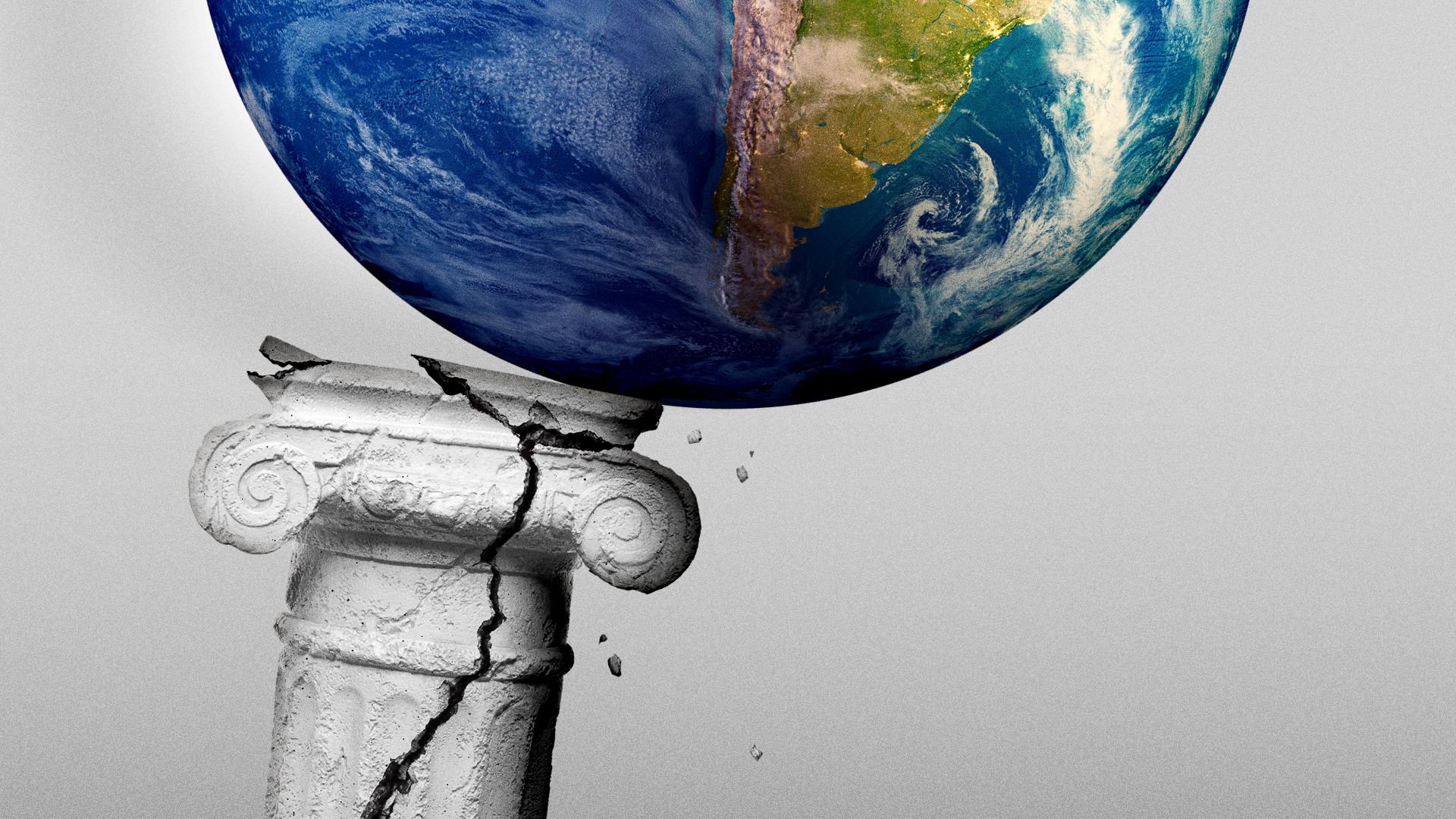
The Middle East conflict wiped out what would have been a modest upgrade to global growth and a stable inflation picture.
- That has been replaced with a fresh warning about soaring energy costs and U.S. prices, which are projected to run far hotter than expected.
Why it matters: What was a more manageable inflation story now looks like a pressure test for central banks that may need to raise interest rates — or hold off on further cuts — even as growth weakens.
- Governments already carrying huge debt loads might need to spend more to cushion the blow for households.
What they're saying: "The energy price surge and the unpredictable nature of the evolving conflict in the Middle East will raise costs and lower demand, offsetting the tailwinds from strong technology-related investment and production, lower effective tariff rates and the momentum carried over from 2025," the Organisation for Economic Co-operation and Development, a Paris-based research and policy group, wrote in its economic outlook released this morning.
By the numbers: The OECD projects U.S. headline inflation will be 4.2% this year, up 1.2 percentage point from its previous projection in December.
- Still, the group expects those new inflation pressures to fade by the end of 2027, with U.S. inflation projected to decline to 1.6% — a rate that is actually 0.7 percentage point lower than its last forecast.
It's a similar story across major economies: G20 inflation is projected to be 4%, up 1.2 percentage point from its December forecast.
- Yet inflation is expected to be stickier than in the U.S. — it will fall to 2.7% by next year, though that is roughly 0.2 percentage point above its December global inflation expectations.
Zoom in: The OECD forecasts the global economy to grow 2.9% this year — the same rate expected in December and a slowdown from the 3.3% growth rate in 2025.
- Its projections for the U.S. economy are rosier compared with the rest of the G20, with a 2% growth rate anticipated this year. That is roughly 0.3 percentage point above its previous growth estimate, the biggest upgrade seen across the economies tracked by the OECD.
Yes, but: Energy price pressures will still weigh on the economy in the near term.
- "In the United States, strong growth momentum in the first quarter of 2026 is expected to be offset by a slowdown in consumer spending, owing to the combination of declining purchasing power, weakening labor force growth and depleted household savings," the OECD warns in the report.
- U.S. growth will slow to 1.7% in 2027, 0.2 percentage point below its December forecast.
What to watch: The OECD says its projections assume that energy prices evolve in line with financial market expectations, with oil, gas and fertilizer prices moderating in the middle of the year.
- "A significant downside risk to the outlook is that persistent disruptions to exports from the Middle East that raise energy prices even further than assumed and aggravate shortages of key commodities, add to inflation and reduce growth," its economists wrote.
On the upside, the global economy can prove more resilient, and the Middle East conflict can resolve quicker than expected, the OECD says.
- It also notes that AI technology yields stronger-than-expected productivity gains that push growth higher.
2. How Warsh could shrink the Fed balance sheet


Kevin Warsh, President Trump's nominee to lead the Federal Reserve, has said repeatedly that he wants the central bank to have a smaller imprint on financial markets. Doing so will be easier said than done.
The big picture: That is the upshot of new research being presented today by Stanford economist Darrell Duffie. He gives a menu of options for how the Fed could shrink its $6.7 trillion balance sheet.
- The good news for Warsh is that it's plausible to accomplish balance sheet shrinkage without major disruption to money markets. The bad news is that it involves complexity and trade-offs.
State of play: Before the financial crisis in 2008, the Fed's total assets were a dainty $900 billion, or 6% of U.S. GDP.
- After nearly two decades of quantitative easing and other programs to respond to crises, it's up to 21% of GDP.
- It includes a dog's breakfast of assets, including $2 trillion in mortgage-backed securities and some remaining stubs of assets left over from emergency programs during the pandemic and the 2023 regional bank crisis.
- But the flip side of those assets is the Fed's liabilities. That includes paper money and the U.S. Treasury's cash management account, but the biggest slice is bank reserves.
Zoom out: Mechanically, if the Fed were to try to slash its assets willy-nilly by selling them, it would involve sucking money out of the banking system, reducing reserves.
- But if it went too far, it would mean huge disruptions in the money markets — causing the Fed to lose control over short-term interest rates and potentially cause an unwanted contraction in credit more broadly.
- That's exactly what was starting to happen in a disruptive episode in 2019.
Zoom in: To make balance shrinkage work, Duffie will argue at the Brookings Papers on Economic Activity, it needs to be accompanied by steps to make banks want to hold fewer reserves — to ensure that it can proceed without those ill effects. He lays out several options for doing so:
- The Fed could adjust regulations so that banks feel less pressure to meet liquidity requirements by holding reserves at the Fed.
- It could change its payments systems so that banks don't need as many reserves for day-to-day transactions.
- It could create a tiered system so that banks that park more money than they need at the Fed as reserves earn less interest.
- It could act to offset seasonal shocks that happen to reserves at the end of each quarter.
The bottom line: Should the Warsh Fed seek a smaller balance sheet, "if you just do it without reducing demand for reserve balances, that won't work," Duffie told us in a call with reporters.
- "If you can do some of the things on my list, that will reduce the demand for reserves, then that can work," he said.
Sign up for Axios Macro