Axios Macro

April 16, 2025

🌧️ There is a gloomy update on the outlook for global trade — the first since President Trump implemented his tariff-heavy trade policy.
- More below, inside the official data that affirms anecdotes of pre-tariff shopping binges. 🛍️
Today's newsletter, edited by Christine Wang and copy edited by Katie Lewis, is 844 words, a 3-minute read.
1 big thing: The U.S.-China decoupling arrives
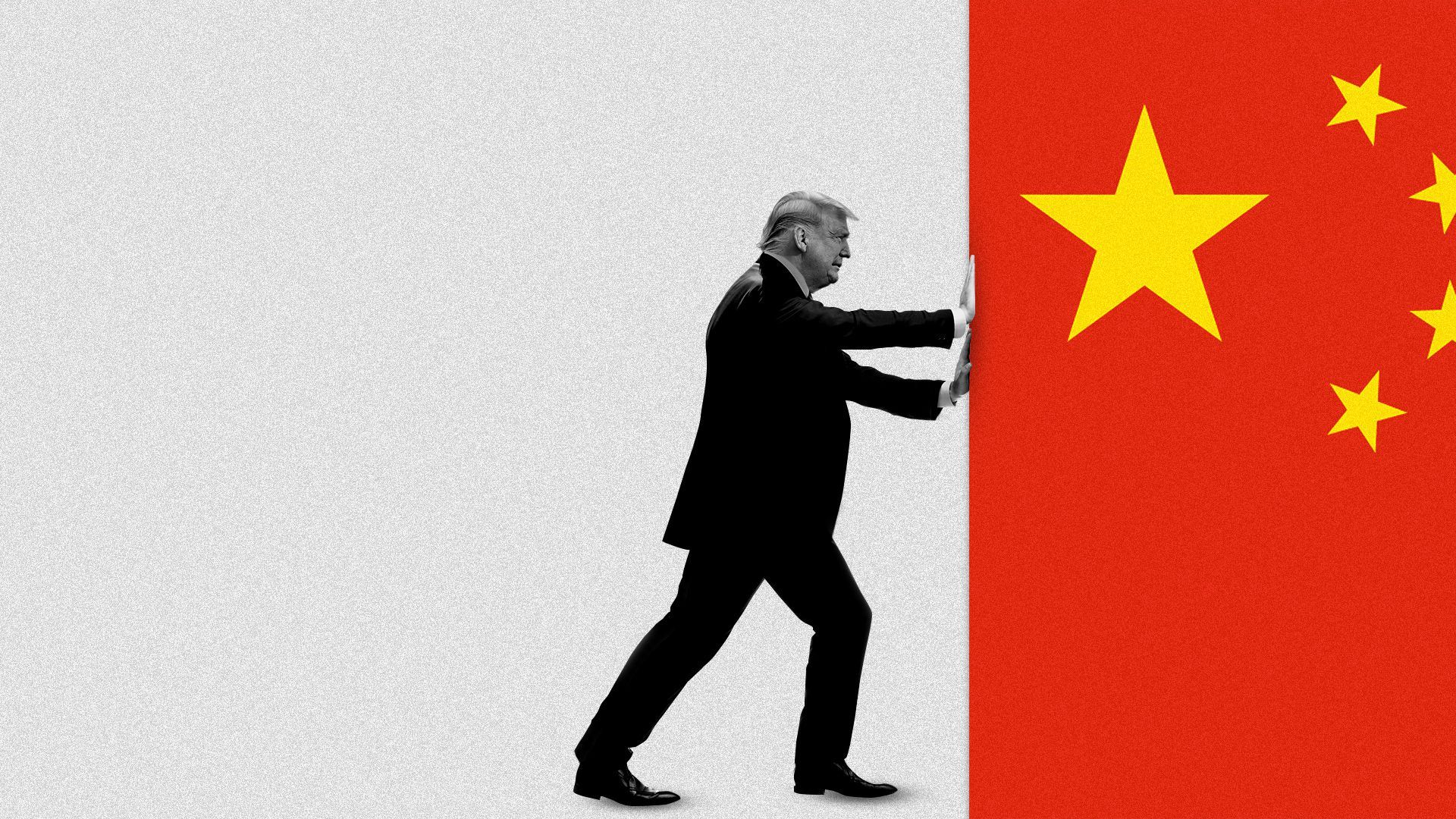
What has been a yearslong economic risk is now reality: The tit-for-tat tariffs effectively end U.S.-China bilateral trade, the final step in the economic decoupling of the world's juggernauts.
- That is the new warning from the World Trade Organization today in the release of its latest global outlook.
Why it matters: The sudden divorce of the two economies might mean profound pain for American workers and the nation's wealth built on the back of a strong trading relationship.
- A prolonged trade fight risks splitting the global trading system into two distinct blocs — countries that trade with the U.S. and those that trade with China.
Stunning stat: The WTO anticipates trade between the U.S. and China will screech to a halt this year.
- Trade of merchandise between the two countries will drop by 80%, a drop that would have topped 90% without the White House's recent exemption for smartphones and other tech goods, according to WTO director general Ngozi Okonjo-Iweala.
What they're saying: "The drop in U.S.-China trade of the magnitudes we are talking about is virtually tantamount to a decoupling of the two economies," Okonjo-Iweala told reporters this morning.
- "This is a phenomenon we've talked about before ... and now we're seeing it emerging," Okonjo-Iweala added. " I think this is one of the most worrying factors for us."
The big picture: The total volume of goods traded around the world is expected to contract by 0.2% this year — an abrupt turnaround from the near 3% increase last year.
- The decline in world trade would be as large as 1.5% in 2025 if Trump reinstates the reciprocal tariffs that are now on pause.
- Consider the counterfactual: If both trade and trade-policy uncertainty were low, the WTO says, world trade would grow by 2.7% in 2025.
Threat level: The group anticipates the trade slowdown — topped with uncertainty about the tariff endgame — will spill over into weaker global growth.
- The WTO expects GDP growth will reach 2.2% in 2025, 0.6 percentage point below its initial forecast that did not account for the global trade war.
- That will nudge up slightly to 2.4% next year, "substandard compared to recent history," it writes in the release.
Between the lines: The Trump administration said it would hold trade negotiations with a slew of nations facing reciprocal tariffs over the next 90 days.
- But China is the exception. The high, country-specific rates have been paused for all countries, though tariffs on China have only increased.
What's new: Trump ordered the Commerce Department to investigate America's reliance on critical minerals from other countries.
- The investigation could further crack down on trade with China, which produces the majority of all critical minerals, many of which are used in defense, energy and electronics sectors.
- Any tariffs that stem from the investigation would "take the place" of current reciprocal tariff rates, according to the executive order Trump signed yesterday.
What to watch: The WTO says countries should cut back excessive reliance on other trading partners, an admission that Trump-like protectionism is the new threat.
- "The U.S. has a point when it says too many countries are dependent on its market, or the production of some critical inputs are too concentrated in certain sectors and geographies," Okonjo-Iweala says.
- "Building global resilience requires interdependence, not over dependence."
The bottom line: The fear of economic devastation from U.S.-China decoupling helped blunt Biden-era trade policy.
- Trump is taking an unprecedented gamble — one that WTO economists admit means its forecast might not be gloomy enough.
2. Pre-tariff shopping spree


Economists say consumers rushed to make foreign-sourced purchases before Trump's broadest tariffs took effect and potentially raised prices for goods.
- That helps explain today's blowout retail sales report.
By the numbers: Retail sales surged 1.4% in March — the biggest monthly jump in two years after back-to-back months of weak consumer spending.
- There was a huge boost from sales of autos and auto parts, which rose 5.3% in March. That was before tariffs on foreign-made cars took effect: As of early April, they are subject to 25% levies.
- Excluding autos, the increase in retail sales was just 0.5%.
Zoom in: Consumers splurged at building material shops (+3%), hobby stores (+2%) and restaurants and bars (+2%).
- Sales at gasoline stations fell 2.5% as pump prices dropped. Consumers pulled back in just two other retail categories: furniture stores (-0.7%) and department stores (-0.3%).
- The Atlanta Fed's GDPNow model — updated after today's retail sales data — shows a slight contraction (-0.1%) in economic growth for the first quarter. (This is the estimate that adjusts for the recent surge of gold imports.)
The intrigue: More recent signals from sentiment surveys suggest that consumers plan to cut back on spending, with rising fears that Trump's trade policy could spike joblessness and hit growth.
What they're saying: "It's hard to feel good about Americans panic-buying cars as consumer confidence craters," Comerica Bank chief economist Bill Adams wrote in a note.
- "Businesses selling cars, appliances, and electronics are likely to see less demand in the next month or two as panic buying ends," he adds.
Sign up for Axios Macro