Axios Latino

¡Buen martes!
- Today we remember award-winning Mexican American novelist Rolando Hinojosa-Smith, who died last week at the age of 93, as well as Mexican American legal scholar Michael A. Olivas, who died at 71.
🪅 Don't forget: Send us your Pachanga Thursday suggestions by replying to this email.
- Puede leer la versiĂłn en español aquĂ.
This newsletter, edited by Laurin-Whitney Gottbrath, is 1,698 words, a 6.5-minute read.
1 big thing: Fighting an undercount
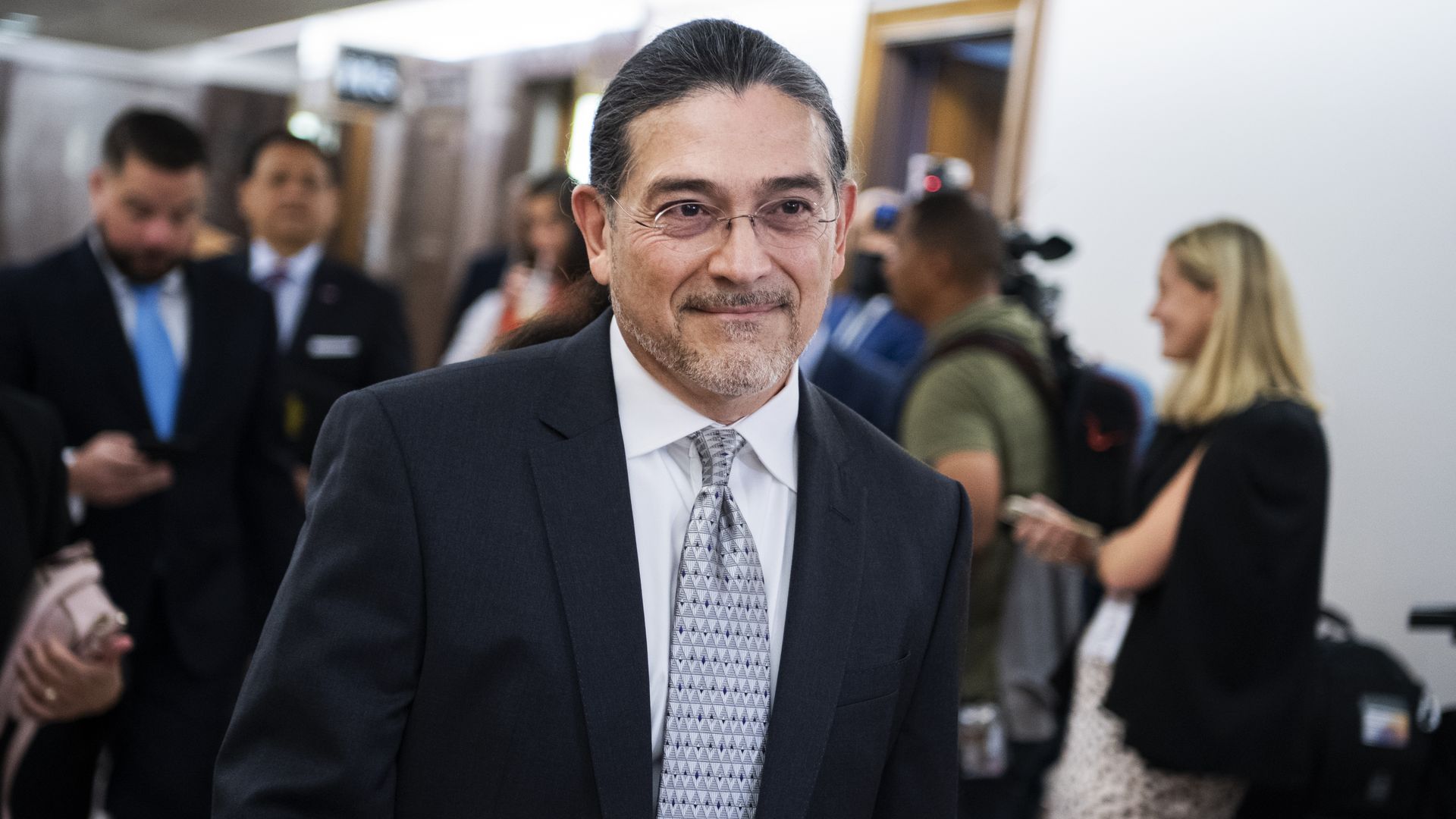
Robert L. Santos in July 2021. Photo: Tom Williams/CQ-Roll Call Inc. via Getty Images
Robert Santos, the first Latino director of the U.S. Census Bureau, says he wants to remedy the severe undercount of Hispanics by returning to old-school ways, including more door-to-door contact, Marina writes.
Why it matters: The undercount of Latinos in the 2020 census was three times higher than in 2010. Many Black and Native Americans were also omitted from the population tally.
- Census counts are used to redraw electoral districts and help determine the allocations of hundreds of billions of dollars in federal funds.
- That means districts with uncounted Latino households could lose key funding for health care and education programs, as well as food stamp benefits and free school lunches.
Between the lines: The Latino undercount has been attributed to insufficient outreach — especially to promote the online forms — during the pandemic, as well as fear and confusion over a planned citizenship question that was scrapped.
What he's saying: Santos will spend most of his time “going out into the communities and talking to stakeholders” to promote participation for 2030 starting now, he said in an interview with Noticias Telemundo.
- The message about the benefits of participating in the decennial count and other surveys from the Census Bureau needs to be made clearer, he said.
Fine-tuning when and how census takers visit households could improve results for upcoming studies by the group, Santos added.
- “With a diverse voice in the leadership of the country’s premier statistical agency we can identify new ways, creative and innovative ones, to collect better data and identify what data isn’t being collected well, what needs to be asked that hadn’t been asked,” Santos said.
2. Hispanic Caucus PAC calls out other Dems
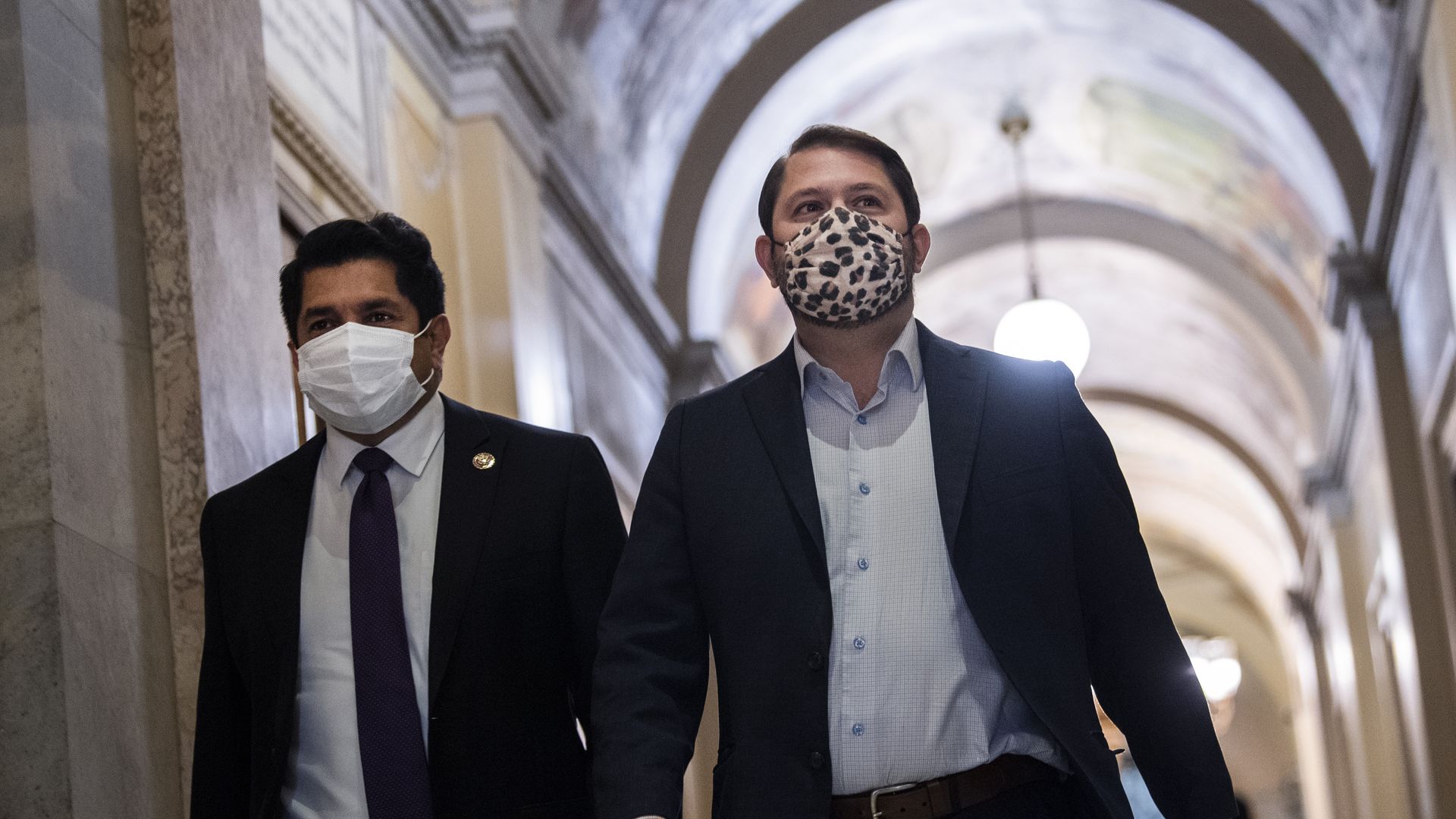
Reps. Ruben Gallego (D-Ariz., right), and Jimmy Gomez, (D-Calif.) Photo: Tom Williams/CQ-Roll Call, Inc via Getty Images
The campaign arm of the Congressional Hispanic Caucus is striking a different tone than in past election years by calling out traditionally white-led Democratic groups and issuing warnings about ignoring Latinos, Russell writes.
The big picture: Rep. Ruben Gallego (D-Ariz.), chair of CHC Bold PAC, in recent weeks has twice rebuked the political action committee connected to House Speaker Nancy Pelosi and endorsed Latino House candidates around the country.
- It's a shift from previous years, when the Bold PAC was mainly dormant beyond raising money for a handful of Democratic hopefuls.
Driving the news: Bold PAC announced late Monday it was making a $1 million ad buy in support of state Rep. Andrea Salinas, a popular Latina candidate, in an Oregon Democratic U.S. House primary.
- It's meant to counter a roughly $1 million ad buy by House Majority PAC — which is aligned with Pelosi — for Carrick Flynn, a white, little known, first-time candidate. Bold PAC also denounced the House Majority PAC when it first announced its ad buy.
- There are three Latina candidates, including Salinas, in the nine-member field.
The other side: House Majority PAC communications director C.J. Warnke told Axios the group believes supporting Flynn in the Oregon primary "is a step toward" securing the House in November.
- The PAC's executive director, Abby Curran Horrell, added it has reserved $42 million of the overall media buy for markets reaching "Latino-influence" districts, although most of those buys will be in English.
- “House Majority PAC has a long history of supporting Latino candidates and engaging with Latino communities in order to elect Democrats to the U.S. House," Horrell said.
The intrigue: Gallego last week also called out House Majority PAC — which is aligned with Pelosi — over its plan to spend just a sliver of its 2022 midterm campaign budget on Spanish-language ads.
- House Majority PAC said it will spend over $100 million on TV and digital ads during the final months of this year's midterm cycle. But only $1.2 million will go to Spanish-language ads.
- "The way that House Majority PAC has made investments, so far this cycle, raises doubts about its commitment to this critical early outreach," Gallego told Axios.
3. Axios Latino interview: Andrea Salinas
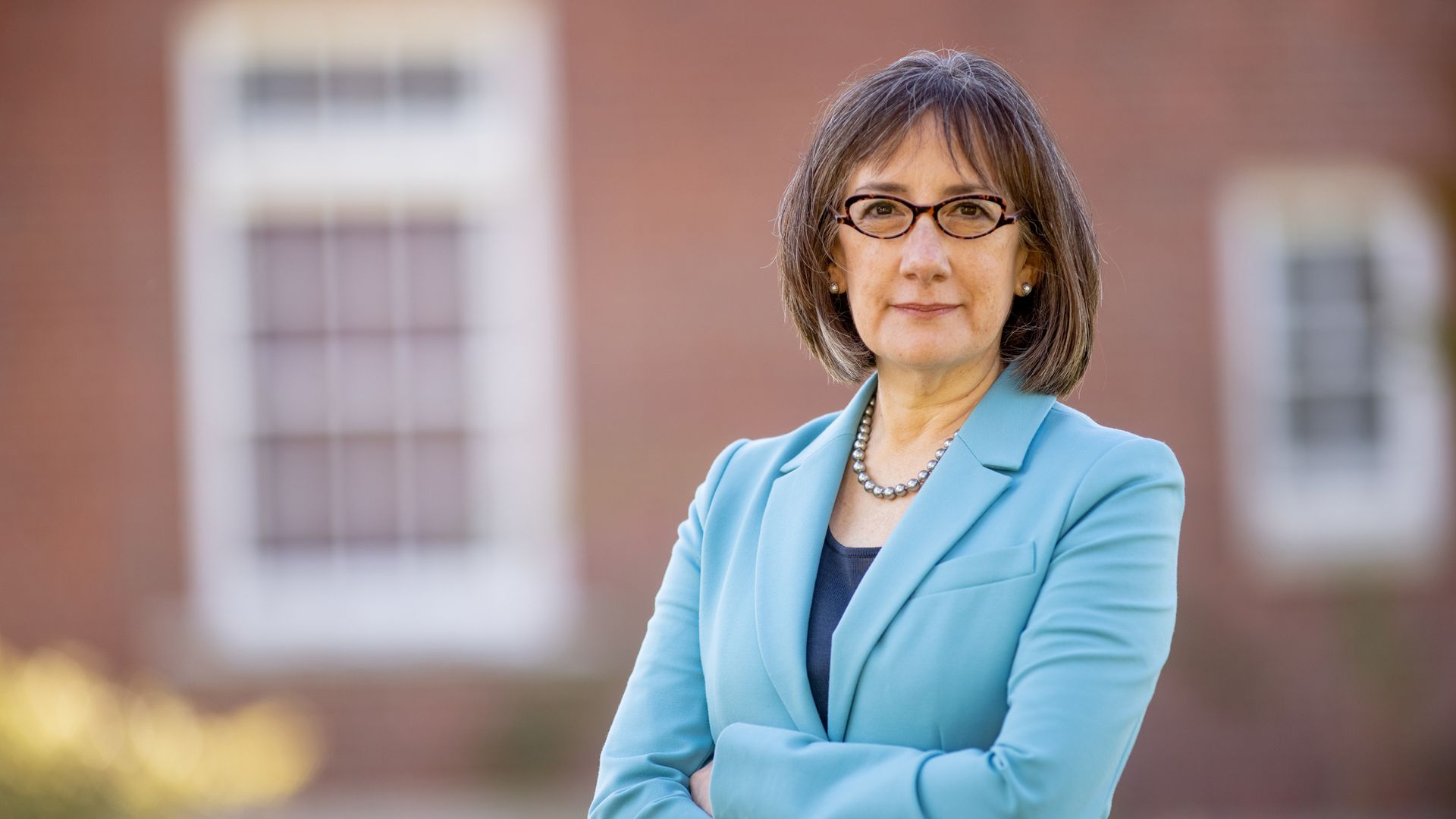
Democratic Oregon state lawmaker and U.S. House candidate Andrea Salinas. Photo: Courtesy of the Salinas Campaign
Oregon state Rep. Andrea Salinas tells Russell she can't believe Pelosi-linked House Majority PAC isn't backing her despite other Oregon Democrats rallying around in her a crowded primary for the U.S. House seat
What she's saying: Salinas says her track record for supporting progressive issues like reducing prescription drugs costs and reproduction rights speaks for itself.
- "Voters and candidates of color delivered majorities for Democrats in the 2020 elections," she says.
- "Yet, despite all this, the House Majority PAC deliberately chose not to endorse me and I'm one of the most qualified Latinos running in a congressional race."
Background: Salinas is the daughter of a Mexican immigrant who worked as a migrant farmworker and later served in the Vietnam War.
- As a state legislator, she's earned the reputation as a coalition builder and a defender of the state's growing Latino population, which is now 21% of her district's total population.
The intrigue: Since entering the crowded Democratic primary, Salinas has earned more than 80 endorsements, including those of around half the Latina Democrats in the U.S. House and of several major labor unions.
- CHC Bold PAC continues to back Salinas despite House Majority PAC putting money on a little-known white candidate.
Don't forget: Only 13 out of the 435 House members are Latina.
4. An email to help combat Alzheimer’s

Illustration: Sarah Grillo/Axios
A new study shows enrolling more Latinos to get representative samples in Alzheimer’s research can be achieved by simply emailing them, Marina writes.
Why it matters: U.S. Latinos are chronically underrepresented in clinical trials for treatments of cognitive disorders, even though they are 1.5 times more likely to be diagnosed with Alzheimer’s or dementia than non-Hispanic whites.
- Remote data collection is being pushed as one way to reach more participants for related genetic research, especially as the pandemic made in-person sampling harder.
Details: People over age 55 were invited in an email campaign to share DNA information for a pilot online registry of brain health led by University of California San Francisco researchers.
- Genetic collection kits with bilingual instructions were mailed out to those who responded with interest.
- The number of Hispanic participants in the ongoing GenePool Study rose tenfold, from 1.7% to 19%, according to pre-print results presented at the Alzheimer’s Association 2022 symposium on Latinos this week.
What they’re saying: “Due to distances, due to trust issues, to the ability of having care partners that can take time off and get you to a clinic, to the ongoing problem of few Latinos getting to specialists that can refer them to trials, tech use and those options is an advantage,” Maria C. Carrillo, the Alzheimer’s Association's chief science officer, tells Axios Latino.
- Yes, but: Carrillo stresses that remote data collection carries challenges, such as possibly excluding people with less internet access or generating trust issues about sharing genetic material unless privacy assurances are given in a plain language.
5. Melissa Lucio's execution halted
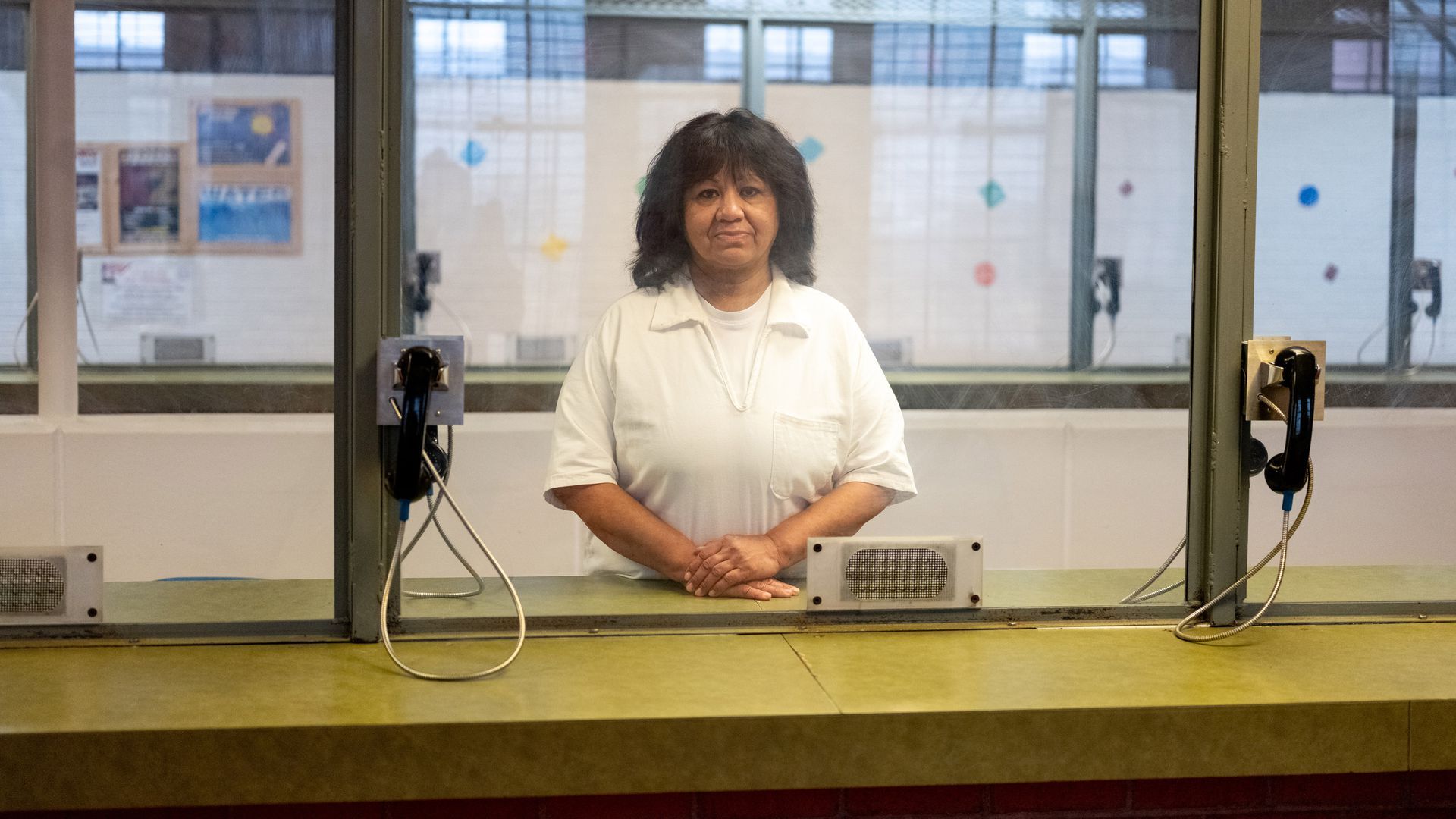
Melissa Lucio poses for a portrait behind glass at the Mountain View Unit in Gatesville, Texas, on March 21. Photo: Courtesty of Ilana Panich-Linsman for The Innocence Project
Lawyers for Melissa Lucio, whose execution was delayed yesterday, are now hoping to convince a court she deserves a new trial based on evidence they say proves her innocence, Astrid Galván writes.
Driving the news: The Texas Court of Criminal Appeals granted a request to stay Lucio's execution, which was scheduled for Wednesday, to allow a lower court to consider the merits of Lucio's innocence claims.
- It's unclear when the lower court will review the case.
- Lucio was convicted in 2008 in the death of her 2-year-old child, Mariah. Her lawyers say she is innocent, pointing to new evidence they argue shows Mariah died from falling down the stairs.
- Prosecutors have maintained Mariah was a victim of child abuse.
What they're saying: "Mariah is in my heart today and always. I am grateful to have more days to be a mother to my children and a grandmother to my grandchildren," Lucio, a mother of 14, said in a statement.
6. Stories we're watching
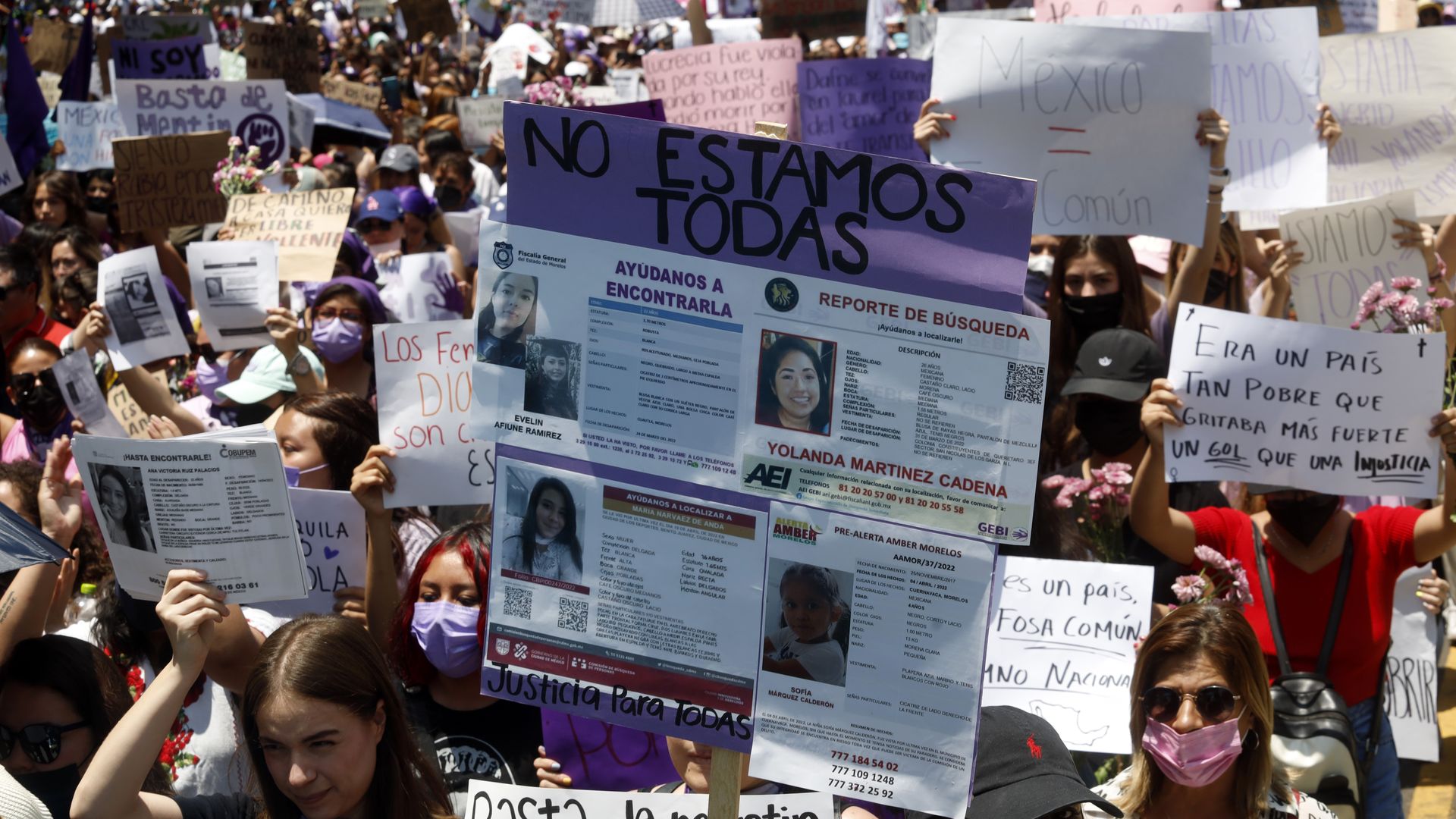
Protesters in Mexico City hold signs with print-outs of missing women reports on April 24. Photo: Luis BarrĂłn/Eyepix Group/Future Publishing via Getty Images
1. Mexico’s Human Rights Commission ordered the government yesterday to prioritize the disappearances of women and femicides after massive protests on Sunday.
- Protesters demanded greater action after 18-year-old Debanhi Escobar, who went missing two weeks ago, was found dead in northern Monterrey, the capital of Nuevo LeĂłn state.
- Escobar's parents accused authorities of not working fast enough on cases of missing women.
- Ten to 11 women are murdered in Mexico every day because of their gender, according to UN data. About 400 women have gone missing this year in Nuevo LeĂłn, which borders Texas.
2. The Organization of American States said Nicaragua remains a full member of the regional body and will be held to its democratic obligations until the end of 2023, after the Central American nation attempted an express exit from the hemispheric group.
- Daniel Ortega’s government on Sunday announced that its planned withdrawal from the Washington-based OAS was effective immediately, despite a charter specifying exiting the group is a two-year long process.
- Ortega’s government also revoked the credentials of representatives to the OAS, including ambassador Arturo McFields, who broke with and denounced Ortega as a “dictator” in March.
- Ortega initially mentioned his exit plans in November after the organization criticized elections in which most candidates were jailed and he was elected to a fourth straight term.
1 smile to go:🦿From junk to prosthetics

A mechanical engineer is helping amputees in Colombia by repurposing scrap metal to make prosthetics that they can have for free, Marina writes.
Details: Juan Salcedo has built prosthetic limbs for 15 years with the motto, “We make junk walk.”
- The parts are sourced from scrap yards or from donations. Those unusable for a prosthetic are sold to help pay for more materials.
- Over 350 people have benefited through the FundaciĂłn Fuente de Esperanza (spring of hope foundation).
- Salcedo decontaminates, sands down and shapes old car parts, pipe tubes and other materials himself: each prosthetic leg requires about 16 tons of junk metal and eight days work.
- The prosthetics are modular, so worn down parts can be switched out without having to replace the whole.
Thanks for reading! If you like Axios Latino, tell a friend to subscribe!
Sign up for Axios Latino

Keep tabs on the stories that most affect the U.S. Latino community on both sides of the border, a collaboration with Noticias Telemundo.