Axios Indianapolis

July 29, 2025

It's Tuesday. Stay safe and cool, friends.
☀️ Today's weather: Mostly sunny and hot, with a high near 95 and heat index values as high as 100.
🎂 Happy birthday to our Axios Indianapolis member Kathy Harbaugh!
⛽ Fuel the stories that matter most to you by becoming an Axios Indianapolis member today.
Today's newsletter is 941 words — a 3.5-minute read. Edited by Lindsey Erdody.
1 big thing: Indiana public broadcasting cuts
Federal funding cuts to public broadcasters have delivered a devastating blow to the 17 public media stations in Indiana and the journalists who work at them.
Why it matters: The cuts will undoubtedly impact station programming.
- Indiana Public Broadcasting Stations has already announced it will eliminate its eight-person statewide reporting team at the end of the year after the state cut its funding for the stations, too.
State of play: The federal cuts were included in a sweeping rescissions package meant to claw back more than $9 billion, including nearly $1.1 billion in funding for the Corporation for Public Broadcasting through 2026 and 2027.
Yes, but: While the cuts target the Public Broadcasting Service and National Public Radio, the national organizations won't feel much of the impact.
- Only around 1% and 15% of NPR's and PBS' national revenue comes through CPB, respectively, with most funding coming from grants, corporate sponsors and viewer/listener donations.
- The majority of federal funding is allocated to local member stations, which use it for day-to-day operations.
Threat level: Hundreds of local stations nationwide are expected to scale back or shut down, especially in rural areas where they are often the only source of local news.
Zoom in: WFYI, the Indianapolis public broadcasting station, is reporting that federal cuts total up to $13 million from the Indiana stations.
- WNIN in Evansville is facing a 37% budget cut. Tim Black, the station's chief executive, told NPR the loss of federal funding would be "pretty darn close to being catastrophic."
Catch up quick: The federal cuts are particularly brutal for Indiana stations, which lost their state funding — more than $3.5 million annually — earlier this year.
- Between state and federal funding cuts, some stations now face budgets slashed in half.
2. Here's how many journalists cover your town

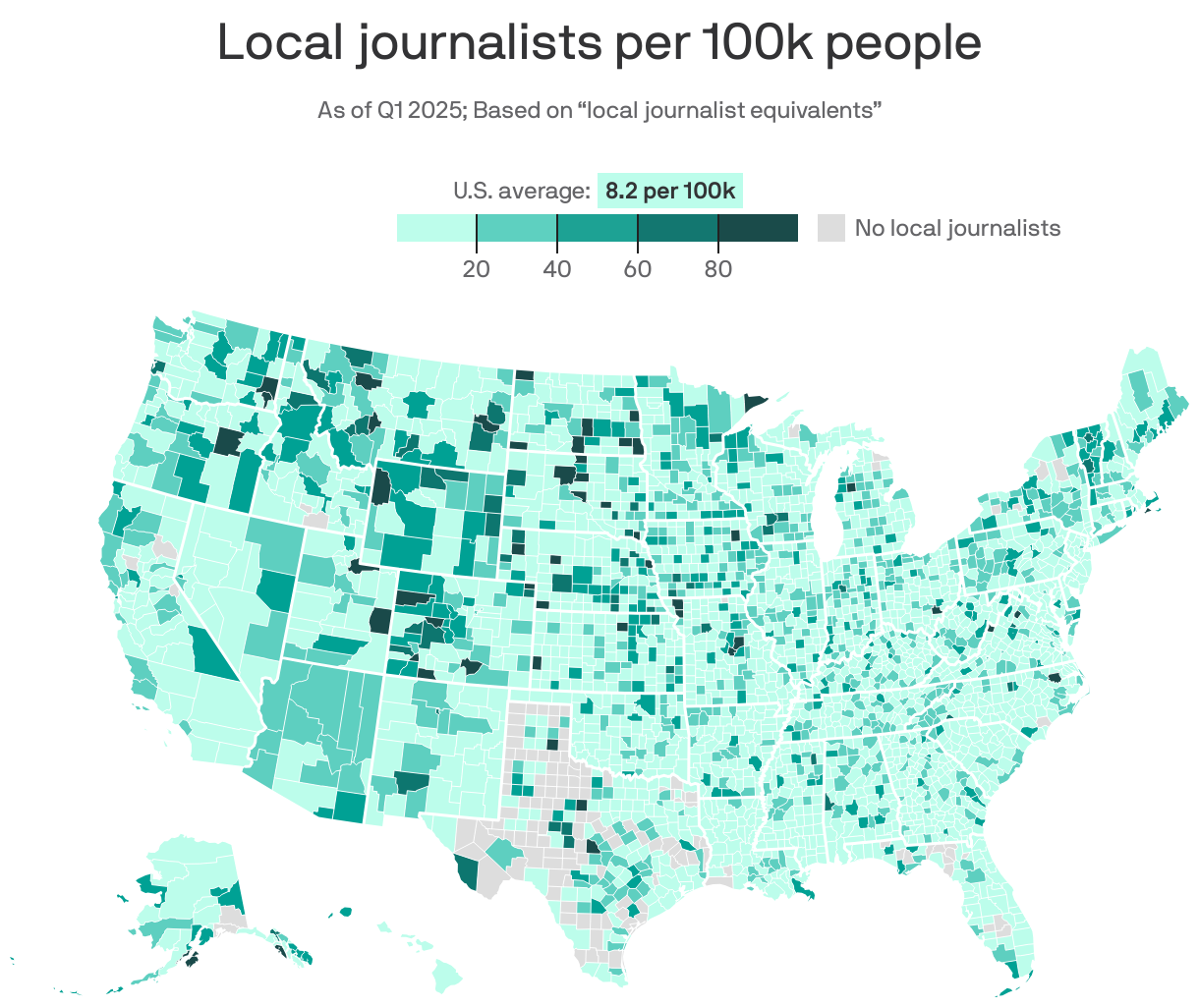
The U.S. has lost about 75% of its local journalists over the last two decades, according to an ambitious new project aiming to illustrate "the stunning collapse in local reporting" as old business models falter and newsrooms scramble for sustainability.
Why it matters: Many American neighborhoods lack adequate news coverage for everything from school board meetings and elections to local sports and cultural events — a problem likely to be exacerbated by cuts to public media.
Driving the news: The U.S. now has 8.2 "local journalist equivalents" (LJEs) for every 100,000 people, according to the Local Journalist Index 2025 from Muck Rack and Rebuild Local News, a local journalism nonprofit.
How it works: The findings are based on Muck Rack's data about journalists and media outlets nationwide, used to show reporters "most likely covering local communities."
- The result is the "local journalist equivalent" — a metric similar to "full-time equivalent," which accounts for part-time employees when measuring the size of a workforce. (Read more about the methodology.)
Zoom in: As a state, Indiana is doing slightly better than the national average with 8.8 LJEs for every 100,000 Hoosiers, according to the analysis, but your access to local news varies widely depending on where you live.
- More than a dozen counties have no local journalists left.
Between the lines: This isn't a purely rural phenomenon, either.
- The state's three most populous counties, Marion, Lake and Allen, have fewer LJEs than the state average, meaning that while top stories will likely be covered, neighborhoods may still lack reliable information on issues like schools, municipal candidates and community improvement efforts.

3. Indy hospitals rank among state's best
Three Indianapolis-area hospitals rank among the best in the state, according to a new U.S. News & World Report analysis.
The big picture: The annual list released Tuesday evaluates more than 4,400 hospitals nationwide across 15 adult specialties and 22 procedures and conditions to determine the best of the best.
- This year, 504 hospitals were recognized with a 2025-26 "Best Regional Hospital" designation from the organization.
Zoom in: U.S. News assessed 161 hospitals in Indiana. Here are the six that performed well enough to be named a Best Regional Hospital and how they ranked.
1. Community Hospital in Munster
2. Indiana University Health Medical Center in Indianapolis (tied)
2. Franciscan Health in Indianapolis (tied)
4. Deaconess Hospital in Evansville
5. Ascension St. Vincent Hospital in Indianapolis
6. Parkview Regional Medical Center in Fort Wayne
Yes, but: None of Indiana's hospitals cracked the national top 50 rankings in any specialty.
4. Pit stop: City closing FSQ camp
⛺️ The city is shutting down a homeless encampment near Fountain Square, effective Aug. 11, closing the area to camping after neighbors raised concerns. (WISH-TV)
🛣️ A neighborhood organization is calling for Indy's robust trail system to expand on the south side, where there are fewer miles of paved trails than other parts of Marion County. (Mirror Indy)
♻️ Beech Grove may be the cleanest community in the state. It's the first to achieve the top award in a program aimed at making more sustainable and resilient places to live. (IndyStar)
💰 Indiana wants more flexibility in how it can spend federal education dollars generally earmarked for low-performing schools and specific programming, like supporting students learning English. (Chalkbeat Indiana)
5. Indy gets a taste of the Korean food explosion

Korean food — ranging from the fine cuisine that wins James Beard awards to the gooey corn dog cheese pulls trending on TikTok — is surging in popularity across the U.S.
Why it matters: Although most Asian restaurants in America serve Chinese, Japanese or Thai food, there's clearly an appetite for more Korean restaurants.
Catch up quick: First came Korean fried chicken. Then, kimchi turned into a go-to condiment, and ready-to-use Korean barbecue sauces hit shelves, says Tim Fires, president of global food service at market research firm Circana.
- Now you can buy Korean corn dogs at Costco. "That's when you know it's hit mainstream."
Our picks:
✊ Arika is sending support to her friends in public media. We need more journalists in our communities, not less.
🦸 Justin is excited to see what cool cosplays show up at Gen Con 2025 after the insane stuff fans made for this year's San Diego Comic-Con.
😍 Lindsey is obsessing over her wedding photos.
Sign up for Axios Indianapolis