Axios Generate

June 26, 2025

1 big thing: Climate out, chaos in as a clean energy driver
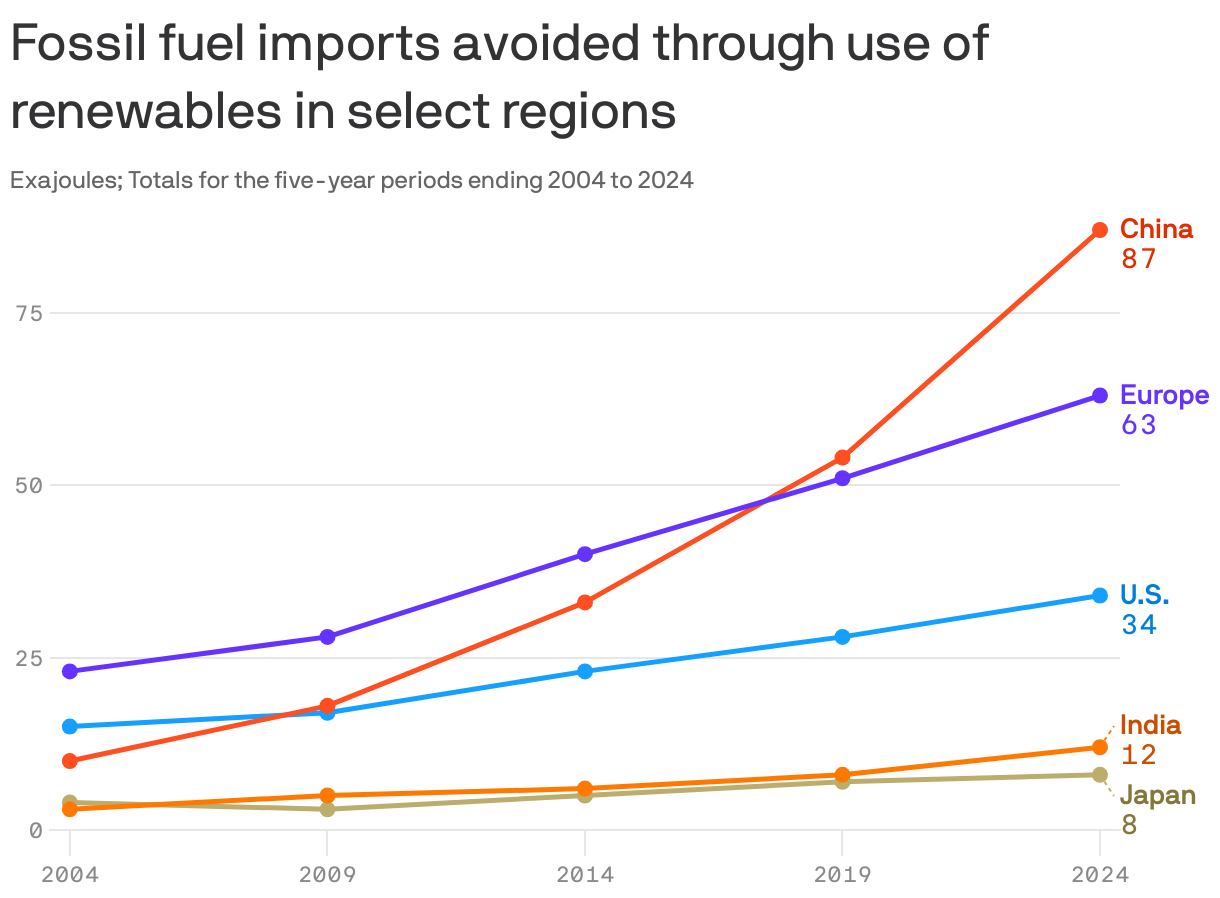
Global upheavals — from supply chain woes to wars — may increasingly spur countries to replace some fossil-fuel imports with homegrown electrons, a new report finds.
Why it matters: "2024 may well become seen as a beginning of a paradigm shift," the latest Statistical Review of World Energy finds.
- The energy transition is becoming "increasingly associated with a need to deliver energy security through energy independence to protect countries from the types of shocks and uncertainty that such events bring."
The intrigue: It goes through 2024, but the idea is consistent with an emerging — if contrarian — school of thought about the Trump 2.0 era.
- While President Trump isn't interested in global warming and renewables, his foreign and trade policies could make him an accidental climate hawk, the thinking goes.
- I recently highlighted Bloomberg columnist Liam Denning's piece: "Trump Is Cementing the Green Energy Transition He Loathes."
The big picture: "Investment in renewables in particular is increasingly being seen as a cornerstone of energy security, enabling countries to disconnect their energy systems from global fuel markets and geopolitical tensions," the World Energy report says.
- It cites Russia's war on Ukraine, Mideast tensions, COVID, extreme weather and more.
- That take is part of the huge annual data review from The Energy Institute, Kearney and KPMG.
Reality check: Displacement of imported fossil fuels with renewable power is concentrated in select markets and a "largely untapped opportunity" elsewhere.
- Major energy importers — including Japan and South Korea — have made much less progress, it finds.
- And overall global demand for coal, oil and gas is still rising.
Friction point: Trump's pullback from traditional alliances, trade wars, and use of fossil fuels as trade chips will help push countries toward domestic electricity sources, Denning writes.
- And don't forget veteran Carlyle analyst Jeff Currie's paper declaring the "New Joule Order."
- It similarly argues that risk and trade concerns — not climate policy — are driving countries to seek domestic sources instead of global commodities.
My thought bubble: A related trend is low-carbon sectors like renewables and hydrogen adapting their domestic messaging to the Trump era.
- You hear much less about climate and much more about how they can help the U.S. become "energy dominant."
- For instance, check out the American Clean Power Association's statement on the Senate's version of the budget reconciliation bill.
The bottom line: Sure, there's a case for Trump 2.0 — and the wider geopolitical landscape — creating momentum abroad for renewables and nuclear on security grounds.
- But that's just a piece of the picture, which also includes Trump dismantling domestic incentives, foreign aid, and leaving the Paris Agreement again.
/2025/06/25/1750887196403.gif?w=3840)
3. 👟 Catch up quick on policy: mining and AI


4. 🤔 Why BP takeover speculation won't go away


Shell's firm denial that it's eyeing acquisition of BP may tamp down chatter of a blockbuster deal for now — but it won't end speculation about BP's fate as long as it underperforms its Big Oil rivals.
Catch up quick: Hours after the WSJ's buzzy scoop yesterday about "early stage" talks, a Shell spokesperson said, "This is further market speculation. No talks are taking place."
- "As we have said many times before we are sharply focused on capturing the value in Shell through continuing to focus on performance, discipline and simplification," the company said.
- It also circulated execs' past comments about using capital to buy back shares, and the company's high bar for outside acquisitions. BP did not comment.
Yes, but: The idea of a Shell-BP mega-merger has been floating around for a while.
- BP has trailed Shell's and TotalEnergies' performance among European-headquartered giants.
- And Big Oil has gotten bigger among U.S. multinationals, with Exxon's roughly $60 billion acquisition of Pioneer Natural Resources that closed last year, and Chevron's efforts to acquire Hess.
What they're saying: "A combination could be the first step toward improving the valuations of the combined company" and boosting free cash flow, Rob Thummel, senior portfolio manager at Tortoise Capital, said in emailed comments about a Shell-BP tie-up.
- BP has recently pivoted back toward its core oil and gas business and gotten more selective about renewables, a move Thummel said recognizes its "core strengths."
- He notes BP's "top tier" assets in the Gulf of America (formerly the Gulf of Mexico), among other holdings.
The bottom line: I asked Thummel whether Shell's comments will put merger speculation to rest. He doesn't think so, noting BP trades at a "cheap valuation."
- "However, the ideal buyer for the various assets that BP owns might not be one company."