Axios Generate

June 10, 2025

✅ Tuesday. We're opening today's edition with a look at climate risks at home, then stepping out for a tour of the news, all in 1,157 words, 4.5 minutes
🎶 Rest in peace to Sly Stone, who passed away at 82. His visionary talent animated work including today's intro tune...
1 big thing: Minority homeowners face higher climate risks

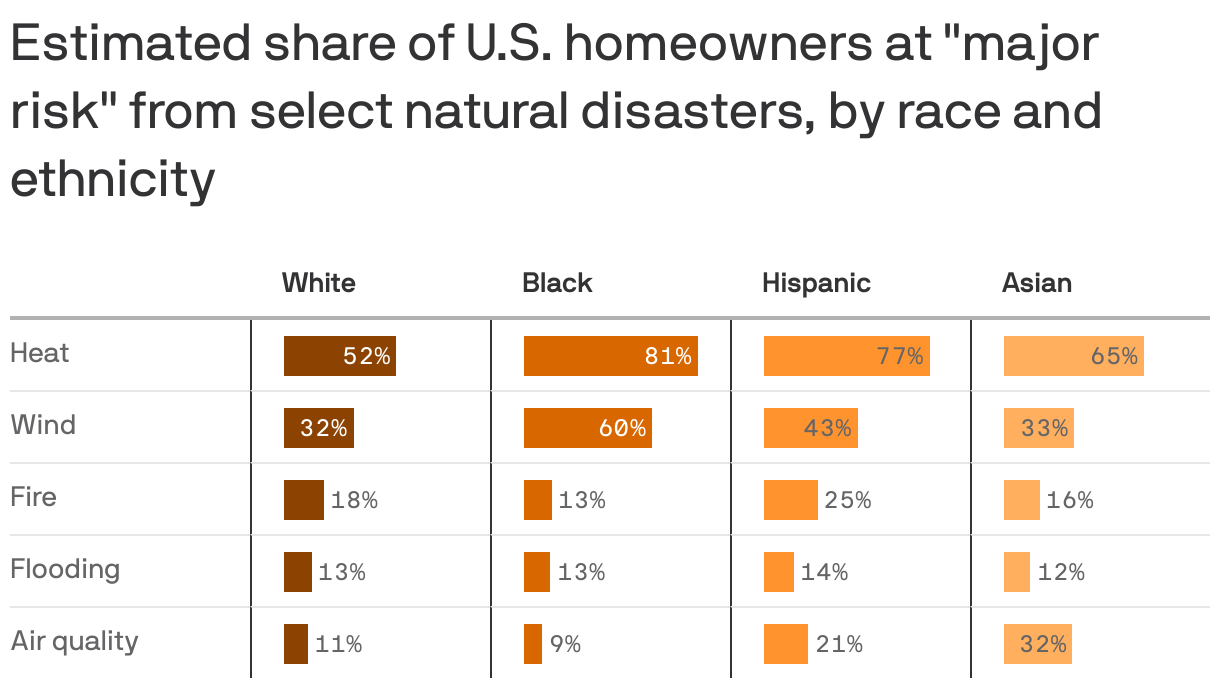
Minority homeowners are particularly vulnerable to certain major climate risks, a Zillow analysis finds.
Why it matters: The findings reflect history and a legacy of redlining and economic disparities that still shape where people live — and how they're affected by climate change.
By the numbers: Nationally, 81% of Black homeowners, 77% of Hispanic homeowners and 65% of Asian homeowners are at risk of extreme heat, compared to 52% of white homeowners, Zillow found.
- Meanwhile, 60% of Black homeowners, 43% of Hispanic homeowners and 33% of Asian homeowners are vulnerable to extreme wind, compared to 32% of white homeowners.
- Some 32% of Asian homeowners and 21% of Hispanic homeowners are vulnerable to poor air quality, compared to 11% of white homeowners and 9% of Black homeowners.
How it works: Zillow's analysis is based in part on climate risk data for homes listed for sale on the platform, using risk modeling techniques from First Street.
- It doesn't include renters, who also face various climate risks.
- See the full methodology here.
Between the lines: Some of the nationwide figures are a result of history and geography, says Zillow senior economist Kara Ng.
- For example: Black homeownership rates are higher in the South, where extreme heat is more common compared to other regions.
Zoom in: Some cities have especially stark differences between groups for certain climate risks.
- In New Orleans, for example, about 95% of Asian homeowners, 92% of Black homeowners and 86% of Hispanic homeowners are vulnerable to flooding, compared to 76% of white homeowners.
The bottom line: Climate risk is making home ownership more expensive due to rising insurance, energy and repair costs, Ng notes in her analysis — adding that vulnerable homes often take longer to sell and go for less money.
- "These impacts have the potential to widen the racial wealth gap and further set back minority groups that historically have been financially disadvantaged," she writes.
2. 🌎 More climate notes: EPA, oceans, insurance
👀 EPA is on the cusp of formally launching repeal of Biden-era power plant CO2 rules.
- The latest: The White House Office of Information and Regulatory Affairs completed its review of the plan on Friday, online records show.
- What we're watching: As EPA moves into the weeds of scuttling Biden-era rules, likely court challenges will test the agency's legal spadework.
🌊 France and COP30 host Brazil used the UN Oceans Conference that opened yesterday to launch the "Blue NDC Challenge," which urges countries to "place the ocean at the heart of their climate plans." Full announcement.
👋 Insurance giant Munich Re is the latest financial heavyweight to bail on various industry climate coalitions.
- State of play: It's leaving the Net Zero Asset Owner Alliance, the Net Zero Asset Managers Initiative, Climate Action 100+ and the Institutional Investors Group on Climate Change.
- Friction point: "We observe an increasing ambiguity in assessing private initiatives under the legal and regulatory regimes across various jurisdictions, potentially resulting in conflicting regulatory requirements and related legal uncertainty," Munich Re said in a wider statement.
3. ⚛️ On my screen: nuclear advice for Trump and the World Bank

📈 The U.S. needs a "nuclear operation warp speed" — named after the Trump 1.0 COVID vaccine initiative — to enable 20 gigawatts of new nuclear capacity by 2035, analysts with Columbia's energy think tank write.
- Why it matters: Their Foreign Policy essay notes rising power demand and also warns that America's "geostrategic influence and national security are undermined by ceding nuclear leadership to Russia and China."
- State of play: Trump's recent orders on nuclear can help if implemented well, but aren't enough, the piece argues in calling for new legislation and executive steps around costs, licensing and more.
- Friction point: One priority is overcoming the "mismatch between a nuclear plant's 60- to 80-year lifespan and the 30-year cost recovery period expected by financial markets."
- What we're watching: It lays out a menu of policy ideas like the milestone-based payment system NASA used to jumpstart the private space sector. Check out the whole thing.
👍 The World Bank should lift its ban on nuclear energy finance, the Energy for Growth Hub argues in a new primer on the closely watched consideration that could come to a head soon.
- What's next: The World Bank's board will consider the topic at a meeting today, per the Hub, which carefully tracks the bank's work.
- The big picture: One reason to act is because most energy demand growth "will be among World Bank client countries in Asia, Middle East, and Africa that are open to nuclear power but still require financing."
- Threat level: Absent financing from trusted institutions, countries will rely on state-backed Russian and Chinese deals that are "often opaque, long-term arrangements that undermine sovereignty and energy security."
👀 Speaking of nuclear, Axios Pro Deals' Alan Neuhauser has a smart look at Westinghouse's reported interest in building 10 new large-scale reactors in the U.S.
- Friction point: Part of the optimistic case is that industry regained muscle memory during the very over-budget Plant Vogtle build in Georgia. But investors and utilities are leery of repeating America's last nuclear misadventure.
4. 🏃 Catch up quick on the IRA battle
Senate Republicans face new and crosscutting pressures as they craft their version of the House "one big beautiful bill" that vastly pares back IRA tax credits.
The latest: The conservative House Freedom Caucus is pressing the Senate to deepen cuts to the Democrats' big 2022 climate law, per a new memo that Punchbowl News obtained.
The other side: Some moderate Republicans in both chambers want to soften the House plan. Clean tech sectors are lobbying heavily and pointing out that lots of IRA investments are flowing to red states and districts.
What we're watching: The Senate Finance Committee, which has yet to produce its plan on IRA tax policies.
5. ⛅ Quote of the day: dimming sunlight edition
"The US residential solar market is in flux. And while proposed terminations on both 25D and 48E (for residential solar loans only) are still just that — proposals — the uncertainty alone appears to be impacting consumer and investor confidence."— Jefferies analysts in a note on turbulence in the residential solar market amid Capitol Hill threats to tax credits
Why it matters: Expect more headwinds for the residential sector after what's already been a very troubled stretch.
- Sunnova and home solar loan company Solar Mosaic both filed for Chapter 11 bankruptcy in recent days, following several other bankruptcies last year in a tough economic market for the tech.
- Jefferies notes volatile movements in other solar stocks. It's not clear if the Senate will soften House plans to scuttle incentives.
The bottom line: Challenging market conditions, combined with the threat of lost federal tax credits, are crushing rooftop solar companies in the U.S., Axios Pro's Katie Fehrenbacher reports.
6. 🧮 Number of the day: Roughly 67%
That's the share of 46 gigawatts of announced U.S. reactor plans — largely aspirational, to be sure — that would serve tech companies, per the research firm ClearView Energy Partners.
Why it matters: "[T]echnology companies may be among a narrow field of players with the financial wherewithal and risk tolerance sufficient to pursue new advanced reactors," it said in a note.
📧 Did a friend, colleague or an AI chatbot send you this newsletter? Welcome, please sign up.
🙏 Thanks to Chris Speckhard and Chuck McCutcheon for edits to today's edition, along with the brilliant Axios Visuals team.
Sign up for Axios Generate