Axios Generate

August 14, 2025

🏊 Let's dive right into a newsy 993 words, 3.5 minutes.
🤖 Axios' AI+ Summit returns to Washington, D.C., on Sept. 17, featuring Anthropic co-founders Dario Amodei and Jack Clark, AMD CEO Lisa Su, White House AI advisor Sriram Krishnan & more. RSVP here.
🎸 This week marks 50 years since the underrated Rod Stewart released the album "Atlantic Crossing," which provides today's rollicking intro tune...
1 big thing: New budget law is quickly changing the energy economy

Fresh data points reveal how the new budget law's looming phaseout of renewable and EV subsidies is quickly shaking up markets for those sectors.
Why it matters: The energy world is awash in predictions about the law's future effects — but facts on the ground are now changing, too.
Driving the news: "EV incentives soared in July, as automakers and dealers worked to move inventory prior to the decline in government support," per Kelley Blue Book analysis.
- The average package soared to 17.5% of the average EV transaction price, up 40% year-over-year, as the industry braces for credit access to vanish on Oct. 1.
- Initial estimates show July EV sales were the second-highest monthly ever, up 20% YOY, as a predicted sales boost ahead of the deadline is materializing.
State of play: On the renewable front, separate new analysis finds that prices in U.S. power purchase agreements (PPAs) are already up 4% since the law's passage. PPAs are often used in the sector to speed project development and financing.
- The new law creates new hurdles for wind and solar projects. To tap credits, they must start construction by early July 2026 or start operating by the end of 2027.
- The law also creates other new restrictions, and all told, the list of eligible projects is shrinking, per the study from clean energy marketplace company LevelTen Energy.
- There's also fresh uncertainty. Treasury's implementation plans are looming as the agency is under White House pressure to take a hard line that limits access.
Friction point: The 4% rise is "the clearest signal yet that the market has already begun to reprice in light of these new risks and headwinds," the report states.
What's next: Even higher costs for the kinds of deals that often help large companies pursue sustainability goals.
- "Buyers that move now can still access projects priced well below what's expected in the quarters ahead," the report states.
The bottom line: Love it or hate it, the law is reshaping U.S. energy and transport economics after just a month — and it's still early days.
Disclosure: Kelley Blue Book is owned by Cox Automotive, a subsidiary of Cox Enterprises, which is the majority owner of Axios.
2. 👀 Gaming out the U.S.-Russia meeting and more policy notes

🛢️ There are energy tensions to spare as President Trump prepares to meet with Vladimir Putin tomorrow in Alaska.
- What we're watching: Failure to make progress might move the White House closer to secondary tariffs on buyers of Russian energy, though Trump's appetite for this beyond recent threats to India is uncertain. "Clearly, there's upside risk for the market if little progress is made," ING's Warren Patterson said in a note.
- The intrigue: There's friction between Trump's European trade deal — which secured commitments to boost U.S. energy purchases — and Putin's interest in sanctions relief under any peace agreement, per RBC Capital Markets' Helima Croft.
- Friction point: "[W]e continue to see US energy diplomacy as an obstacle to a near-term settlement of the Russia-Ukraine war, as we are not sure that Putin will accept any agreement that does not entail a path to regaining access to what had been the country's most valuable export market," she writes in a note.
⛏️ Several DOE offices are seeking proposals for up to $1 billion in funding for various kinds of projects to boost domestic critical minerals and supply chains.
🚛 Via The Hill, "The Federal Trade Commission (FTC) has declared that an emissions agreement between California and four major truck makers is 'unenforceable' — paving the way for noncompliance with the Golden State's pollution rules, which are stricter than federal standards."
3. 🇺🇸 Mapped: where the data centers are heading
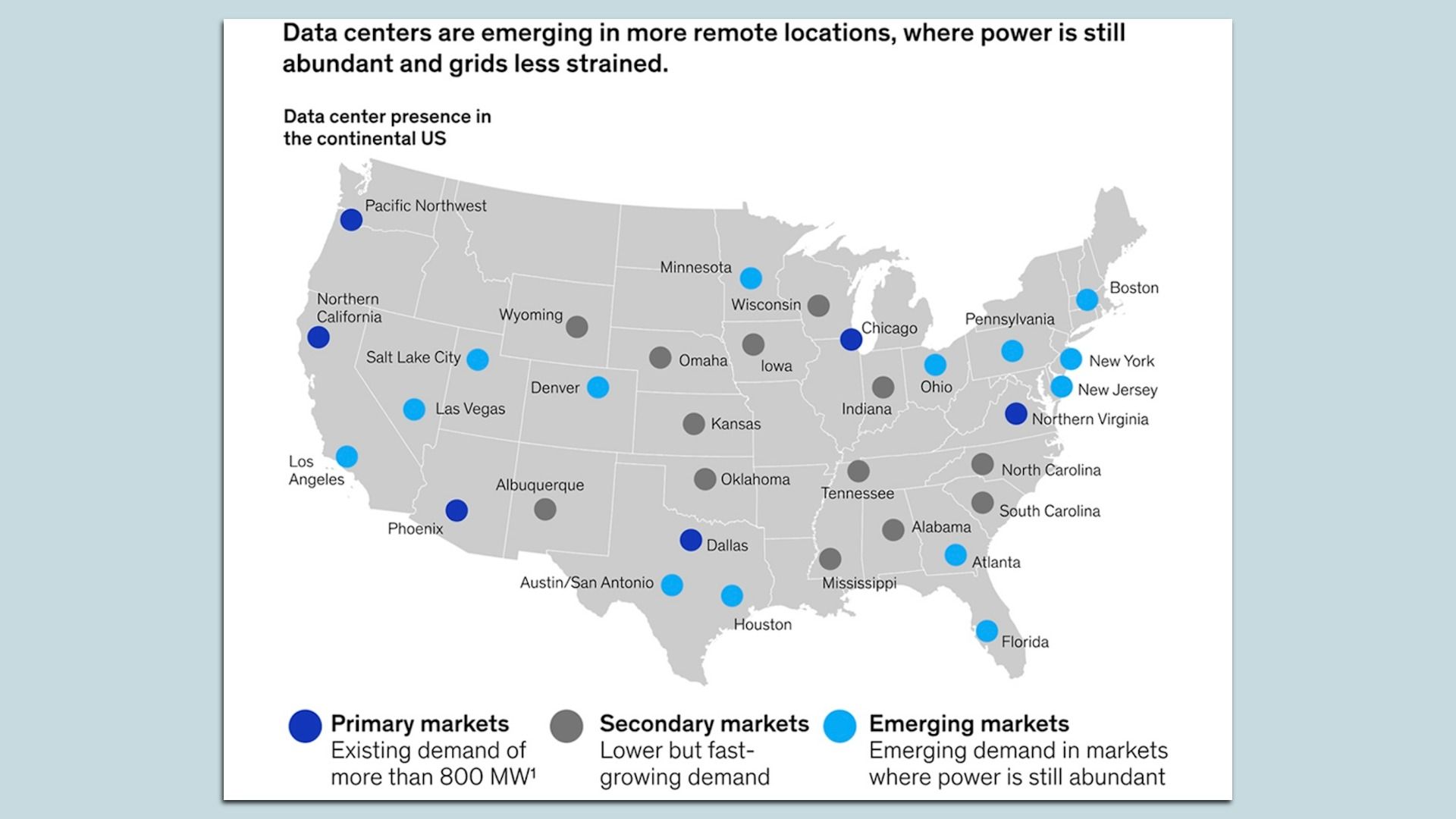
Hyperscalers are "turning to secondary, high-potential and emerging markets" as the primary data center regions are getting saturated, new McKinsey analysis finds.
Why it matters: The report finds that states can reap major financial and employment benefits but must plan for grid strains, demands on water supplies for cooling, public backlash and other problems.
4. 🏃 Catch up quick on extreme weather

⚔️ Air conditioning is a new political battleground in France, the NYT reports, amid record-setting heat there and elsewhere in Europe.
- "Decades ago, bickering over air-conditioning might have seemed strange in Europe, where there was historically little need for it," the NYT notes. But the continent is warming.
🌡️ Climate change made the heat wave that gripped Norway, Sweden and Finland last month, straining health and social services, about 2°C hotter, the research group World Weather Attribution concludes.
🔥 Canada is living through its second-worst wildfire season on record, CBC reports.
- "More than 7.3 million hectares [18 million acres] have burned this year so far, more than double the 10-year average for this time of year," it reports, citing government data.
5. 💬 Quote of the day: COP30 chaos edition
"This COP risks being the most exclusionary in the history of the UN climate convention."— Claudio Angelo of the Brazilian NGO Observatorio do Clima
That comes in Bloomberg's piece with wild info about the sky-high lodging costs and scarcity in Belém, the Brazilian city where the annual UN talks occur in November.
Why it matters: Activists and developing country delegations say the problems risk effectively keeping them sidelined.
6. 🧮 Number of the day: roughly 94%
That's the share of peak load growth in the PJM region from 2024-2030 that's slated to come from data centers, per a new letter to stakeholders from the grid operator's board chairman.
Why it matters: That data point helps inform the decision to begin crafting new policies for incorporating large loads while ensuring adequate power supplies. Go deeper
📧 Did a friend send you this newsletter? Welcome, please sign up.
🙏 Thanks to Chuck McCutcheon and Chris Speckhard for edits to today's edition, along with the brilliant Axios Visuals team.