
Axios Generate

June 12, 2025

🧑🍳 We've got a broad menu today, but it's light, too, at just 1,267 words, 5 minutes.
🎙️ Bulletin: President Trump will sign legislation today that thwarts California's rule to phase out sales of gasoline-powered cars and some other state vehicle policies, a White House official confirmed. AP has more.
🎶 Rest in peace to Brian Wilson, the Beach Boys visionary whose talent shines on with today's intro tune...
1 big thing: Chuck Schumer's strategy to save the IRA
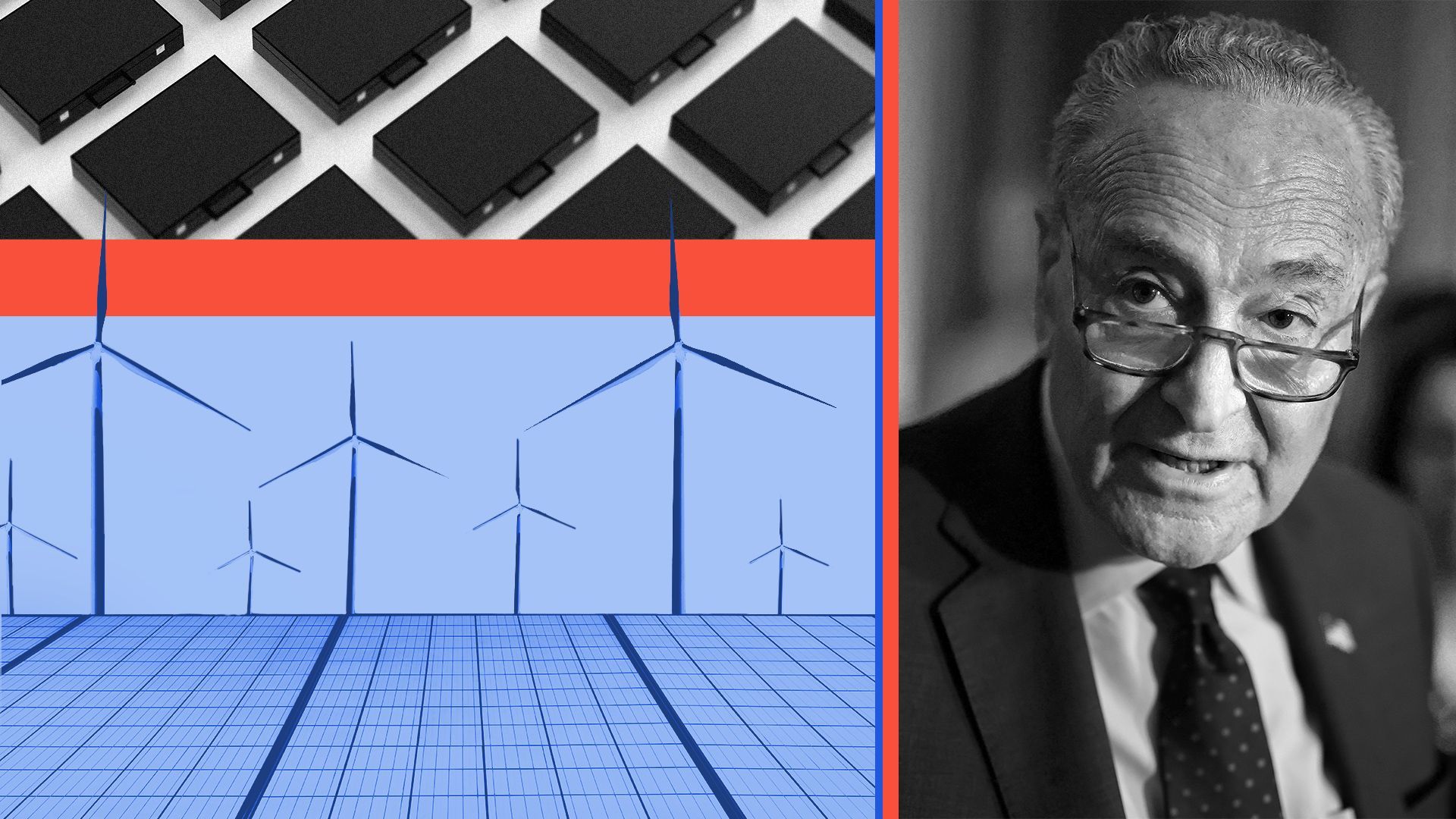
The Senate's top Democrat tells Axios he's activated a multi-pronged strategy to salvage the 2022 climate law that he helped craft.
Why it matters: Minority Leader Chuck Schumer sees multiple pressure points to counter House-passed GOP legislation that largely halts the Inflation Reduction Act's unprecedented low-carbon energy tax credits.
- Schumer said 16 GOP senators — whom he didn't name — may be open to persuasion, and he's assembled a team of eight Democrats who have "good relationships" with them to lobby.
"We want a critical mass of Republicans to go to [Majority Leader John] Thune and say, 'You've got to change this, because I'll lose thousands of jobs in my state,'" he said in an interview.
- Democrats are citing analyses, like this one from the firm Energy Innovation, that show IRA-linked jobs and investments flowing heavily to red states.
- There are also efforts to have Democratic governors lobby GOP governors. The pitch is heavy on consumer cost arguments and the risks of ceding clean tech sectors to China, too.
The intrigue: Schumer is looking to leverage bipartisan interest in U.S. AI leadership.
- "We've gone to the AI industry and said, 'You say you need more energy. Why would you cut off the quickest, cheapest way to get more energy to the grid?'"
- He pointed to a recent letter from the Data Center Coalition — which includes Google, Meta, Microsoft and Amazon — to Thune arguing that tax "certainty" is needed.
- There's also collaboration with green groups, low-carbon energy associations, and unions on lobbying efforts.
Friction point: Schumer hopes Democrats' floor strategy can produce changes before the bill gets that far.
- "We are going to have a lot of amendments that are going to be very difficult for Republican senators to vote against," he said. "That helps them push their leadership to do something so they can avoid the painful vote."
- "Then we have another bite at the apple in the House," Schumer noted.
The other side: Republicans are confident they can get the bill to President Trump's desk, even as some acknowledge it may take longer than initially expected.
What we're watching: The Senate Finance Committee, which has yet to release its version of the budget plan's tax provisions.
- Its text will be the next tangible sign of whether Senate Republicans will make big changes to the House plan.
Reality check: It's tough to see how the IRA emerges from the reconciliation fight without getting significantly pared back.
- The White House and many top Republicans call it a "green new scam" and say the law's hundreds of billions of dollars in subsidies are wasteful.
The bottom line: "I've been spending 24/7 for the last few weeks, just doing everything I can to keep some, if not all, of the improvements we made in the IRA," Schumer said.
2. 🏭 The CO2 stakes of EPA's power plant repeal


The future of that orange line ☝️ will depend in part on EPA's new proposal to block any carbon emissions limits on power plants — and the legal battles sure to follow when it's finalized.
Why it matters: EPA didn't just start the process of undoing Biden-era CO2 rules yesterday — it went much further.
- The agency is "proposing to make a finding that GHG emissions from fossil fuel-fired power plants do not contribute significantly to dangerous air pollution," the plan states.
What we're watching: If the courts uphold the plan, "it could free the government from legal requirements to regulate climate emissions from other stationary sources such as refineries and industrial facilities," E&E News reports.
- But EPA also floated a narrower alternative.
3. 🛢️ Geopolitical risk roars back into crude markets


Crude oil prices surged yesterday amid rising Middle East tensions before retreating slightly today.
Threat level: RBC Capital Markets' Helima Croft said in a note that the region's multi-year war hasn't hampered regional energy supplies.
- But Croft said: "It is worth remembering that Iran and its proxies did target tankers, ports, and critical energy infrastructure such as Saudi Arabia's Abqaiq facility in 2019 in response to Washington's re-imposition of maximum pressure sanctions."
4. The World Bank's next steps on nuclear
Generate readers probably saw this, but just in case: the World Bank's board yesterday ended the institution's longtime ban on nuclear energy finance.
Why it matters: The bank and other multilateral development banks are important funders of development projects and can also provide technical aid and other assistance.
Catch up quick: Bank president Ajay Banga, in an email to staff, said the bank would work with the International Atomic Energy Agency on nonproliferation safeguards.
- "Together with the IAEA and other partners, we will support efforts to extend the life of existing reactors in countries that already have them, and help support grid upgrades and related infrastructure," he wrote.
- It would also work to "accelerate the potential" of small modular reactors, states the memo obtained by Axios.
What they're saying: "The next step is for the World Bank to quickly build a team of nuclear experts," Todd Moss, founder and executive director of the Energy for Growth Hub, tells me.
- "Fortunately, the US Congress has already introduced legislation supporting the creation of a nuclear technology trust fund at the World Bank," said Moss, a former State Department official and bank adviser who has long called for ending the ban.
What we're watching: "Another big next step: other development banks can now follow suit allowing them to co-finance reactors together," he said via email.
- "I'm especially watching the Asian Development Bank since the opportunities for deploying next generation nuclear in that region are huge."
Go deeper: World Bank ends its ban on funding nuclear power projects (NYT)
5. 🧁 Bonus nuclear notes: Amazon and startups
🤝 Amazon is expanding — and revamping — its power deal with Talen Energy for output from the Susquehanna nuclear plant in Pennsylvania to eventually provide 1.9 gigawatts through 2042.
- The intrigue: They're moving away from their current 300 megawatt arrangement to have Amazon directly tap the plant's power, with Talen noting "transition to a 'front-of-the-meter' arrangement after the completion of transmission reconfigurations expected in the Spring of 2026."
- State of play: A Talen investor deck about the deal notes that it "de-risks" the collaboration and doesn't need FERC approval. Investors like it so far, with Talen's stock jumping nearly 8% on the news.
- What we're watching: The companies said they would also explore building small modular reactors at the Susquehanna site.
🐣 The nuclear fuel company Standard Nuclear, Inc., is emerging from stealth with $42 million in funding led by Decisive Point, with other money from Andreessen Horowitz, Washington Harbour Partners, others.
- State of play: Its "reactor agnostic" product is "tiny uranium-bearing spheres encapsulated by successive layers of carbon and ceramic-based materials," it said.
- The intrigue: The company isn't entirely new but instead "built on assets purchased at auction following the bankruptcy of the Ultra Safe Nuclear Corporation," TechCrunch reports.
6. 🧮 Number of the day: +29.5%


Small modular reactor startup Oklo Inc.'s share price jumped 29.5% yesterday.
State of play: The company said the Defense Department had made a preliminary selection of Oklo to provide power to the Eielson Air Force Base in Alaska.
- The Sam Altman-backed startup also announced a $400 million share offering yesterday.

7. 💬 Quote of the day: LNG edition
"The rapid growth you are seeing right now in LNG exports is going to shrink our trade deficits with all of our key trading partners."— Energy Secretary Chris Wright
He spoke to reporters as DOE touted four 20-year agreements between JERA, Japan's largest power generator, and U.S. LNG exporters.
State of play: The plans total up to 5.5 million tons per year.
- They're purchase and sales agreements with NextDecade Corp. and Commonwealth LNG, and earlier-stage plans with Cheniere and Sempra Infrastructure.
- Deliveries would start around 2030, per Reuters, which has much more reporting from Tokyo.
📧 Did a friend, colleague or an AI chatbot send you this newsletter? Welcome, please sign up.
🙏 Thanks to Chris Speckhard and Chuck McCutcheon for edits to today's edition, along with the brilliant Axios Visuals team.
Sign up for Axios Generate


