Axios Generate

May 12, 2025

🐣 The week is hatching with lots of market and policy news. We've got you covered in just 915 words, 3.5 minutes.
🎙️ Bulletin: Energy Secretary Chris Wright told Fox News that today DOE will make 47 changes, "mostly just straight out eliminations," to rules on dishwashers, shower heads and more.
🎸 Dire Straits' "Brothers in Arms" turns 40 years old this week and provides today's intro tune...
1 big thing: Markets vs. memes on U.S. oil output
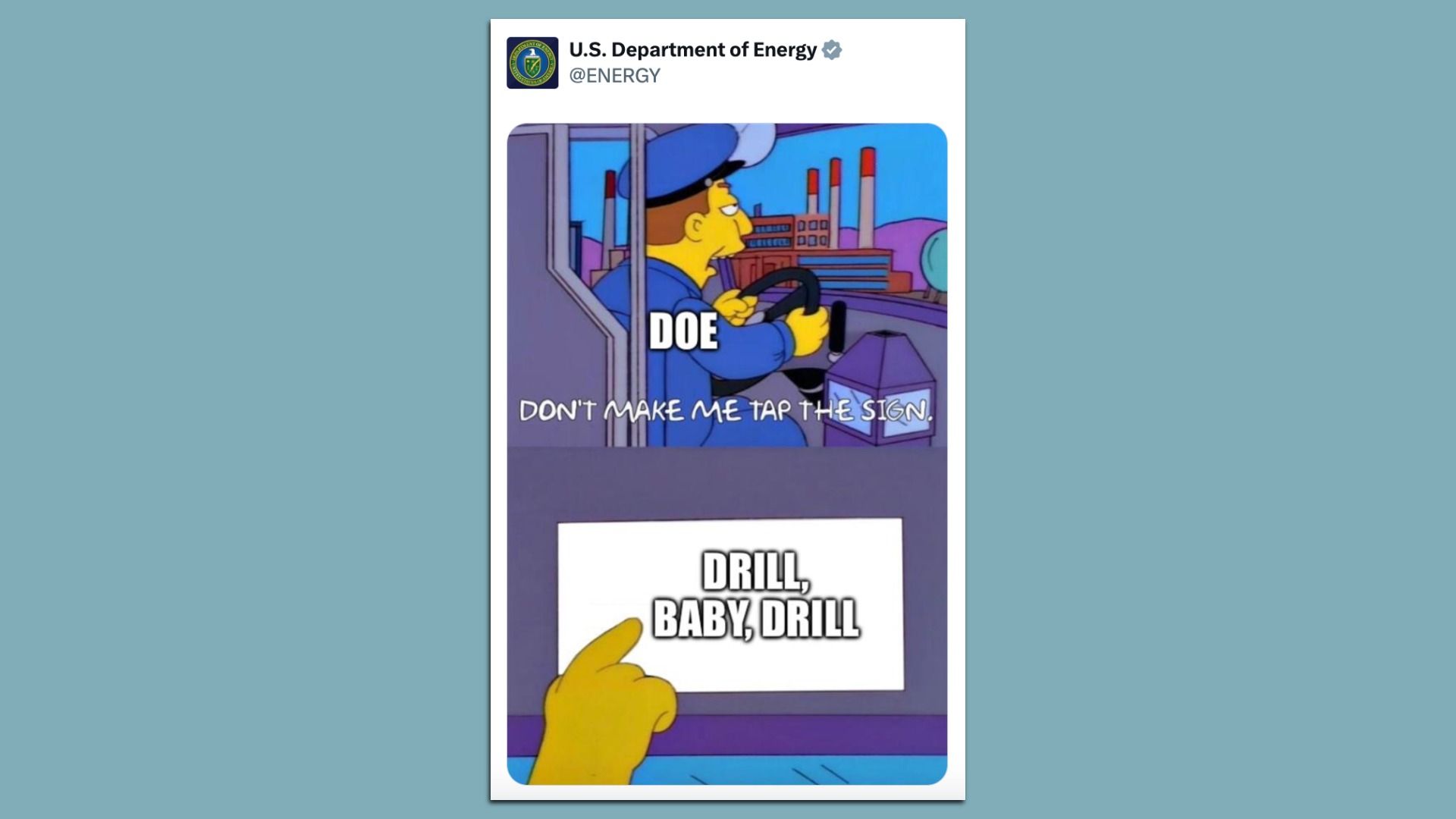
DOE used a classic "Simpsons" meme Saturday to promote "drill, baby, drill," but new analysis shows the challenge of making it stick outside of Springfield.
The latest: U.S. crude production should drop slightly next year, S&P Global Commodity Insights said today.
- The firm also revised its global demand growth estimate down sharply.
Why it matters: The production forecast — in S&P's first such outlook since the April 2 tariff rollout — would be the first year-over-year U.S. decline in roughly a decade aside from the 2020 COVID crisis.
- Yes, the dip it envisions is pretty small and would follow modest growth this year.
- But it's nonetheless a shift at a time when President Trump is vowing to "unleash" U.S. energy.
The big picture: "A price-driven decline in U.S. production would be a pivot point for the oil market — and set conditions for a potential price recovery," S&P VP Jim Burkhard said in a statement.
- "But much will depend on the severity of an economic slowdown and the impact on demand growth beyond 2025," he said.
The intrigue: It's all fluid! Crude prices jumped this morning on news U.S. and China will slash their tariffs on each other for 90 days.
- The U.S. benchmark WTI gained 4%, trading around $63.46 per barrel.
State of play: The accelerated increase in OPEC+ barrels and economic headwinds from trade wars are prompting bearish predictions from S&P and others.
- S&P now sees global demand growing 750,000 barrels per day (bpd) this year, down from their prior estimate of 1.25 million.
- Its findings are based on Brent crude averaging in the mid-to-low $60s per barrel for the remainder of this year, with WTI in the $60s or high $50s.
- There's additional risk if trade tensions don't cool and OPEC+ keeps quickly unwinding production curbs.
How it works: S&P sees U.S. crude production averaging 13.46 million bpd this year, about 250k above 2024.
- While shale production is fairly nimble, responses to price changes still have a lag time, and new barrels from offshore wells and other long lead time projects are less price-sensitive, S&P notes.
- But next year it sees output dipping to 13.33 million bpd.
What we're watching: How various analyses shift in months ahead with the never-a-dull-moment changes in trade friction.
- The International Energy Agency's next supply and demand outlook drops Thursday.
2. ⏰ It's crunch time for the IRA in Congress

House Republicans are showing their cards on bills to scuttle Biden-era energy and climate policies and replace them with their own priorities.
Why it matters: The changes are part of budget "reconciliation" measures that are immune from filibuster in the closely divided Senate.
- They would also put various Trump 2.0 efforts into statute, giving them more legal backing.
Driving the news: The Energy and Commerce Committee unveiled far-reaching plans to rescind billions of dollars in IRA grant and loan finance via EPA and DOE.
- The draft bill unveiled late last night ahead of tomorrow's markup would also block vehicle emissions and mileage rules.
State of play: The bill provides $2 billion for the Strategic Petroleum Reserve, mostly for new oil purchases but some for repairs.
- It also has several permitting changes aimed at providing what an aide called "investment certainty" and expedited review for natural gas and other projects.
- One of them dictates that DOE "shall deem" LNG export applications to major markets in the public interest.
- Another section adds new user fees that speed up FERC reviews of gas pipeline and LNG projects, and limits judicial review.
Catch up quick: Last week, the House Natural Resources Committee approved its portion of the bill that includes expanded oil and gas leasing.
What we're watching: The fate of tax subsidies for low-carbon equipment manufacturing, energy projects, EV sales and more that together are the heart of the 2022 climate law.
What's next: Tomorrow, the tax-writing Ways and Means Committee is scheduled to start marking up its portion of the wider reconciliation package, but the energy tax piece remains unreleased this morning.
3. 🧁 Bonus policy notes: Permitting, LNG, carbon
⚖️ Fifteen state Democratic AGs sued President Trump and other officials, alleging "emergency" energy permitting under a January exec order illegally skirts "critical ecological, historical, and cultural resource review."
- Why it matters: They're asking a federal court to call the EO unlawful and to thwart permits and other actions under it.
👍 FERC issued a supplemental report that finds Venture Global's proposed CP2 LNG project would bring "no significant cumulative air quality impacts."
- Why it matters: It brings the export project closer to a final investment decision.
💵 Via the NYT, "The White House has ordered federal agencies to stop considering the economic damage caused by climate change when writing regulations, except in cases where it is 'plainly required' by law."
4. 🔌 Number of the day: 166,000+ megawatts
That's the potential peak power demand this summer in grid manager PJM's massive region that spans parts of the Midwest and mid-Atlantic coast.
Why it matters: That "extreme planning scenario" tally is the first time in PJM's annual summer outlooks that generation capacity "may fall short of required reserves," it said.
- But PJM is expecting a much lower peak of around 154,000 megawatts, and and there are adequate reserves to meet it, the outlook states.
- Full analysis.
5. 💬 Quote of the day: wind jeopardy edition
"This is an urgent and unsustainable situation that we are in right now with Empire Wind 1."— Molly Morris, president of Equinor Renewables Americas, speaking to E&E News
Why it matters: She tells the outlet that Equinor may have to terminate the project very soon unless Trump officials lift their stop-work order, citing $50 million per week in costs.
📧 Did a friend, colleague or an AI chatbot send you this newsletter? Welcome, please sign up.
🙏 Thanks to Chris Speckhard and Chuck McCutcheon for edits to today's edition, along with the brilliant Axios Visuals team.
Sign up for Axios Generate