
Axios Generate

August 11, 2025

🎒We're heading toward back-to-school season with Cliffs Notes on climate policy, oil, power prices and more, all in 1,123 words, 4 minutes.
📻 Happy birthday to singer-songwriter Joe Jackson, who has today's intro tune...
1 big thing: The climate work emerging in Trump's shadow

So hot right now: initiatives outside of government in response to Trump 2.0 officials pulling back climate science and data programs.
Why it matters: The federal government historically does research and produces climate data that's widely used by academics, local governments, companies and others. But outside groups are stepping forward.
A few projects that caught my eye...
⚠️ The National Academy of Sciences just launched a "fast-track" review of the latest evidence on how greenhouse gases threaten human health and welfare.
- It's a response to EPA's planned revocation of its 2009 "endangerment finding" that's the legal underpinning of Clean Air Act climate rules.
🔢 The new Cornerstone Sustainability Data Initiative, co-led by a former EPA researcher, is an open-source hub for info corporations use to tally supply chain emissions.
- The project — unveiled Friday — comes after EPA decided to stop supporting the in-house research that many companies use, the NYT reports.
🧑🔬 This fall, the American Geophysical Union and the American Meteorological Society will issue a formal call for manuscripts on climate change in the U.S.
- It will be the next step in their planned initiative, launched in May, to "sustain the momentum" of the next National Climate Assessment.
- That's the congressionally mandated, multiagency report series that faces an uncertain future under Trump 2.0.
🥊 Many veteran climate scientists are "launching a coordinated response" to DOE's new report that challenges mainstream academic views on climate impacts, CNN reported.
Reality check: Scientists aren't claiming they can replace projects like the NCA with these ad hoc efforts.
- And obviously the National Academy can't regulate emissions in response to EPA's pullback, though I wouldn't be shocked to see its new work surface in court battles.
The other side: Trump officials say Democratic policies variously downplay domestic costs of emissions regulations and overstate climate threats.
What we're watching: Energy Secretary Chris Wright tells CNN that "we'll probably have public events here in D.C. this fall" about DOE's report.
- DOE didn't provide more info, and several of the report's authors tell Axios they're not aware of anything coming up. But co-author Steven Koonin thinks it's a good idea.
- "At the right time, I personally think a public forum highlighting points of scientific agreement and disagreement would have a salutary effect on the public and political dialogue about these issues," he said via email.
2. 🏃 Catch up quick on business: CO2 capture, Big Oil, lithium

🕵️ Steel, mining and energy giants today announced a consortium to explore CO2 capture and storage "hubs" across Asia.
- Why it matters: Companies involved include BHP, ArcelorMittal Nippon Steel India, Chevron, Mitsui & Co and others.
🛢️ Oil and gas majors are "stepping up their hunt" for new reserves, the FT reports in a new feature.
- Why it matters: It's happening as a "slower than expected transition to clean energy sets the stage for stronger fossil fuel demand for decades to come," per the FT.
🔋 Via Bloomberg, lithium prices and stocks shot up today after battery giant CATL halted operations at a large Chinese mine.
- Why it matters: The move is "spurring speculation that Beijing might move to suspend other projects as it tackles overcapacity across the economy," the news service reports.
3. 👀 A big week for oil markets awaits
The next few days will bring a mix of oil market-moving data and geopolitical info.
What's next: The latest supply and demand outlooks from OPEC and DOE's independent stats arm both land tomorrow.
- Then the International Energy Agency's latest report arrives Wednesday.
Friction point: All eyes Friday will be on Trump's meeting with Russian President Vladimir Putin.
- Trump last week announced 25% tariffs on India over its purchases of Russian oil as the White House seeks leverage for a cease-fire in Ukraine.
- But the plan, which would bring U.S. tariffs on the country to 50%, doesn't take effect until Aug. 27.
What they're saying: "Clearly pricing will be choppy for some time until we get a firmer picture of the likelihood of any Ukraine peace deal, as well as next steps on India within the 21 day reprieve period," Sparta Commodities analyst Neil Crosby said in a note.
What we're watching: Friday's meeting, of course. But also potential secondary sanctions against China, the largest buyer of Russian barrels.
- Vice President JD Vance, in a Fox News interview that aired yesterday, said Trump hasn't made a firm decision.
- "The China issue is a little bit more complicated, because our relationship with China ... affects a lot of other things that have nothing to do with the Russian situation," Vance said.
4. ♣️ The oil stakes of Trump's Russia strategy
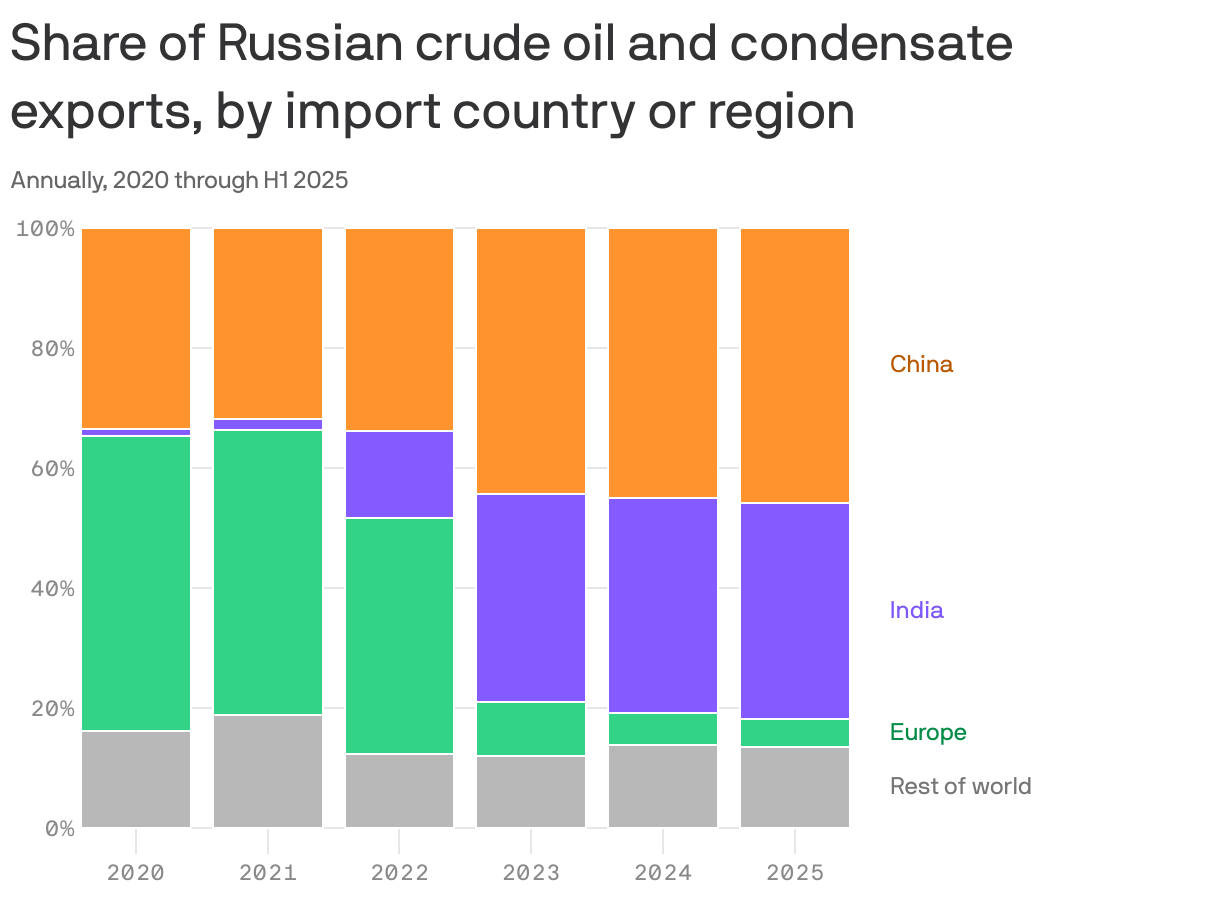
India's imports of Russian oil have soared since the invasion of Ukraine as Europe began shunning Kremlin-backed barrels, and China's purchases have climbed too.
5. 💵 Power costs rise amid data center boom

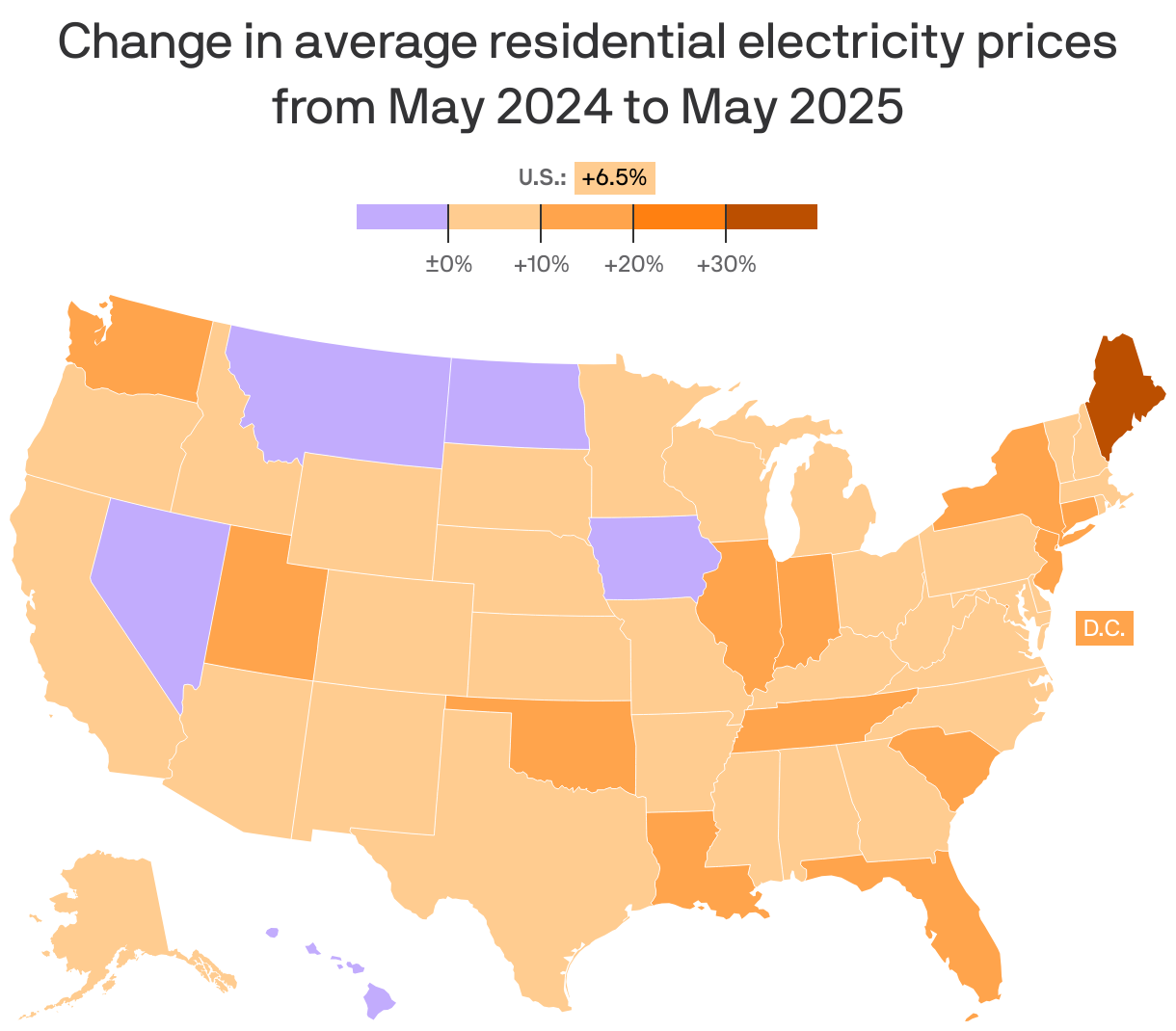
Electricity costs are rising nationwide — and could get even higher for some amid the explosion in data centers powering AI and more.
Why it matters: Surging power bills could further stress many Americans' budgets as pretty much everything else gets more expensive, too.
By the numbers: The nationwide average retail residential price for 1 kilowatt-hour of electricity rose from 16.41 cents to 17.47 cents between May 2024 and May 2025, per the latest available data from the U.S. Energy Information Administration, a gain of about 6.5%.
- Some states saw much larger increases, such as Maine (+36.3%), Connecticut (+18.4%) and Utah (+15.2%).
- Just five states saw a decrease, including Nevada (-17.7%) and Hawai'i (-7%).
Between the lines: Electricity prices vary regionally and have many influences, from basic supply and demand to fuel rates and infrastructure costs.
- Yet many analysts point to power-hungry data centers as a driver of rising rates, especially in data center hotspots.
- That's partly because of data centers' immediate demand for energy, but also because of investments in new transmission lines and other gear to handle their expected proliferation — costs passed along to customers.
The bottom line: Many of us are paying for the AI boom, whether we use the tech or not.
6. 🧮 Number of the day: -46%
The research firm Wood Mackenzie's estimate of newly installed U.S. rooftop solar capacity in 2030 is a whopping 46% below its projection before the new budget law.
Why it matters: Killing the investment tax credits makes home solar systems less affordable, states the analysis, and a separate summary predicts more industry bankruptcies.
What's next: It nonetheless projects the market will start growing again in 2028, and finds"substantial" long-term growth despite huge near-term hurdles.
- 7.5% of "suitable" owner-occupied U.S. homes had solar systems at the end of 2024.
📧 Did a friend send you this newsletter? Welcome, please sign up.
🙏 Thanks to Chuck McCutcheon and Chris Speckhard for edits to today's edition, along with the brilliant Axios Visuals team.
Sign up for Axios Generate