Axios Generate

April 16, 2025

🐪 Halfway there! We'll get you over the hump with a quick but informative 1,380 words, 5 minutes.
🎸 Happy birthday to Peter Garrett, frontman of conscience-rockers Midnight Oil, who have today's intro tune...
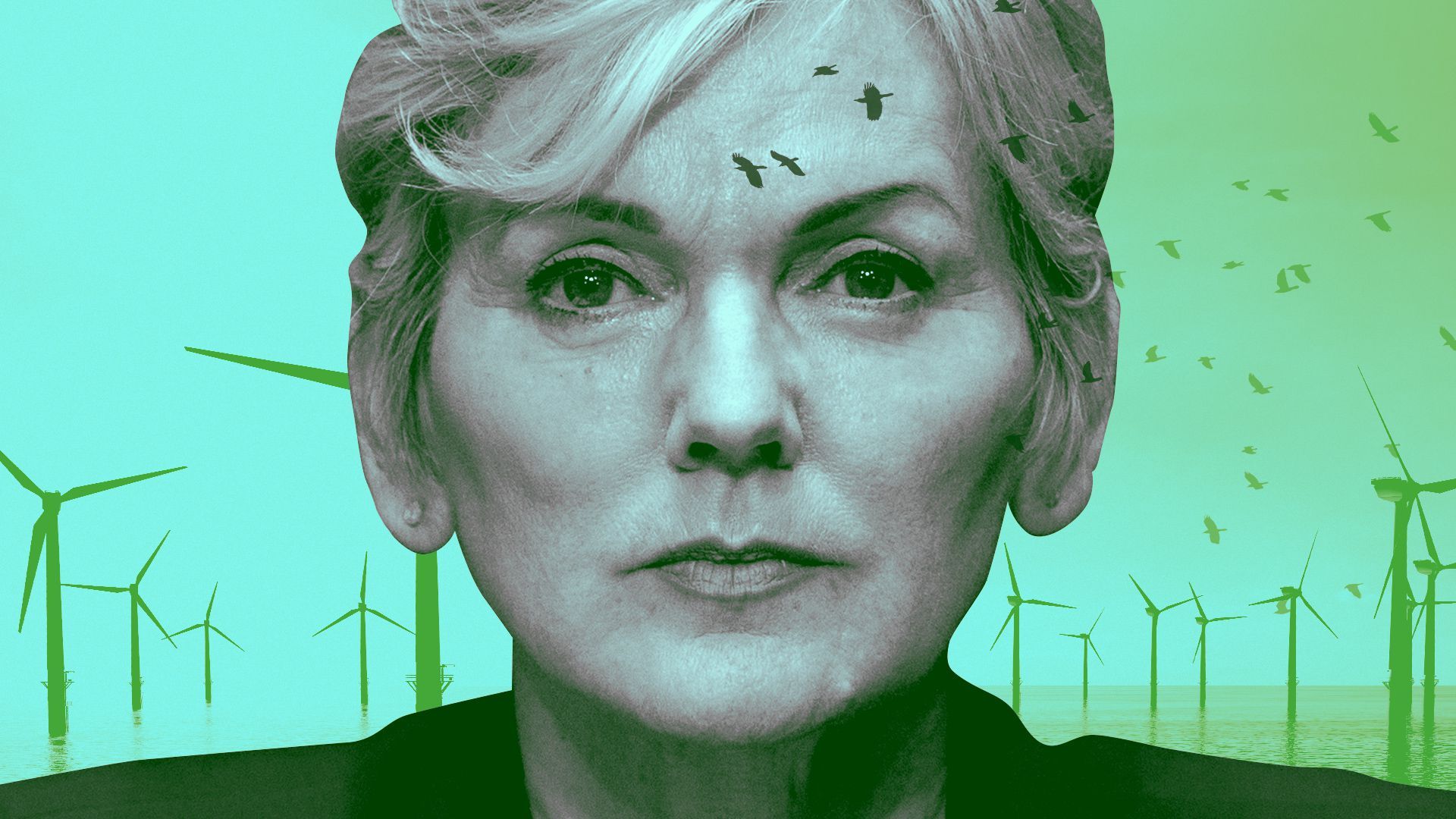
1 big thing: Granholm sells energy dominance — with tax credits

Jennifer Granholm has a message for global energy companies: Now's the time to invest in the U.S.
Why it matters: As Energy secretary, Granholm — who just joined DGA Group as a senior counselor — oversaw the dramatic expansion of DOE programs that Trump officials are targeting for sweeping cuts and office closures.
- But President Trump's broader energy-dominance agenda can still flourish as long as the IRA's energy tax credits are kept largely intact, Granholm told Axios.
What she's saying: "What I am telling people is that, if these tax credits for manufacturing in the United States stay, and the 10% tariff stays, there is not a better time to locate in the United States if you are looking to do a big [capital expenditure] project," Granholm said.
- New development could be easier, she said, if this Congress addresses permitting legislation. And she noted the Trump administration's openness to using public lands for energy projects.
- She's bullish the administration will continue support for advanced nuclear, enhanced geothermal, and minerals projects that all have gotten bipartisan backing.
Federal incentives spurred hundreds of U.S. factories to announce plans to build or expand, she said — but many still haven't had ribbon-cuttings.
- That means the Trump administration should want to preserve the tax credits because it "can take credit for all of those," she said.
The big picture: Her new counseling role harks back to her job as secretary. It sent her crisscrossing the country to cheer the agency's funding as a win for economic development and jobs.
- Reflecting on last November's Republican trifecta, Granholm said other election-cycle issues crowded out the IRA and IIJA programs, while climate change was "not as high on people's list as how much they're making."
Between the lines: Biden officials like Granholm had reasoned that the bulk of DOE money was safe from Republican cuts because it flowed to red states and congressional districts.
- Today, "I don't have confidence that they're fully safe," Granholm said.
- Republican appropriators on the Hill are open to considering DOGE cuts in the upcoming budget process.
Recent DOE loan disbursements and funding for nuclear fuel supply contracts, however, give her hope.
- Before she left the agency, Granholm had lunch with her successor, Chris Wright, and came away "very hopeful that there would be continuity in many areas."
- "It's a question of who's actually doing the big overall policy and what the administration is focused on," she said.
The bottom line: The appeal to move manufacturing back home has special resonance to Granholm as the Trump White House pursues a full-scale trade war.
- "Tariffs, obviously, are a tool," Granholm said. "But so are carrots."
If you need smart, quick intel on energy and climate policy for your job, get Axios Pro Policy, where this story first appeared.
2. ⚖️ Judge orders Trump to let climate funds flow
A U.S. district judge has ordered several federal agencies to "immediately" resume the flow of nationwide funding under the IRA and the 2021 infrastructure law.
Why it matters: The laws provided unprecedented finance for a wide range of projects, but officials at EPA, DOE, Interior and beyond have halted many funds.
Driving the news: Judge Mary S. McElroy wrote in a preliminary injunction that while a president is entitled to enact his agenda, agencies lack "unlimited authority" to further it.
- "[N]or do they have unfettered power to hamstring in perpetuity two statutes passed by Congress during the previous administration," the Rhode Island judge who President Trump nominated in 2019 wrote in yesterday's order.
Catch up quick: A group of nonprofits and the National Council of Nonprofits sued a suite of agencies and the White House budget office last month.
- It's among multiple suits unfolding against Trump 2.0 efforts to halt funds under the Biden-era laws.
The other side: Justice Department lawyers argued in a filing that Congress gave federal agencies "broad discretion to select among eligible recipients of funding."
- The agencies are also "entitled to temporarily pause funding for current recipients to determine whether they wish to redirect that funding elsewhere," they wrote.
- The White House did not provide immediate comment.
What's next: McElroy ordered the Trump administration to file a status report on their compliance by late this afternoon.
- Separately, Politico reports that a Washington, D.C., judge is expected to rule today on whether EPA legally nixed $20 billion in climate law grants.
3. 🍰 Bonus policy notes: DOE, minerals, permitting
🧑🎓 A suite of universities sued the Energy Department over a new policy that limits support for "indirect costs" of DOE research funding to 15%.
- Go deeper: Full complaint...NBC coverage...DOE announcement
⛏️ Via the WSJ, "The Trump administration said Tuesday that it is opening an investigation that could result in tariffs on critical minerals, rare-earth metals and the products that use them, such as batteries and consumer electronics.
📝 President Trump issued an executive order telling White House offices and federal agencies to make "maximum use of technology in environmental review and permitting" of energy and infrastructure projects.
4. 🤔 Parsing Trump's European import idea


There's probably room for the EU to buy even more U.S. oil and gas, but the $350 billion target President Trump floated to bargain down new tariffs would be a heavy lift.
Why it matters: Trump sees U.S. fossil fuels as a negotiating point with countries in Europe and Asia — a merger of his trade and "energy dominance" agendas.
Catch up quick: Trump last week focused on more energy exports to end the trade deficit with the EU.
- "They're going to have to buy our energy from us, because they need it," he said in the Oval Office. "They can buy it, we can knock off $350 billion in one week."
Yes, but: EU purchases of U.S. energy are already really big share of U.S, exports (see above), and several analyses crossed my desk that highlight challenges to hitting Trump's $350 billion target.
- Wood Mackenzie's Ed Crooks explores various reasons why even more oil and gas exports can't alone transform bilateral trade balances.
- "[T]he mechanics are challenging," the firm's vice chair for the Americas writes.
- "Countries will need to make commitments to buy more US oil and gas to show that they are not just offering empty promises. In the oil market, refiners and fuel suppliers will generally not want to make those long-term commitments," he writes.
The intrigue: When it comes to LNG, long-term contracts are common, but other challenges remain.
- A smart WSJ piece unpacks why there's "little appetite" to buy more U.S. energy beyond the recent expansions.
- "To reach Trump's $350 billion target means the U.S. would replace most of the EU's other suppliers in Norway, North Africa and the Middle East," Matthew Dalton and Georgi Kantchev report.
Threat level: The WSJ writers and other analysts note that EU officials are wary of again hitching their wagon to a single supplier after the breakup with once-dominant Kremlin-controlled supplies.
What we're watching: The role of energy in U.S.-EU talks now that Trump has paused 20% tariffs (though the 10% levy remains).
5. 🔋 Key battery player plans big expansion and fundraise

Battery materials company Sila plans to build a much larger plant and will raise hundreds of millions of dollars in the coming years to fund it, CEO Gene Berdichevsky tells Axios.
Why it matters: American-made battery materials could see a boost from tariffs and restrictions on critical minerals from China.
Driving the news: Sila announced yesterday that it has started commissioning its silicon anode plant in Moses Lake, Washington.
- It plans to start producing its battery materials in Q3, with qualified production for customers beginning in Q4.
State of play: Berdichevsky says Sila has enough funding to get its Moses Lake plant, at 5 GWh, up and running and generating revenue.
- But to build a much larger 100 GWh "world scale" plant, it would need to raise another round of equity and debt, he adds.
- The new factory could be an expansion of the current site in Moses Lake, provided Sila could get enough electricity to the site, Berdichevsky says.
Unlock the whole story, and talk to our sales team about Axios Pro Deals for a steady diet of scoops and smart analysis.
6. 🧮 Number of the day: 8.6%
That's the research firm BloombergNEF's new projection of data centers' share of U.S. electricity demand in 2035, up from 3.5% today.
Why it matters: "Energy demand growth for data centers will outpace electric vehicles, hydrogen and all other demand classes over the next five years," it estimates.
📧 Did a friend, colleague or an AI chatbot send you this newsletter? Welcome, please sign up.
🙏 Thanks to Chris Speckhard and Chuck McCutcheon for edits to today's edition, along with the brilliant Axios Visuals team.
Sign up for Axios Generate