Axios Generate
April 08, 2025

👨🍳 Today we have a wide but light menu that's just 1,165 words, 4.5 minutes.
🐺 The quasi-revival of the dire wolf (it's complicated) means we're happily giving the Grateful Dead today's on-point intro tune...
1 big thing: Drill, baby, drill takes a backseat — for now
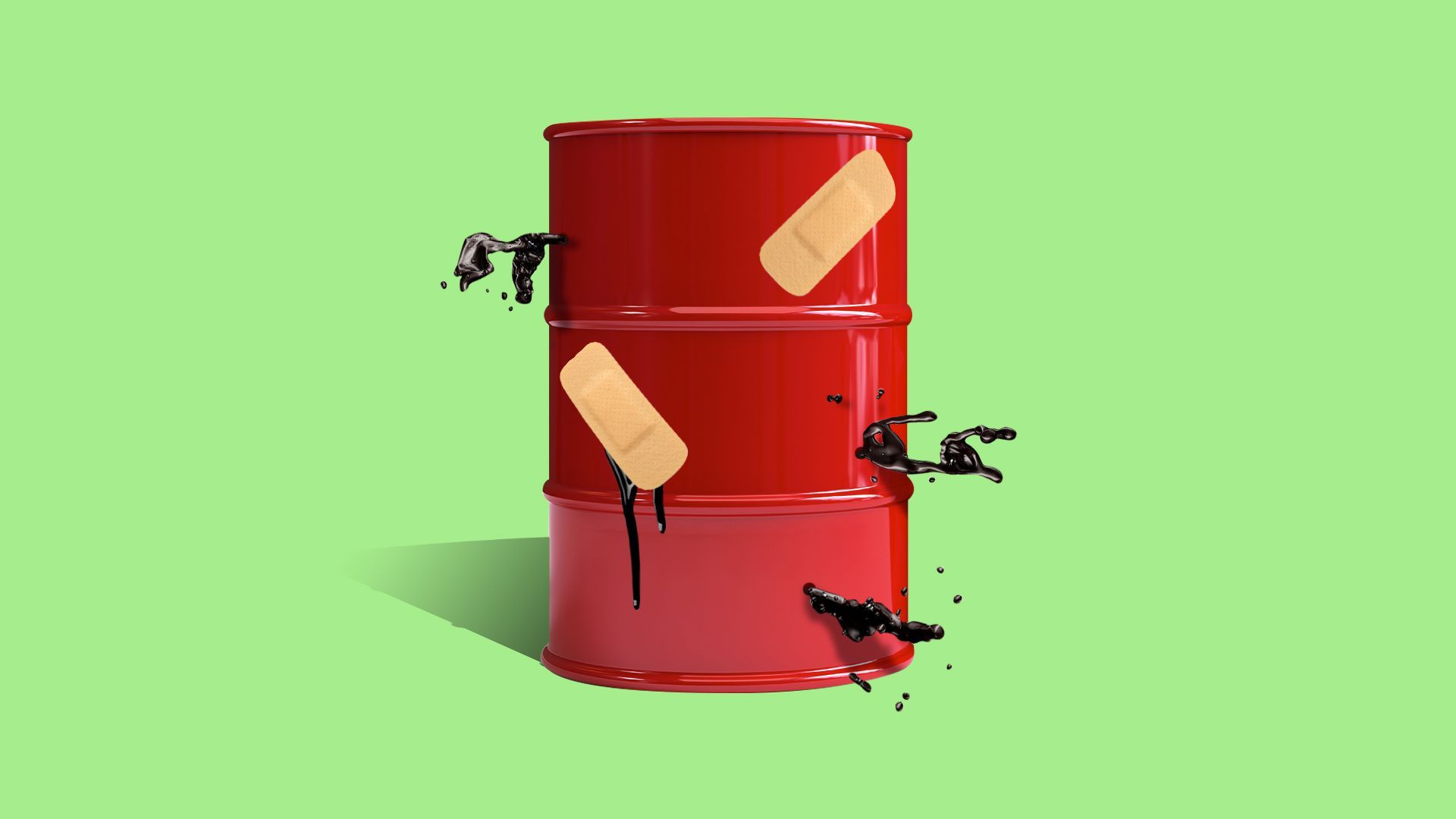
President Trump's social media celebration of falling oil prices highlights how — intentionally or not — his policies favor lowering fuel costs over boosting output. For now, anyway.
Why it matters: The swoon should send consumer gasoline costs downward, which Trump ran on.
- But oil prices are falling into a zone that discourages production growth — especially if a prolonged trade war badly dims the global economic and demand outlook.
Friction point: "The oil industry expected strong support from this White House, but there's no way production will grow at $60" per barrel of West Texas Intermediate crude oil, energy analyst Ben Cahill of UT-Austin tells me via email.
- Exploration and production companies "have to worry about a recession, so they'll take a cautious approach to [capital expenditure] and planning. Production growth is off the table unless the macroeconomic outlook improves," he said.
Yes, but: An Energy Department spokesperson said Trump's lowering energy costs by cutting "red tape."
- "These policies benefit American consumers while also reducing regulatory burdens on energy producers, making it less costly to operate in the United States," the spokesperson said in a statement to Axios.
The big picture: "Drill, baby, drill" is also a long-term idea.
- White House policies aim to expand access to federal lands and ease regulations, which could be bullish for growing production or at least compensating for eventual shale declines.
"'Drill, baby, drill' and 'low fuel prices' don't have to occur simultaneously in Trump's energy agenda," oil expert Ellen Wald said.
- Conventional production can have years-long — or in the case of offshore, even decades-long — planning and development horizons, she notes.
Threat level: Wald nonetheless said the effect of today's trade policies can cloud that long-term development vision.
- She said the economic uncertainty Trump has introduced will lead companies to act conservatively and avoid major capital allocations.
- If Trump wants to have lower fuel costs and promote future drilling, he'll need to reassure execs and investors that he's "taking steps to promote stability and security in the near and longer-term future," she said via email.
State of play: U.S. regular gasoline is averaging over $3.20 per gallon.
- But Patrick De Haan, head of petroleum analysis at GasBuddy, said prices will soon fall as crude slides and recession risks loom.
- Oil prices are at their lowest levels since 2021, with WTI shedding roughly $10 per barrel since April 2 and trading at $61.21 this morning.
What's next: "If tariffs aren't scaled back soon, the national average could fall below $3 per gallon in the weeks ahead, with no clear indication of how long it might stay there as market volatility persists," De Haan said in a blog post.
The bottom line: "[There's] no better way to 'leash' the US oil patch than a trifecta of recessionary demand pullback, greater-than-expected OPEC+ supply, and higher production costs from steel tariffs," Center for Strategic and International Studies oil scholar Clay Seigle tells Axios via email.
2. 🌡️ Last month was Earth's 2nd-warmest March on record
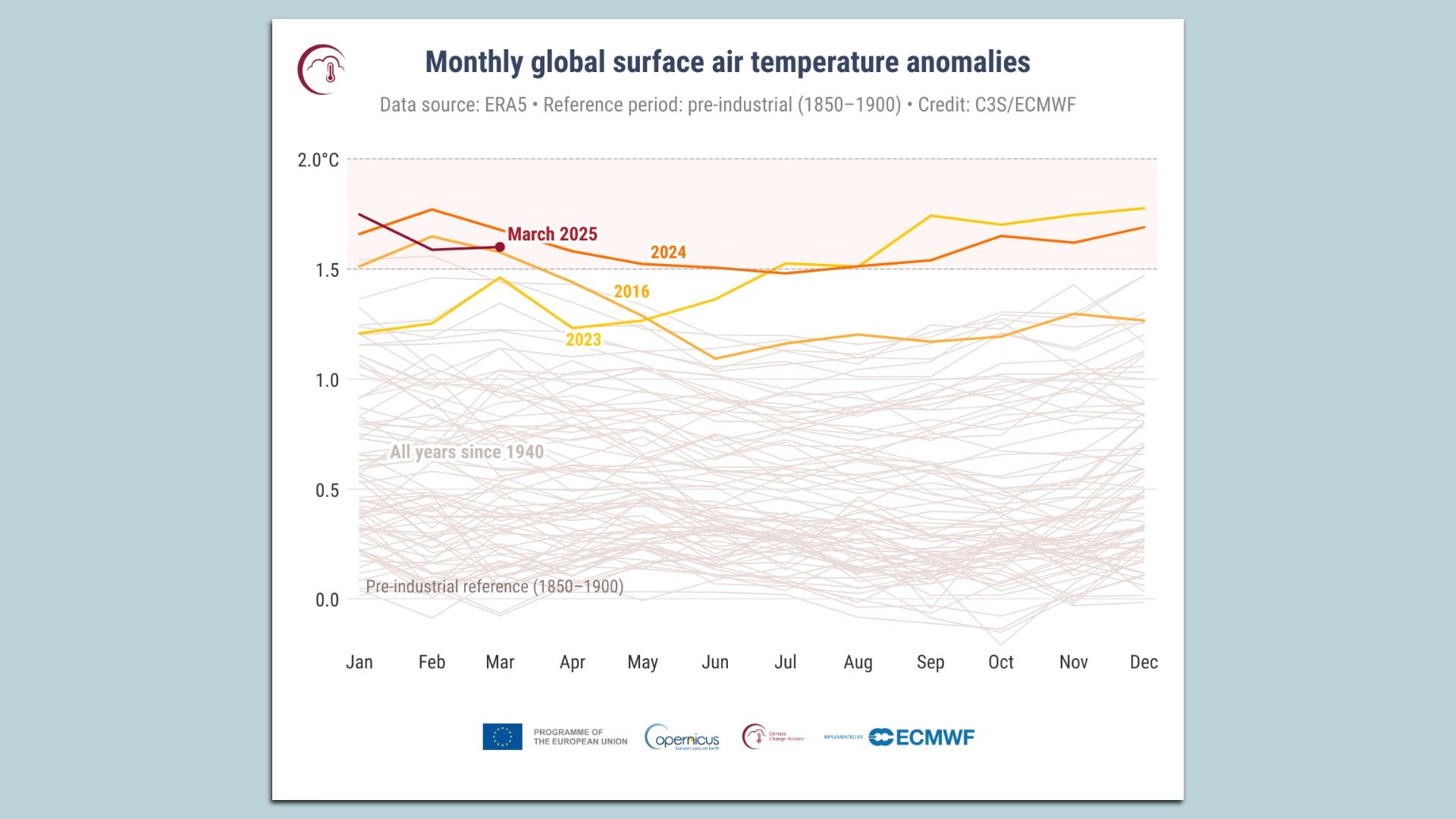
Earth just had its second-warmest March in temperature records that date back to the 1800s, trailing only last year, per the EU's Copernicus Climate Change Service.
Why it matters: It's yet another sign of a warming planet from one of the major stewards of global climate data.
State of play: Average surface air temps were 0.65°C above the 1991-2020 average and 1.60°C above pre-industrial levels, Copernicus said.
- Meanwhile, Arctic sea ice reached its lowest monthly extent for March in nearly a half-century of satellite records at 6% below average.
- "This marks the fourth consecutive month in which the sea ice extent has set a record low for the time of year," Copernicus said.
3. 🖋️ Trump's new coal push and more policy notes
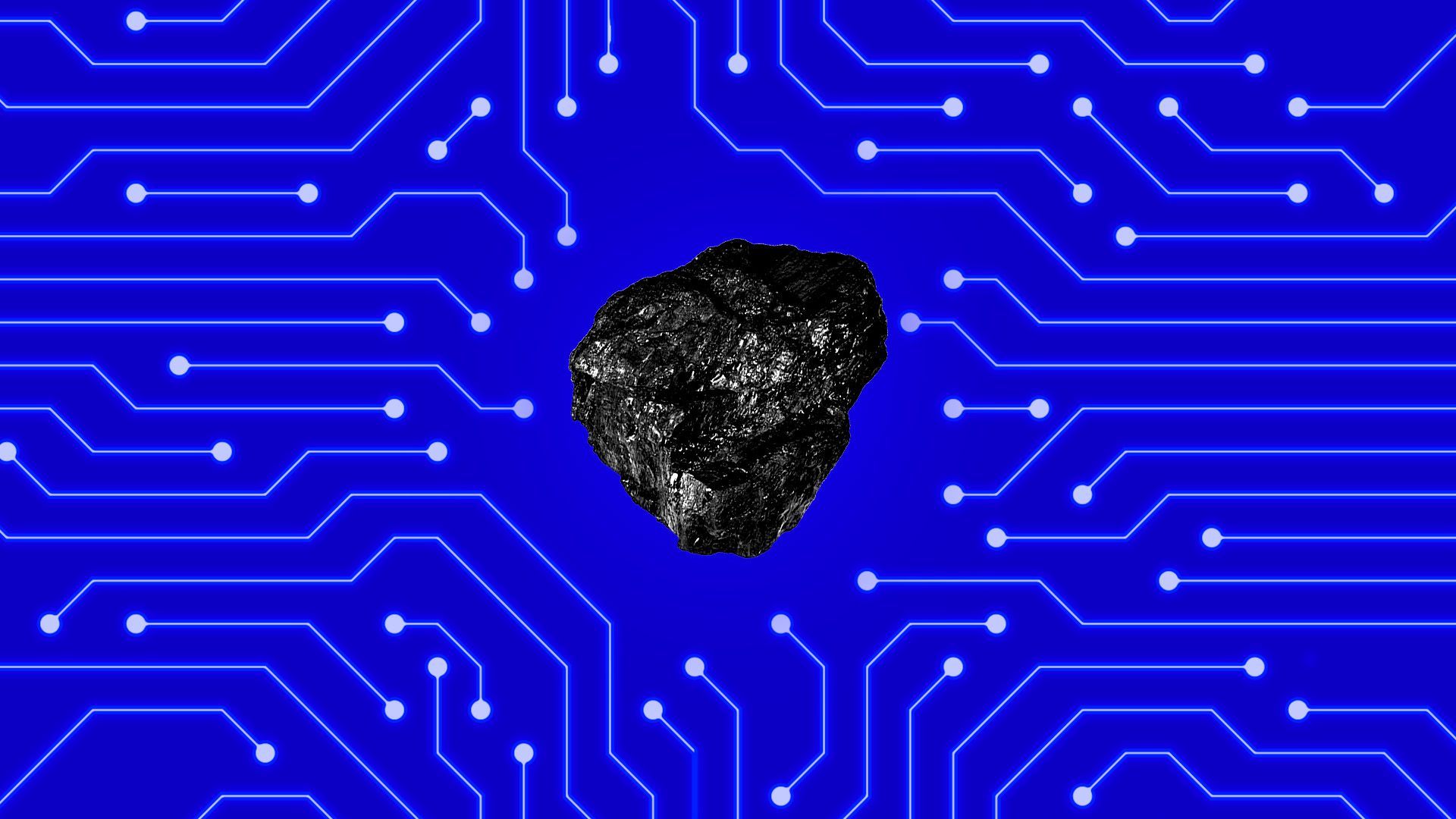
1. 🆕 President Trump will sign an executive order today aimed at "reinvigorating" the U.S. coal sector, per a summary document.
- State of play: It directs the White House energy council to designate coal as a "critical mineral." The order also instructs agencies to ID coal resources on federal lands and "lift barriers" to mining.
- The intrigue: Another piece aims to help agencies adopt "coal-related" exclusions from very in-depth environmental reviews under the National Environmental Policy Act.
- Reality check: Reversing the long-term decline in U.S. coal demand is a tall order, though rising power demand is prompting some utilities to delay coal plant shutdowns.
- The bottom line: The order comes as Trump 2.0 officials have talked up coal, among other sources, as a way to help meet AI power needs. Bloomberg has more.
2. 🧳 Via Reuters, Energy Secretary Chris Wright tomorrow will "launch a nearly two-week tour of three Middle East countries, including Saudi Arabia."
4. 👟 Catch up quick on tech: battery woes and a Tesla alum's fundraise



1.🪫 Bedrock Materials, which was developing sodium-ion batteries, has decided to return its remaining capital and stop the development of its tech.
Why it matters: Battery startups have been hit hard by the changing policy landscape, the slowing EV market, and the reality of competing with China's low-cost lithium-ion batteries.
Zoom in: Co-founder and CEO Spencer Gore announced the move on LinkedIn on Saturday.
- "The world changed," Gore wrote, from the one supportive of EV policies, higher lithium prices, and major EV growth when Bedrock launched.
- "Our modeling pointed to a clear outcome: in a world where lithium remains abundant, today's sodium-ion batteries can't compete on cost," Gore wrote.
The bottom line: Betting against the dropping costs of lithium-ion batteries — similar to silicon solar panels — isn't a good idea.
2.⚡Heron Power, a startup founded by former Tesla executive Drew Baglino, is raising a $50 million Series A to develop next-generation transformers for electric grids, three sources familiar with the offering tell Axios.
Why it matters: Baglino's involvement has pushed the offering's valuation into the hundreds of millions, two of the sources say.
Driving the news: Heron Power in March began raising $30 million to $50 million, the two sources tell Axios.
- Capricorn Investment Group, a sustainability-focused impact investor, has emerged as a likely lead, both sources say.
Context: Baglino joined Tesla in 2006, eventually rising to SVP, responsible for batteries, motors and power electronics.
- "If he opened a taco stand there'd be significant interest," one of the sources tells Axios. "He's an A+ player."
Zoom in: Heron plans to manufacture solid-state electrical transformers in the U.S.
Unlock both stories, and for a steady diet of scoops and smart analysis, talk to our sales team about Axios Pro Deals.
5. 🐄 Number of the day: 100,000+ cattle and sheep
That's how many will be screened under a $27.4 million Bezos Earth Fund and Global Methane Hub initiative to ID animals that emit less of the potent greenhouse gas.
Why it matters: "Selecting and breeding for these traits — just as farmers have done for centuries for milk yield, fertility, or disease resistance — can lead to substantial, permanent emissions reductions across the industry," the announcement states.
- Some animals within a herd of cattle can produce 30% less methane.
What's next: The Bezos fund is providing $19.3 million and the Global Methane Hub is providing $8.1 million.
- It will fund research and breeding programs in North America, Latin America, Europe, Africa, and Oceania.
📧 Did a friend, colleague or an AI chatbot send you this newsletter? Welcome, please sign up.
🙏 Thanks to Chris Speckhard and Chuck McCutcheon for edits to today's edition, along with the brilliant Axios Visuals team.