Axios Generate

May 21, 2025

🐪 Happy Wednesday! We're opening with an AI scoop, but we've got plenty more, all in a quick 1,236 words, 4.5 minutes.
🎙️ Bulletin: Direct air capture firm Climeworks is cutting 22% of its staff, Bloomberg reports, noting CO2 removal startups "face a reckoning" as Trump 2.0 officials cut climate programs and incentives.
🎸 At this moment in 1978, The Kinks had just dropped the killer album "Misfits," which provides today's intro tune...
1 big thing: An exclusive look at the Bezos plan to find AI climate wins

👀 First look: The Bezos Earth Fund is unveiling the first recipients in its grant program to harness AI for biodiversity protection, sustainable proteins, improving power grids and more.
Why it matters: While AI's energy suck gets tons of attention, the Bezos program explores how AI can further climate and ecological work.
The big picture: Today the fund is revealing the 24 grants under phase 1 of the $100 million "AI for Climate and Nature Grand Challenge" launched in 2024.
- Each project will receive an initial $50,000. Later this year, up to 15 of the most promising will receive $2 million.
- Initial recipients take part in an "innovation sprint" where they refine the project and are matched with private-sector AI and tech experts for collaboration.
Driving the news: Just a few examples of projects from university researchers and nonprofits, per the Bezos fund summaries...
- Essential Impact, a nonprofit biosciences group, will create an AI tool to ID fungi in under-researched regions that produce shelf-stable proteins.
- Cornell University researchers are creating a platform that uses artificial cells and AI to "accelerate sustainable protein design and production without live cell fermentation."
- The National Audubon Society will "deploy AI-powered acoustic monitors across Latin America to track bird populations and measure conservation impact."
- The Wildlife Conservation Society will scale an "AI-enhanced reef monitoring platform that analyzes imagery 700 times faster" to model climate impacts and protect corals.
- Botanic Gardens Conservation International will use AI and drone imagery to monitor hundreds of threatened timber species and detect illegal logging.
- The University of Witwatersrand will use AI to "enhance weather forecasting in Africa by merging new ground data with satellite inputs." The goal is to produce medium-range forecasts up to 3,500 times faster to help with climate and farming resilience.
The intrigue: The program has a norm-breaking approach.
- It sought applicants with cool ideas and will help them leverage tech expertise, rather than making deep, longstanding AI experience the table stakes.
"The way we did this grand challenge was a little different, and it was deliberate in every way," Amen Ra Mashariki, the fund's head of AI and data strategies, said in an interview.
- One goal is bridging the gap between front-line environmental work and advanced tech innovation.
- "We want climate and nature experts, climate and nature people who have been on the ground solving these problems. We want to bring you into this AI revolution," he said.
State of play: There's a lot of interest in using AI for environmental aims.
- Mashariki said the program received over 1,200 proposals and considered ways the fund could best accelerate solutions.
- "We have to think about: what does philanthropy do that the market would not already jump in and take advantage of," he told Axios.
What we're watching: Which of the 24 initiatives move through to larger funding awards from the Bezos group.
2. ⛏️ Geopolitical risks for "key energy minerals" are rising
Generate readers know there's rhetoric to spare about diversifying mineral supplies, but a big new International Energy Agency report finds that geographic concentration is growing.
Why it matters: "Diversification is the watchword for energy security, but the critical minerals world has moved in the opposite direction in recent years, particularly in refining and processing," IEA states.
- Increasing supply concentration in a handful of countries alongside growing export restrictions is "raising the risk of painful disruptions," the agency said in a statement.
The big picture: Average market share for the top three refining nations of "key energy minerals" rose from 82% in 2020 to 86% last year, IEA said, citing data on copper, lithium, nickel, cobalt, graphite and rare earths.
Go deeper: The overall report explores the market for a wide group of minerals from many angles. Take it for a spin.
3. 😬 Global forest loss hits record — with CO2 in tow
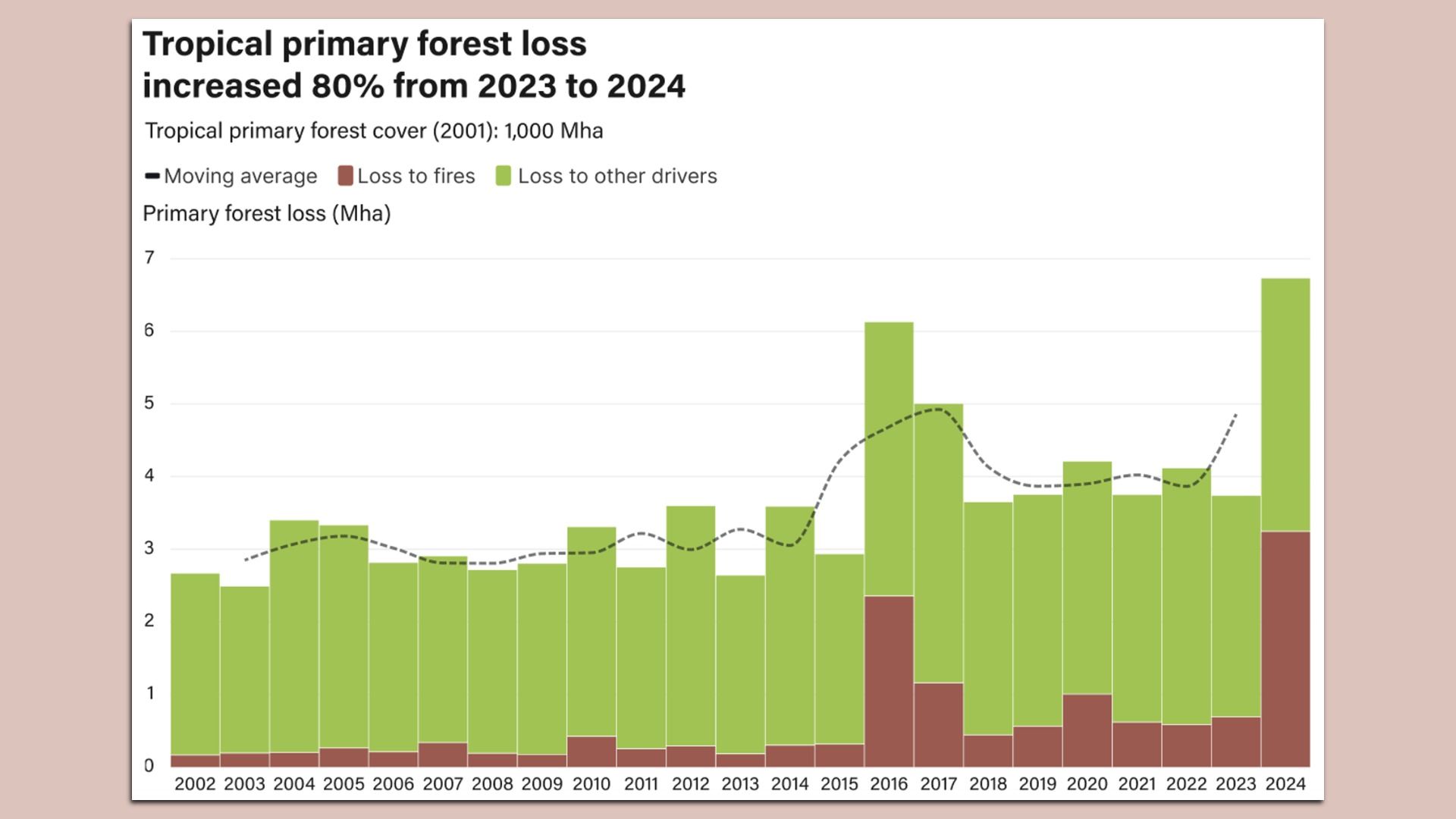
Global forest loss hit the highest level on record last year, per detailed University of Maryland and World Resources Institute tracking data.
Why it matters: The CO2 emissions from fires — the largest single cause of forest loss last year — are very high. And losing forests lessens CO2 absorption.
Driving the news: Tropical regions specifically lost 6.7 million hectares (17 million acres) of primary rainforest in 2024, an area roughly the size of Panama.
- Total global tree cover loss reached 30 million hectares (73 million acres) "due to extreme fire seasons outside the tropics in Canada and Russia," the report states.
- But the analysis focuses most heavily on the tropics, noting their importance for biodiversity, carbon storage and regulating regional climates. Brazil and Bolivia saw the largest losses.
Threat level: Fires brought nearly 50% of last year's primary tropical forest loss, the first time in the project's two decades-plus of tracking that this was the leading cause.
- These blazes are a mix of human and climate influences. They're often set on farming land or to clear forests for agriculture, but sometimes spread.
- Last year was the hottest on record, and "extreme conditions fueled by climate change and El Niño made these fires more intense and harder to control."
Stunning stat: Global fires caused 4.1 billion tons of CO2 emissions in 2024, "equivalent to more than 4 times the emissions from air travel in 2023," the analysts write in a blog post.
The bottom line: "It's a global red alert — a collective call to action for every country, every business and every person who cares about a livable planet," Elizabeth Goldman, co-director of WRI's Global Forest Watch, said in a statement.
4. 🏃 Catch up quick on policy: deep-sea mining, small nukes, IRA, solar tariffs
⛏️ The Interior Department is taking steps toward sale of subsea mining leases off the coast of American Samoa.
- Why it matters: Trump officials are keen to tap what could be large resources in U.S. and international waters, calling it a national security boost. But many scientists and environmentalists say it risks lasting ecological damage and that big knowledge gaps remain.
- Driving the news: Interior said yesterday that the U.S.-based firm Impossible Metals made a formal request for a sale. The agency will post a formal request for information and vows to weigh input from a range of stakeholders.
⚛️ The Tennessee Valley Authority is asking federal regulators for permission to build a GE Vernova Hitachi Nuclear Energy small modular reactor at its Clinch River Site.
- Why it matters: It's the first U.S. utility to file a construction permit application with the Nuclear Regulatory Commission for the design.
- The intrigue: The announcement is a sign of the times — it couches the plan in "energy dominance" terms and doesn't discuss nuclear's climate benefits.
⚡ The House Rules Committee is meeting this morning in the final step before sending the GOP's budget reconciliation bill to the chamber's floor.
- What we're watching: Looming text revisions that might include even deeper cuts to IRA credits. Also keep an eye on which proposed amendments will get floor votes.
☀️ The U.S. International Trade Commission said domestic manufacturers face injury from photovoltaic cells exported from Malaysia, Vietnam, Cambodia and Thailand.
- Why it matters: The vote yesterday paves the way for Commerce to implement its decision to impose steep tariffs.
- Catch up quick: Some domestic companies brought the case, alleging Chinese companies are avoiding penalties by routing production through these nations. Go deeper.
5. 🥤 Quote of the day: thirsty data centers edition
"Telling entities that they can come in and stick more straws in the ground for data centers is raising a lot of questions about sound management."
— Kyle Roerink, executive director of the Great Basin Water Network
He's quoted in MIT Technology Review's deep dive into data centers expanding in Nevada.
📧 Did a friend, colleague or an AI chatbot send you this newsletter? Welcome, please sign up.
🙏 Thanks to Chris Speckhard and Chuck McCutcheon for edits to today's edition, along with the brilliant Axios Visuals team.