Axios Generate

June 09, 2025

🥞 Welcome back! We're starting the week with a wide-ranging but quick 1,120 words, 4 minutes.
🎸 Rush's final album "Clockwork Angels" arrived 13 years ago and provides today's intro tune...
1 big thing: Threats to Tesla's revenue are piling up
Tesla faces fresh risks to a big income stream: sales of regulatory credits to other automakers under vehicle emissions and efficiency rules.
Why it matters: Tesla's credit sales were $595 million last quarter and totaled $3.36 billion in the five quarters through Q1 of 2025.
- The credits are awarded to companies like Tesla that exceed emissions standards.
- Producers of gas-powered vehicles buy them to help meet various CO2 and mileage standards.
The latest: Republicans on the Senate's commerce committee late last week proposed ending civil penalties under the Transportation Department's fuel economy rules.
- It's part of the committee's portion of the budget "reconciliation" bill — the top GOP and White House legislative priority.
- The provision would "modestly" cut auto prices by ending penalties on automakers that now "design cars to conform to the wishes of DC bureaucrats rather than consumers," a GOP summary states.
The intrigue: "This Senate action would effectively end the market for CAFE credits," Chris Harto, a senior policy analyst at Consumer Reports, tells Axios via email.
- Dan Becker, who heads the Safe Climate Transport Campaign at the Center for Biological Diversity, noted: "Why buy credits if Trump gives you a get out of CAFE free card?"
Driving the news: Separately, DOT on Friday issued an "interpretive rule" that bars consideration of EVs when it sets these mileage rules.
- It's a step toward crafting replacement standards, DOT said.
- This paves the way for less aggressive requirements — and less need for buying credits.
State of play: Several buckets of credits benefit Tesla, the dominant U.S. EV seller.
- EPA emissions standards, Transportation Department fuel economy mandates, and California's ambitious clean cars program all provide opportunities.
- European emissions rules also generate credits.
The big picture: The regulatory credit market was already facing risks before all the news late last week.
- EPA is planning to rescind Biden-era EPA carbon emissions rules for model years 2027 and onward.
- The House-passed reconciliation bill and the Senate GOP proposal would also nix them. And the House bill pulls back Biden-era DOT mileage rules.
- Both chambers have passed measures that end EPA's approval of California's auto emissions rules.
Threat level: Potential loss of credit revenues comes at a perilous time for Tesla.
- Its sales have slumped in recent quarters, and CEO Elon Musk's rightward turn and alliance with Trump are among the reasons why, analysts say.
- The House plan ends $7,500 consumer purchase subsidies for EVs under the Democrats' 2022 Inflation Reduction Act.
By the numbers: Credit revenues exceeded Tesla's overall profit last quarter — in other words, it would have been in the red without them.
- Yes, Q1 was atypically weak for Tesla, but consider Q4 of 2024, when Tesla reported $2.13 billion in profits that were helped along by $692 million in credit sales.
- In Q3, those numbers were $2.17B and $739M, respectively.
Friction point: More broadly, the meltdown of Tesla CEO Elon Musk's relationship with Trump also creates new and unpredictable risks for the billionaire entrepreneur's business empire.
Yes, but: There are plenty of court battles ahead over Trump 2.0 and GOP policies, including efforts to scuttle California's rules.
The bottom line: "If the administration gets its way on all of its stated policy objectives around vehicle regulations, there will no longer be any market in the US for Tesla's regulatory credits," said Harto.
2. 📊 Charted: The coming LNG wave

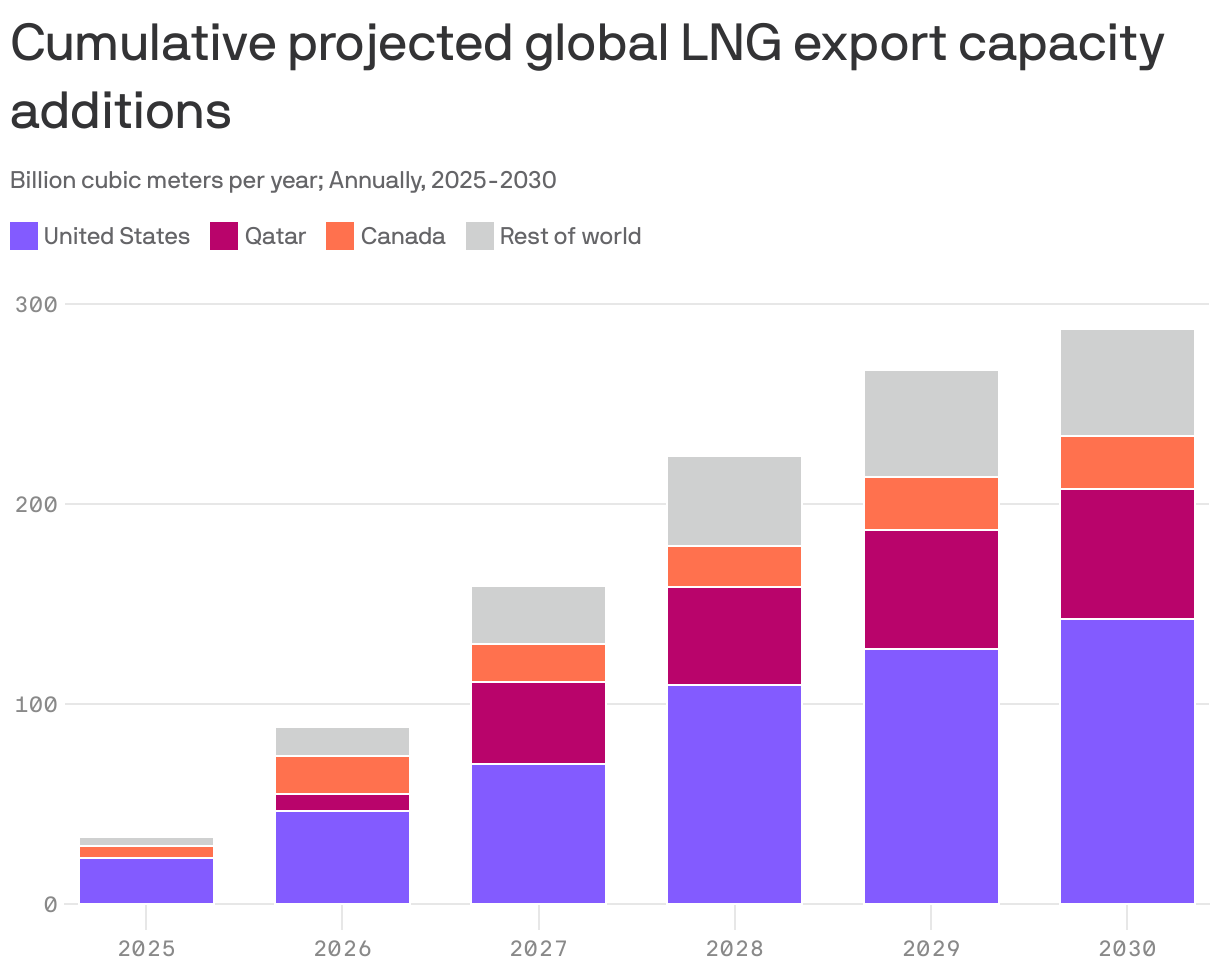
A historically large wave of new LNG is heading for global markets this decade.
Why it matters: There could be a medium-term supply glut, though there's not consensus among analysts and execs about the market balance.
- The new resources signal investor confidence in long-term demand for the fuel.
- Climate advocates fear locking in decades of new fossil infrastructure.
The big picture: The International Energy Agency just launched an online tracker of projects that have reached final investment decisions and/or started construction.
What's next: IEA sees nearly 300 billion cubic meters per year of cumulative capacity arriving in 2025-2030, a massive scale-up from today's 670 bcm market.
The bottom line: "This represents the largest capacity wave in any comparable period in the history of LNG markets," IEA said.

3. 🌥️ Sunnova is bankrupt and more solar notes
⚖️ Sunnova, the troubled residential solar heavyweight, yesterday filed for Chapter 11 bankruptcy in Texas, documents show.
- Why it matters: The residential sector is "reeling from a torrent of headwinds, including high interest rates, rising tariffs on imported equipment and reduced state incentives in California," Bloomberg notes.
- Threat level: The House-passed GOP budget plan would quickly end federal tax incentives for residential projects, creating vastly more peril for the sector.
📊 The wider U.S. solar industry added 10.8 gigawatts of new generation capacity in Q1, a steep decrease from the prior three months but still the fourth-largest quarter ever, per newly released industry data.
- What we're watching: The pace of new additions is slated to slow, but the "base case" from the Solar Energy Industries Association and Wood Mackenzie still averages almost 43GW annually in 2025-2030.
- Threat level: That projection does not include the rollback of various tax incentives in the GOP budget plan, which the industry warns would critically harm the sector.
4. ⚛️ On my screen: the path to new reactors
💵 "Westinghouse is in talks with US officials and industry partners about deploying 10 large nuclear reactors to meet the goals of President Donald Trump's executive orders," the Financial Times reports.
- State of play: The company has an approved large reactor design, the AP1000, that was used in Southern Company's Plant Vogtle expansion in Georgia.
📄 A pair of helpful reports crossed my desk that summarize reactors that could be commercialized in the U.S. — and what it will take to actually get projects built.
- The big picture: An FTI Consulting analysis sees potential for 260 gigawatts of new deployments by 2055 (the current U.S. fleet is 102 GW) — but a lot has to break right. It explores project risk mitigation and finance strategies.
- Zoom in: An Arthur D. Little report drills down on small modular reactor designs and the companies looking to commercialize them. "Coordinated efforts across the entire nuclear ecosystem" will be needed, including governments' financial support.
💬 SMR developer NuScale is in discussions with a majority of "tier one" hyperscalers that are interested in buying power from its advanced nuclear reactors, CEO John L. Hopkins tells Axios Pro's Katie Fehrenbacher.
5. 🛢️ Petro-number of the day: 12.96 million barrels
S&P Global Commodity Insights expects U.S. oil production will fall more steeply next year than they previously thought, with the firm now seeing a drop to 12.96 mbd.
Why it matters: The U.S. "will be disproportionately impacted by sluggish global oil demand growth and a coming supply surplus," the analysts said, noting the accelerated return of OPEC+ barrels and other factors.
What we're watching: Tomorrow's updated outlook from the Energy Department's independent stats arm, which most recently projected very modest U.S. growth next year.
📧 Did a friend, colleague or an AI chatbot send you this newsletter? Welcome, please sign up.
🙏 Thanks to Chris Speckhard and Chuck McCutcheon for edits to today's edition, along with the brilliant Axios Visuals team.
Sign up for Axios Generate