Axios Generate

October 01, 2020
Good morning. Today's Smart Brevity count: 1,196 words, 4.5 minutes.
🚨 Coming soon: Axios is expanding into local news to get you smarter faster about where you live. Read more about what’s next here.
🎵 And at this moment in 1971, Honey Cone was atop the Billboard R&B charts with today's intro tune that's a felony heartbreak in the first degree...
1 big thing: An important offshore wind investment
Illustration: Lazaro Gamio/Axios
America’s nascent offshore wind industry is getting a boost with news Thursday that should make it easier to support the sector's massive infrastructure, Axios' Amy Harder scoops.
Driving the news: Denmark-based Ørsted, the world’s leading offshore wind developer, has inked a multimillion-dollar deal with a U.S. shipbuilder to construct the sector’s first ship that's compliant with a law controlling shipping goods in U.S. waters.
The big picture: The investment, of an undisclosed amount, comes in the face of headwinds for the sector.
- The Interior Department, which has authority over projects in federal waters, has been slow in its review process of both individual projects and the cumulative impact of several proposed farms.
- President Trump personally dislikes wind and recently included future offshore wind leases in a ban initially focused on oil-and-gas drilling off some coastal states along the southeast.
Where it stands: Ørsted and its joint venture partner Eversource Energy, a Northeastern electric utility, have a contract with Edison Chouest Offshore, a Louisiana-based marine transportation company, to build what’s considered the industry’s first Jones Act-compliant ship.
- The deal they're announcing Thursday indicates Ørsted’s optimism that its numerous U.S. projects will eventually come to fruition despite review delays.
- “However, a full scale build-out of the domestic supply chain and the jobs and investment that would be created, remain on the sidelines until there’s more federal permitting certainty,” says Thomas Brostrøm, CEO of Ørsted North America, Offshore.
How it works: The Jones Act is a century-old federal law that requires goods shipped between U.S. ports to be transported on ships that are built in the U.S., (mostly) owned by U.S. companies and operated by U.S. citizens.
- The offshore wind industry, much like the offshore oil industry, requires special ships to construct and maintain infrastructure.
- Since America is just beginning its offshore wind sector, companies building the first ones are often using ships and equipment from Europe, whose industry is far more developed.
- Companies have had to shuffle people and equipment — moving from one ship to another and then back — to comply with the Jones Act.
- This particular ship will be used to house workers who will operate and maintain wind farms.
Why it matters: Making ships compliant with the Jones Act is widely considered an essential step in growing the industry in the United States. Other companies will be able to use the ship, per Ørsted spokesperson Lauren Burm.
The intrigue: The ship resembles a mini cruise liner and will be more than 260 feet long (a little shorter than the Statue of Liberty). It will be built at Edison Chouset’s shipyards in Florida, Mississippi and Louisiana via 300 new construction jobs, according to Ørsted.
2. A new fossil fuel divestment move
The University of Cambridge said this morning that it "aims to divest from all direct and indirect investments in fossil fuels by 2030" and plans to ramp up renewable energy investments.
Why it matters: With one of the largest endowments in Europe at £3.5 billion ($4.45 billion), the U.K. school " arguably becomes the most prominent university to aim for divestment," per Institutional Investor.
The intrigue: Cambridge also said that going forward, research funding and other donations will be reviewed to ensure donors can show "compatibility with the University’s objectives on cutting greenhouse gas emissions before any funding is accepted."
- The school has pledged to cut its greenhouse gas emissions to zero by 2038.
Go deeper: Cambridge university to dump fossil fuel investments by 2030 (Financial Times)
3. Fusion energy might finally be coming into view

A cutaway rendering of Sparc, a compact, high-field, DT burning tokamak that could eventually power a nuclear fusion plant. Photo: CFS/MIT-PSFC — CAD Rendering by T. Henderson
Let's spend more time with something we barely grazed in yesterday's edition. Axios' Bryan Walsh reports that researchers this week reported notable progress in a vital field for the future: nuclear fusion.
The big picture: Producing emissions-free power by nuclear fusion might represent the most effective step we could take to combat climate change. But just as importantly, the work reminds us of the difference science can make in human life.
What's happening: In a series of papers published this week, researchers evaluated a compact nuclear fusion reactor being developed by researchers at MIT and a spinoff called Commonwealth Fusion Systems — and concluded it is likely to work.
- Construction on the fusion reactor, called SPARC, is expected to begin next spring and should be finished in three to four years.
- If successful, that would be far faster than the International Thermonuclear Experimental Reactor (ITER), the world's biggest fusion project, which has been under construction for years and still isn't scheduled to begin delivering power until 2035.
How it works: Nuclear fusion mimics the mechanics of a star, bringing atoms together at temperatures of tens of millions of degrees to release vast amounts of energy.
- Unlike nuclear fission, fusion produces little radioactivity and could theoretically run on plentiful isotopes of hydrogen, rather than rare uranium.
- The SPARC design uses new electromagnet technology to produce a higher magnetic field, which means a smaller reactor. That could mean fewer design problems than massive reactors like ITER.
Yes, but: Nuclear fusion has been 20 years away since 70 years ago, and every time the technology seems to be within workable reach, it manages to elude our grasp.
Sign up here for Bryan's Axios Future newsletter.
4. California's fires cut solar generation
Screenshot from EIA's report on wildfires and solar generation
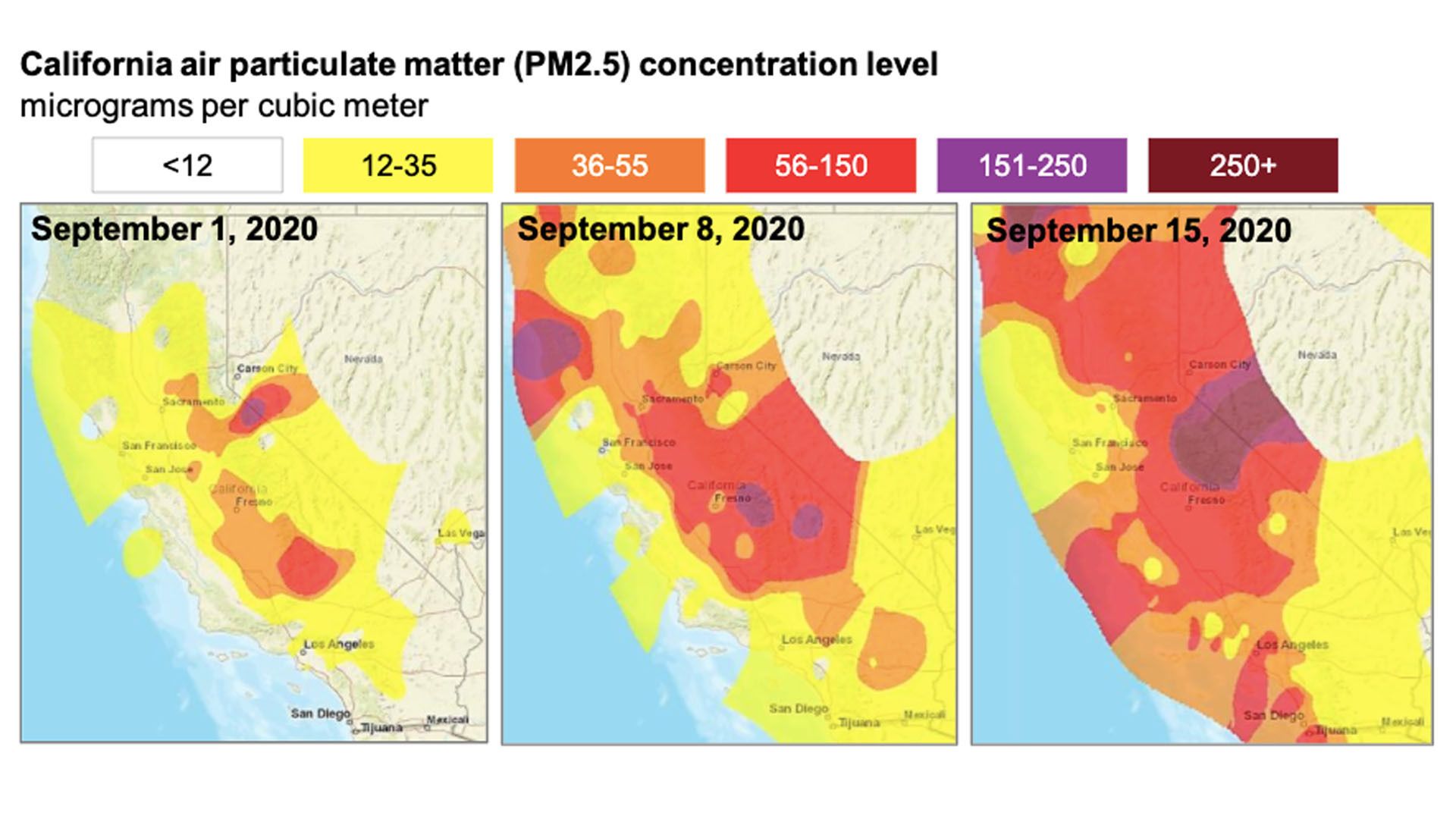
From the apocalypse files: A new Energy Information Administration analysis shows that pollution from California's dreadful wildfires has substantially curtailed solar power generation in the state.
Why it matters: Everything's connected, man!
- The growing wildfires in California — a problem worsened in part by global warming — create complications for one of the power sources that can help fight climate change.
- And as Energy Impact Partners' Shayle Kann tweeted, it's "especially bad news given that wildfire risk is highest in hot weather, when power demand peaks and you need solar the most."
How it works: Smoke from the fires contains fine particulate matter, a highly dangerous respiratory pollutant that also cuts the amount of sunlight reaching solar panels.
By the numbers: Average utility-scale solar generation in California during the first two weeks of September declined by nearly 30% compared to July's averages, EIA said.
(The figures apply to solar generation in the jurisdiction of the California Independent System Operator, the grid manager for almost all of the state.)
5. The politics of pandemic driving


A brief new study makes the case that Democrats are curtailing their travel more than Republicans during the pandemic.
Why it matters: Transportation analyst Michael Sivak's report provides another window into the forces that have caused a steep drop in oil demand during the crisis.
- It's also another indication of how political leanings are affecting behavior, a topic probably most discussed with respect to mask-wearing.
How it works: Sivak overlaid Federal Highway Administration data with Cook Political Report analysis of states' political leanings in the upcoming presidential election.
The intrigue: The short analysis published in Green Car Congress argues that while the data show the decline in driving on urban roads is somewhat greater than the decline on rural roads, there's more afoot.
- "Although the states with preference for the Democratic presidential candidate tend to be more urban than the states with preference for the Republican presidential candidate, the urban/rural difference does not fully account for the main finding."
6. Tesla news: Lobbying and Model 3 prices
While we're all waiting around for Tesla's Q3 sales numbers this week, I noticed that they've expanded their outside lobbying team.
Driving the news: The Silicon Valley electric automaker has brought on the D.C. firm Cassidy & Associates, a newly available filing shows.
- Lobbyists on the account include former aides to Sen. John Barrasso, Rep. Steve Scalise and former Sen. Harry Reid.
And speaking of Tesla, Reuters reports that it "cut the starting price of its Chinese-made Model 3 sedans on Thursday by about 8% to 249,900 yuan ($36,805), once Chinese subsidies for electric vehicles are taken into account."


