
Axios Generate

September 04, 2025

π We're moving the chains this morning with news on renewables, Congress and more, all in just 1,096 words, 4 minutes.
β‘οΈ Breaking: Hitachi said it's spending over $1 billion to expand U.S. grid infrastructure manufacturing, including a new transformer factory in Virginia.
- Why it matters: The "Trump administration-backed" investment will help meet demand from AI data centers, it said. Go deeper.
ποΈ Happy 44th birthday to the legendary BeyoncΓ©. Axios graphics wizard and resident BeyoncΓ© historian Sara Wise chose today's killer intro tune...
1 big thing: Trump's U-turn starts to influence clean-power downshift
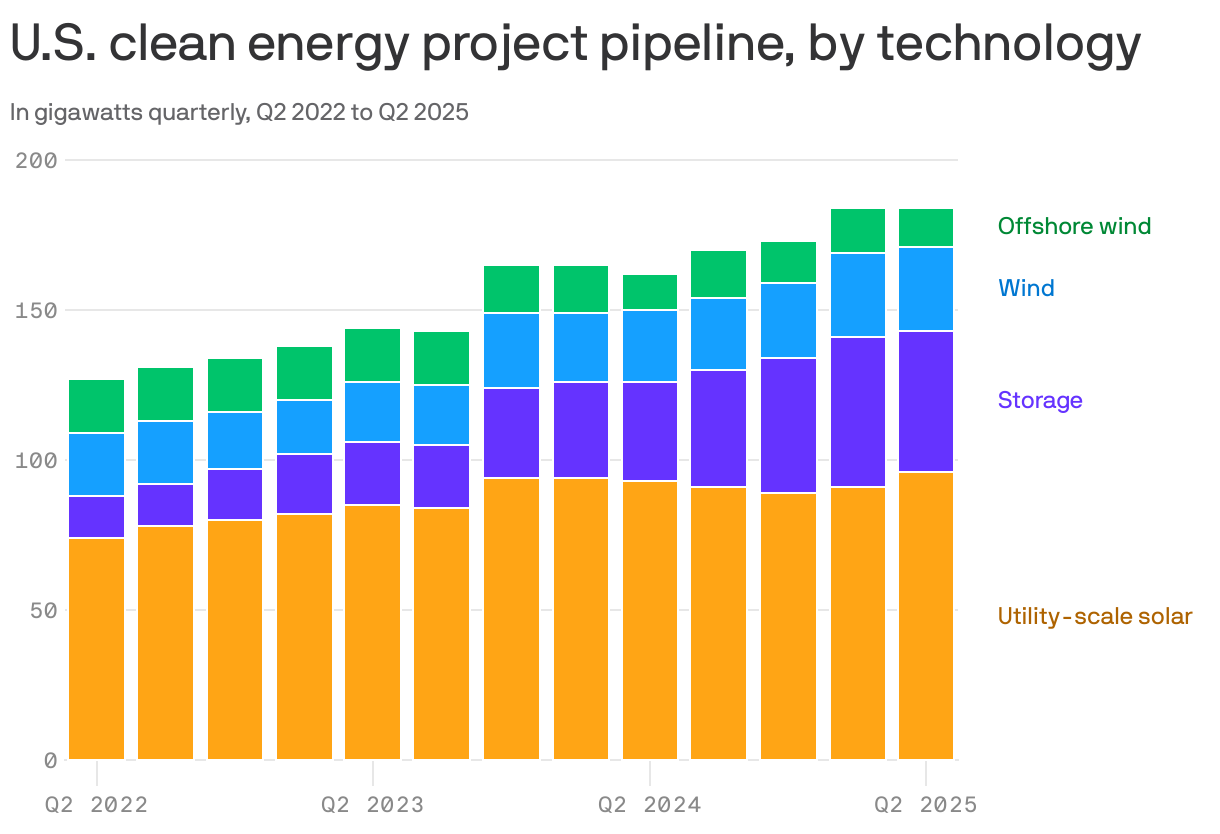
Combined levels of U.S. "clean" power installations barely grew in Q2, and the future project pipeline also stalled, new data shows.
Why it matters: The effects of Trump 2.0 policy U-turns are coming into focus, the American Clean Power Association said alongside its latest market snapshot.
- The numbers are "early indicators of federal policy attacks and fluctuating trade policy," ACP said.
- They come a week after separate Rhodium Group and MIT data showed spikes in canceled EV and battery manufacturing plans.
Driving the news: ACP's Q2 and first-half market report tallies wind, utility-scale solar, and battery storage.
- Q2's capacity additions of 11.6 gigawatts were just 1% higher than Q2 2024, and the first half of 2025 saw a decline compared to last year.
- The pipeline of projects under construction or in "advanced development" did not grow (check out the graphic above).
- The amount of future electricity contracted via corporate power purchase agreements dropped sharply.
Yes, but: The picture varies by technology.
- Installations of storage β a smaller sector than wind and solar β rose 63% in the first half of 2025 compared to 2024.
- Wind ticked up 12%, but utility-scale solar installations were 23% below the first six months of 2024.
What we're watching: The fallout from policies and decisions that surfaced since the period covered by the report.
- Think new restrictions for onshore wind and solar projects that have ties to federal lands, and Trump officials' intent to scuttle permits for offshore wind developments.
- Meanwhile, developers are racing to tap wind and solar tax credits sunsetting under the GOP budget law.
- Projects must start construction by July 4, 2026, or begin operations by the end of 2027 to access the subsidies.
The bottom line: "The uncertainty created by new bureaucratic delays and unclear demands is having a chilling effect on the pipeline for future energy projects," Jason Grumet, ACP's CEO, said in a statement.
2. βοΈ Analysts: Russia and China challenge U.S. LNG "dominance"
China's brewing deal with Russia to vastly boost purchase of Kremlin-backed gas has "major implications" for the global LNG market, analysts with Columbia's energy think tank write.
Why it matters: China is the world's largest gas importer. The deal with Russia would ripple through the global industry β including the U.S., already the world's top LNG exporter with more volumes on deck.
Driving the news: The Columbia researchers posted a look at the preliminary β and still uncertain β Russia-China deal for the Power of Siberia 2 pipeline and planned expansions through other routes.
- One takeaway: it could soften the global LNG market early next decade β extending expected oversupply projected in the late 2020s.
- That means downward pressure on prices and even preventing some projects in LNG-exporting nations from going forward.
Friction point: "Coupled with the arrival of a sanctioned Russian LNG cargo from the Arctic LNG 2 export project to China, it signals that the two countries are moving to challenge US LNG dominance," write Anne-Sophie Corbeau, Erica Downs, and Tatiana Mitrova.
What we're watching: It explores the countries' commercial and geopolitical motivations for the agreement that would likely have difficult financial terms for Russia.
- "Domestically, [Power of Siberia 2) is regularly invoked as proof of both Russia's resilience and its special strategic partnership with China. In other words, it carries heavy political symbolism."
Go deeper: I'm just scratching the surface, so do check out the whole thing.
3. π§ Bonus: Charting Russia's gas export changes
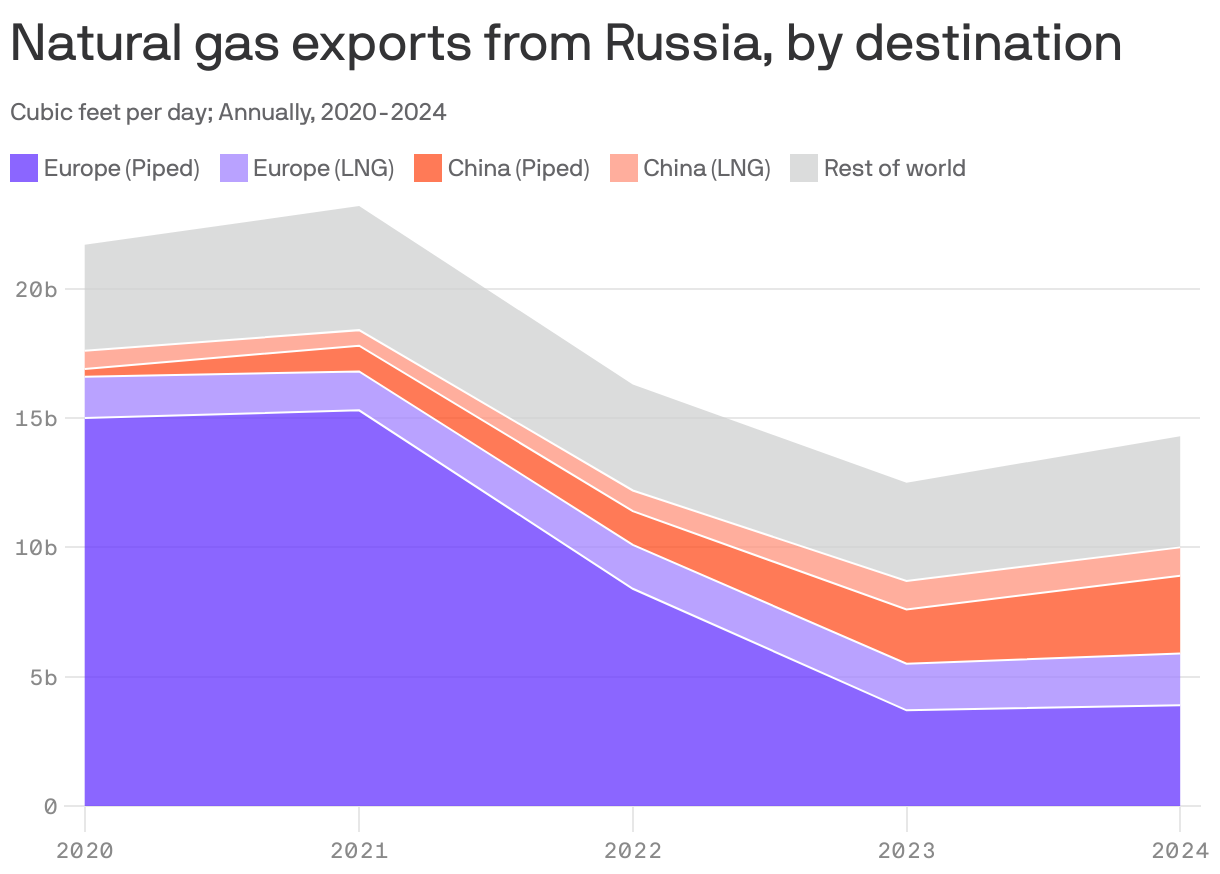
This graphic helps explain why Russia is eager to expand the Chinese market for its huge gas supplies.
- It shows declining European shipments since the attack on Ukraine ruptured those ties.

4. π Meet distributed energy's new boosters
A new group aims to provide a "unified voice" for distributed energy tech like batteries, smart thermostats, home solar, demand response and more.
Why it matters: The Common Charge coalition arrives as power demand and prices rise and policy changes shake clean tech markets.
The big picture: It brings together energy companies, other nonprofit groups, and consumers.
- Initial members include residential solar and storage company Sunrun, Advanced Energy United, and Eco Capital, to name a few.
- The coalition argues that distributed energy can be a vital tool for solving overlapping cost and resilience challenges.
- Maximizing these assets is "crucial to protect our grid and energy consumers in the age of data centers, rising energy costs, and severe weather," acting executive director Katherine Hamilton said in a statement.
The intrigue: Hamilton, a veteran clean tech advocate, tells Axios the new nonprofit isn't another trade group. She cited the breadth of its members.
- "We're here to inform energy consumers, from families to businesses, and even policymakers on how these assets can benefit them and protect their communities," she said via email.
- The group will also be "shining a light" on "unfair" policies that stand in the way. But the focus is less on direct lobbying and more on "building capacity and amplifying work being done in states and localities," she said.
What's next: It's recruiting a full-time executive director, and several more staff members are likely to follow, Hamilton said.
5. πββοΈ Catch up quick on Congress and oil
βͺοΈ The House voted along party lines last night on GOP measures to nix Biden-era land management plans for Alaska, Montana and North Dakota.
- Why it matters: Republicans say the policies wrongly stifle economically beneficial energy and mineral development. They're looking to upend them with Congressional Review Act resolutions immune from Senate filibusters.
- The other side: The House Sustainable Energy and Environment Coalition, a Democratic group, said the plans "balance multiple uses" and killing them is a "giveaway for Trump's corporate polluter friends." Go deeper.
π’οΈConocoPhillips plans to cut 20-25% of its global workforce. "We are always looking at how we can be more efficient with the resources we have," spokesperson Dennis Nuss said. Go deeper.
6. π₯ Quote of the day: Chevron jab edition
"If you look at some of the European companies in our industry, they have lost a lot of relevance because they embarked on a strategy that said, 'We're going out of the oil and gas business.'"β Chevron CEO Mike Wirth, speaking to the New York Times
π§ Did a friend send you this newsletter? Welcome, please sign up.
π Thanks to Chuck McCutcheon and Chris Speckhard for edits to today's edition, along with the brilliant Axios Visuals team.
Sign up for Axios Generate


