Axios Generate

June 05, 2025

☕ Good morning! We've got a quick tour of the energy investment map, some take-y stuff on Trump, and IRA updates — all in just 1,081 words, 4 minutes.
🎶 At this moment in 1981, the legendary Chaka Khan ruled Billboard's R&B charts with today's intro tune...
1 big thing: Global clean-energy investment doubles fossil fuels

Record capital is flowing into energy despite lots of geopolitical tension and economic uncertainty, but the picture varies among technologies, a new global analysis finds.
Why it matters: The International Energy Agency's investment report tallies regional and source-specific trends at a time when the world remains badly off pace for reaching Paris Agreement goals.
A few high-level takeaways from the huge annual report...
☀️ New is outpacing old.
- Investment in "clean" tech — a catch-all term for renewables, grid tech, storage, nuclear and more — is slated to reach $2.2 trillion this year.
- That's twice the $1.1T for coal, gas and oil, IEA finds.
🔌 Electrons are outpacing molecules in new spending.
- Electricity sector investment is slated to reach $1.5T in 2025, "some 50% higher than the total amount being spent on bringing oil, natural gas and coal to market."
🏭 But don't forget the whole supply pie is growing.
- Global demand for coal, gas and oil — together the world's dominant sources — is rising.
- Coal supply investments are projected to grow 4% this year, driven by China and India.
- Spending on new LNG facilities is on a "strong upward trajectory," and approvals of new gas-fired power are growing. The oil picture is different (see next item).
🇨🇳 As always, the numbers out of China are remarkable.
- The country's share of global clean investment grew from a quarter to a third over the last decade alone.
- But everything is bigger in China — especially coal. It green-lit almost 100 gigawatts of new coal-fired power plants last year.
💻 Data centers are driving investments in fossil fuels and clean tech alike.
- One snapshot: IEA sees $18 billion in cumulative investment in gas-fired generation specifically to meet data center demand by 2030.
🟩 Green finance faces setbacks on multiple fronts.
- The "remarkable growth" in energy VC over the last decade has ended for now, with another drop in 2025 to follow declines the past two years.
- While some elements of sustainable finance remain "robust," the prior "flurry of activity" from banks to green their practices has slowed "as regulatory and policy support has ebbed in key markets."
What we're watching: A fluid landscape.
- "[S]ome investors are adopting a wait-and-see approach to new project approvals" amid cloudy trade and economic outlooks, it states.
- That said, "we have yet to see significant implications for spending on existing projects."
Go deeper: These huge IEA reports are a choose-your-own-adventure, so do check out the whole thing.
2. 🛢️ Charted: a shaky year for oil and gas finance


Upstream oil and gas investment is slated to fall this year, driven by a sharp decline among independent producers.
Why it matters: Lower oil prices and modest demand growth projections have consequences.
The bottom line: The projected 6% drop would be the first year-over-year decline since the COVID slump and the largest since 2016.

3. 🤔 Donald Trump's accidental climate push
A fascinating mini-trend is emerging: analysts arguing that Donald Trump's foreign and trade policies are bullish for clean electricity globally.
The latest: Check out Bloomberg columnist Liam Denning's smart new piece ("Trump Is Cementing the Green Energy Transition He Loathes").
- The basic idea: in a fragmented, less secure world, energy-importing countries turn to sources that aren't traded globally.
- That favors homegrown electrons over imported molecules, which ultimately helps renewables, EVs and nuclear.
Yes, but: It's not pollyannish — he notes, for instance, that China's coal use is still rising in absolute terms while falling as a share of its power.
- But overall: "The end result of Trump's dominance-plus-deglobalization agenda is a pathway, imperfect as it is, toward decarbonization — provided one's leaders can grasp that, of course."
Catch up quick: There's connective tissue with Carlyle analyst Jeff Currie's paper declaring the "New Joule Order."
- Risk concerns — not climate policy — are driving countries to seek domestic sources instead of imported commodities, he argues.
- Tariffs are part of that stew of geopolitical and financial security risks. And the U.S. has "signaled a willingness to weaken its security commitments to allies and trading partners while imposing tariffs."
The latest: That IEA report I flagged above notes that 70% of increased clean energy spending occurred in net fossil fuel importers over the last five years.
- China wants to "exert leadership" in new tech, while the EU pushed to speed renewables and efficiency spending to make up for the loss of Russian gas.
The bottom line: Coal, oil and gas demand are all still rising. But "if trade is under threat, then so are fossil fuels," Currie's paper notes.
4. 👟 Catch up quick on the IRA battle
📊 The House budget plan would drag growth of wind, solar and storage after an initial rush to build before credits vanish, the research firm BloombergNEF projects.
- The big picture: Overall, it sees 10% less capacity built by 2035 than what otherwise would have occurred, though the changes are not evenly distributed. Wind faces more jeopardy.
- The intrigue: The slower growth and emissions in tow would come as the world is off track for reaching Paris climate goals, but that said, BNEF's projected renewables hit under the bill is smaller than another key analysis.
🆕 Senate environment committee Republicans unveiled their reconciliation plan that largely tracks with House efforts to cancel IRA climate grants, the methane fee and more.
- What we're watching: All eyes are on the Senate Finance Committee to see how much its contribution softens the House-passed bill that vastly scales back IRA tax credits.
📑 Crux, a startup that removes friction from clean energy deals, is out with a new analysis of the financing landscape — and how Congress could change it.
- Why it matters: It's a mixed picture. Capital markets are opening up for novel tech beyond mature wind and solar, it finds. But it warns of uncertainty and headwinds from policy changes including the House plan.
- State of play: Credit transferability plays a big role. The House bill that ends it would mean developers would rely more on debt capital, and private markets are "opaque, illiquid, and inefficient," a summary states. Full report...Latitude Media coverage.
🔍 The Congressional Budget Office released financial estimates of revenues from nixing or limiting various IRA credits (while finding the overall House budget plan raises deficits).
- Zoom in: Check out the Ways and Means Committee tab in this spreadsheet for estimates on specific tax provisions.
5. 🧮 Number of the day: over $170 billion
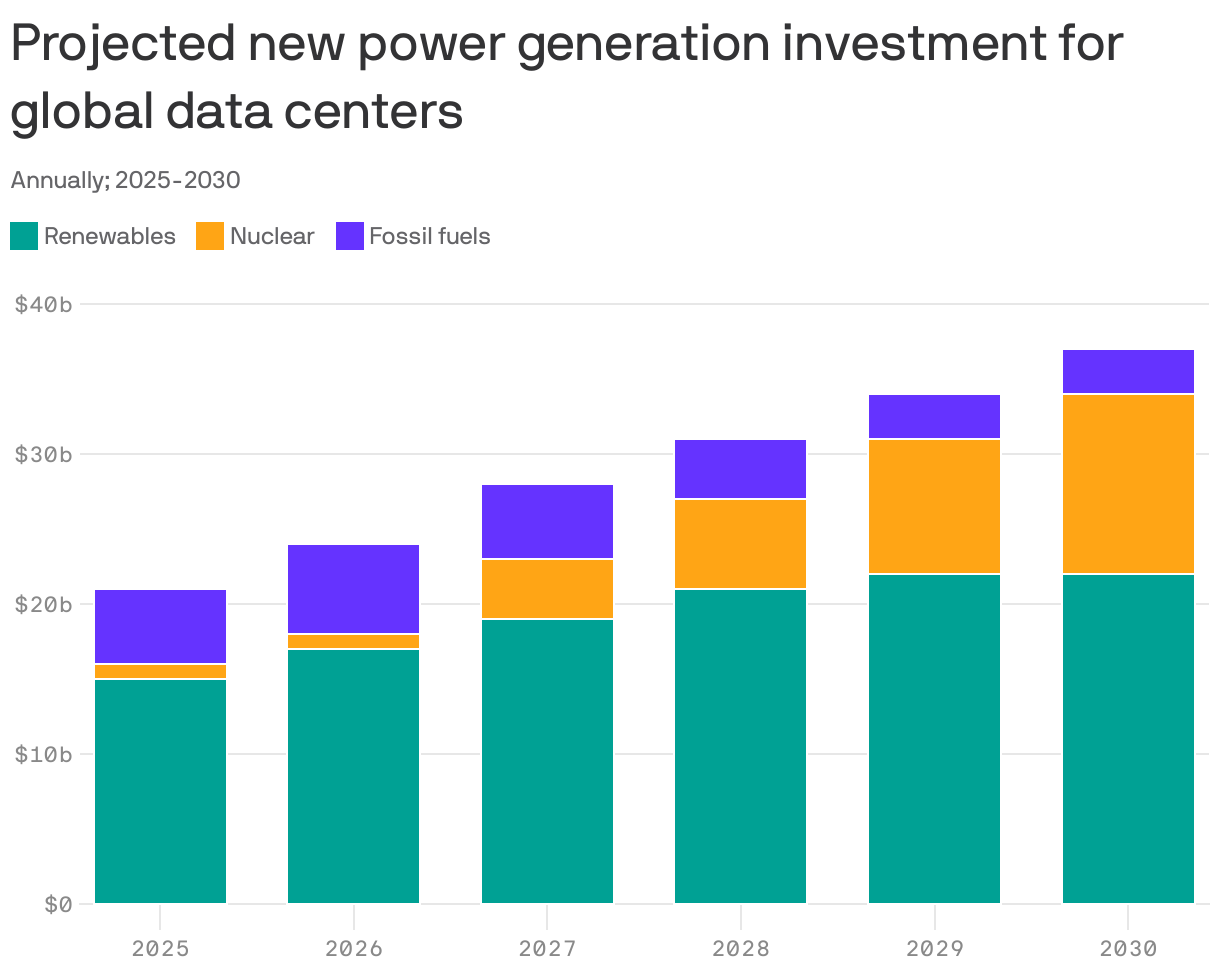
Data center energy demand will require upwards of $170 billion worth of investments in new power generation capacity, IEA's latest report finds.
- BTW, pages 186-187 of IEA's big report has a nice, wind-angle look at the U.S. picture on data centers — including grid needs.
📧 Did a friend, colleague or an AI chatbot send you this newsletter? Welcome, please sign up.
🙏 Thanks to Chris Speckhard and Chuck McCutcheon for edits to today's edition, along with the brilliant Axios Visuals team.
Sign up for Axios Generate