Axios Generate

September 08, 2025


👋 Hello Axios readers! This is Amy Harder, and I'm so thrilled to share that I'm rejoining the team as national energy correspondent.
- (Still) based in Seattle, I'll be covering the future of energy and everything that broad beat entails. I'll be focusing a lot on AI (including my first article today!) and leaning into live events.
- I'm particularly excited to get the band back together with Ben Geman and our editor Chuck McCutcheon, both of whom I've worked with before. Today, we've got 1,533 words, a 6-minute read.
🎸 This week marks 45 years since pop craftsmen XTC dropped the album "Black Sea," which provides today's intro tune...
1 big thing: What AC, AI and Vegas' Sphere tell us about energy

The AI boom — and the corresponding boom in energy demand — is reviving an age-old debate: Is there such a thing as "bad" energy use?
Why it matters: In the first episode of a new podcast launched today, I go on a journey of energy self-discovery.
- I talk to experts about three different ways — often wasteful ways, critics would argue — that society uses energy: air conditioning, AI and the Sphere, Las Vegas' massive cylindrical concert venue.
The big picture: The "Shocked" podcast, supported by the University of Chicago, tackles a range of topics, including geoengineering, China's dominance in batteries and more.
Driving the news: It opens with a recitation of angry emails that a writer received after calling on people to use less air conditioning. We discuss just how essential AC is — particularly in lower-income countries facing the brunt of higher temperatures driven by global warming.
- We find that 10 air conditioners are sold every second, and focus on the appliance's growth in India.
- "If we talk about the market today, it's 14 to 15 million room air conditioners," said Kanwal Jeet Jawa, head of Daikin India. "When I started, the total market was maybe less than 10,000."
Check out this wild tidbit: Singapore's founding prime minister was asked about the most important factors in the country's success.
- First, he said, was promoting multicultural tolerance.
- Second? Air conditioning. He called it "one of the signal inventions of history. It changed the nature of civilization by making development possible in the tropics."
How it works: I then ponder energy's essential role in AI. Energy is so important to a data center's business that it's literally how the centers are measured and how companies are charged, specifically in megawatts.
By the numbers: The numbers here can feel a little abstract, because they're measured in wonky terms. Let's break it down, with help from Bruno Berti, head of product for NTT Global Data, which designs, builds and operates data centers.
- One of NTT Global Data's standard centers is designed to provide 36 megawatts, about the same amount of power as 36,000 homes.
Zoom in: Berti explains that inside a typical center, computing equipment racks about 7 feet high and 2 feet wide had, traditionally, consumed three to five kilowatts — or three to five homes' worth of power in one rack.
- "Now with AI, those pieces of equipment are 120 kilowatts a rack, and Nvidia is now talking about technology that actually says 600 kilowatts. So that's 600 homes in one rack's worth of equipment," Berti said.
- Put another way, that's something like a 12,000 percent increase.
Editor's note: This article was written based on content from the podcast, which was created by a team including University of Chicago experts and producers at Magnificent Noise. Amy is also the inaugural fellow at the university's Institute for Climate and Sustainable Growth.
2. 🗺️ The divided map of oil demand growth

Here's a counterintuitive thing: oil demand growth in developing countries is less sensitive to price changes than in advanced economies.
Why it matters: New IEA commentary lands amid analysts' divides about future consumption growth.
State of play: IEA's Alexander Bressers writes that "on the face of it," modest prices should juice consumption more in developing countries.
- Their industries are often oil-thirsty (think mining and farming), and energy is a higher share of household budgets in poorer states.
Yes, but: So why is the reverse true in recent years?
- One cause: fuel subsidies and price controls are more common in emerging and developing states, which limits the effect of crude price changes.
- And oil markets are priced in dollars. Recent declines in the currency's strength have been pronounced against the euro, which helps boost EU demand, Bressers writes.
What we're watching: New supply-demand outlooks dropping this week.
- The latest from DOE's stats arm lands tomorrow, while monthly OPEC and IEA reports arrive Thursday.
The bottom line: The trajectory of oil thirst affects investments, corporate strategies, and emissions.
3. 🏃 Catch up quick on oil and gas: sanctions and markets
⚔️ EU leaders are readying new energy sanctions against Russia, but the Trump team's appetite for fresh U.S. measures is a moving target as European Commission officials head to Washington this week.
- What we're watching: "If the Europeans drew a line and said: 'We're not going to buy more Russian gas, we're not going to buy Russian oil'. Would that have a positive influence on the US leaning in more aggressively [on sanctions] as well? Absolutely," Energy Secretary Chris Wright tells the FT.
📈 Oil prices are up to start the week despite OPEC+ deciding over the weekend to add more barrels to the market, with Brent crude trading around $67 this morning.
- What they're saying: The combo of a smaller supply OPEC+ boost than what's been happening in prior months and the prospect of fresh EU sanctions on Russia create upward pressure, ING analysts said.
- The intrigue: RBC Capital Markets' Helima Croft, in a note, said the actual addition in October will be much smaller than the 137,000-barrel-per-day headline because some members are already producing more than they've pledged.
- The bottom line: "We do not see the unwinding of the voluntary cuts as a reprisal of the 2015 and 2020 market share wars given the volume and timing of the increases," she writes.
4. 🚗 Sign o' the times: VW launches affordable EV push

Over the weekend, Volkswagen unveiled plans for a family of new, affordable EV models based on the ID.Cross concept shown above.
Why it matters: Automakers are grappling with the rise of low-cost Chinese EVs from BYD and other brands making inroads in Europe.
What's next: Volkswagen plans to start bringing the four new models, which have ranges up to around 260 miles, into production next year.
- The company is showing them off at the big Munich auto show this week, where the rise of Chinese EVs will be a theme.
5. 🗓️ Big this week: the future of gas markets

The huge Gastech conference unfolds in Italy with CEOs and top government officials to spare. A few things I'll be watching ...
🖥️ The gas-AI nexus. There's a brand new sub-conference and exhibition space this year about AI and data centers, a sign of AI's growing prominence in energy strategies and investing.
🇨🇳 China-Russia fallout. Russia is claiming it finally landed a deal with China to build the massive Power of Siberia 2 pipeline.
- But check whether companies and other governments really see the project happening, or just diplomatic posturing. There's reason for doubt.
🗞️ News from Trump's team. Wright and Doug Burgum — who leads Interior and the White House energy council — will attend.
- I'll be looking for any progress drumming up investor and offtaker interest in the proposed Alaska pipeline and LNG project — a project that faces big hurdles.
- U.S. officials hope to boost exports to Europe even beyond the rise in recent years as Russian exports to the bloc plummeted. Trump's team will be making the "sales pitch," a top aide said last week.
🔭The future of LNG. U.S. growth gets lots of attention. But analysts with Columbia's energy think tank just dropped a new analysis of how Qatar, also a heavyweight, might play its cards. More on that below.
6. 🧁 Bonus: where the LNG will come from
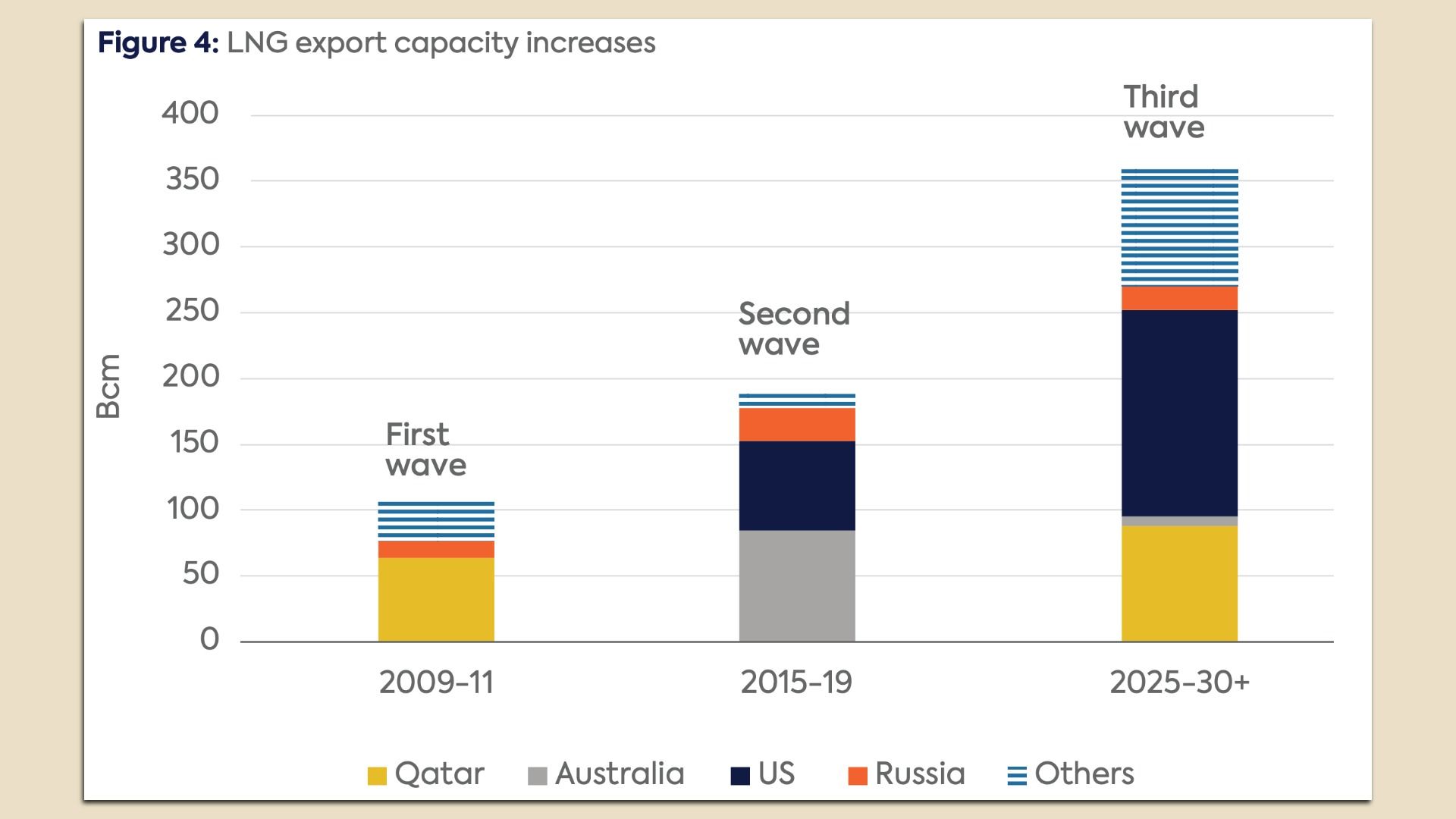
This graphic lays out how Qatar and the U.S. will play outsized roles in the coming LNG supply surge, but more entrants are arriving too.
- It's from that Columbia analysis I flagged above.
Why it matters: Qatar's decisions will affect oversupply the authors and other market-watchers see arriving in a few years, as well as prices and demand growth.
What we're watching: The essay gets into Qatari options. One is "active market management" that delays some volumes of future supply that's not already contracted.
- But another is an aggressive market share push that drives down prices, undercutting U.S. LNG.
7. 💬 Quote of the day: climate politics edition
"If you ask Americans, do you want to do this for the climate? Do you want to do that for the climate? People will say 'yes, yes, yes, yes, yes.' When you ask Americans: what are your most important issues? And how important is climate? It's not very important at all, even for the youngest Americans."— Political data analyst Galen Druke during an appearance on the "Not Even Mad" podcast
Why it matters: Polling shows a split-screen on climate.
- The public typically favors tougher action to address the problem.
- But it ranks near the bottom when people field open-ended questions about their priorities.
🙏 Thanks to Chuck McCutcheon and Chris Speckhard for edits to today's edition, along with the brilliant Axios Visuals team.
🚨New from Axios: A show built for your small screen launching this month. We're bringing you candid conversations with leaders shaping business, tech, culture and more. Watch the promo video ... Read more in Variety.
Sign up for Axios Generate