
Axios Generate

June 11, 2025

🐪 Halfway. We're getting over the hump with a quick 1,276 words, 5 minutes.
🚨 Situational awareness: President Trump today said the newest trade deal with China would provide the U.S. with needed supplies of rare earth materials.
🌡️ Bulletin: Last month was Earth's second-warmest May in temperature records that date back to the 1800s, per the EU's Copernicus Climate Change Service.
📻 At this moment in 1981, Kim Carnes was No. 1 on Billboard's Hot 100 with today's intro tune...
1 big thing: Projected crude-oil dip undercuts "drill baby drill"
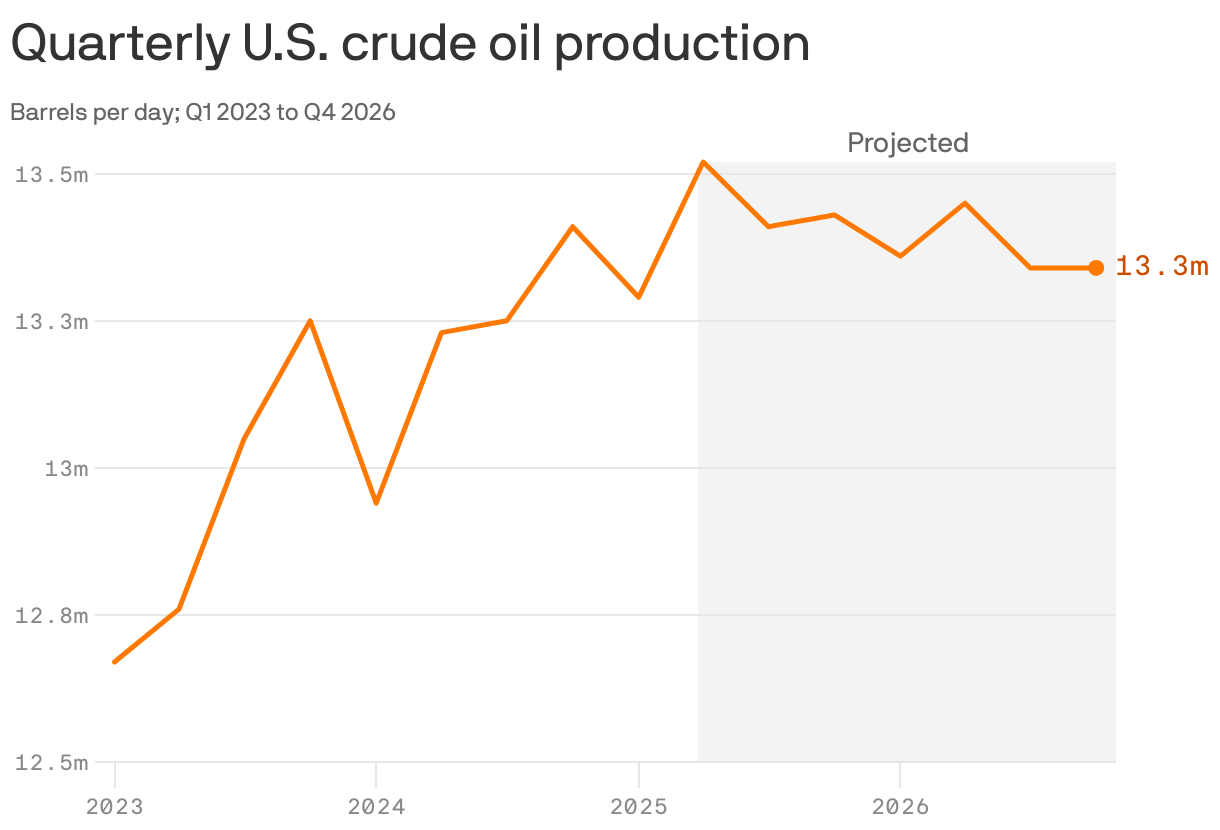
Fresh projections add weight to a problem for President Trump's "drill baby drill" push — many companies won't follow along in this price and tariff landscape.
The big picture: A revised outlook from DOE's independent stats arm shows U.S. crude output sliding in the second half of 2025, and a small year-over-year drop in 2026.
- It would be the first annual decline since COVID battered demand in 2020-2021.
Why it matters: Yes, the revisions are small and yes, the U.S. remains by far the world's top producer.
- But the symbolism is big as the White House promotes its "energy dominance" agenda.
State of play: The Energy Information Administration yesterday estimated that U.S. output will dip 0.3% to average 13.37 million barrels per day in 2026.
- It's the latest in several downward revisions this year, but the first that sees a decline — last month's version still estimated a very small rise over 2025.
Driving the news: EIA cited a steeper-than-expected drop in active rigs, adding "we forecast U.S. operators will drill and complete fewer wells through 2026."
- S&P Global Commodity Insights goes further, projecting that 2026 will slide to an average of just under 13 mbd.
The intrigue: Onshore shale is the biggest part of U.S. output.
- One big question is whether a total U.S. production decline next year would be a blip or an inflection point — at least without far higher prices on a sustained basis.
- Remember that in early May, the CEO of Permian Basin heavyweight Diamondback Energy told shareholders that onshore U.S. production has likely peaked.
What they're saying: "It's peak shale at this price," oil analyst Rory Johnston, founder of Commodity Context, tells me.
- "This is not a geological or kind of a fatalistic peak, but rather an economic one," he said in an interview.
- The current prices and cost structure, especially with tariffs pushing costs up, "is not conducive to profitability for these firms, so they're going to start pulling back."
Yes, but: Lots of caveats here. One is that Trump's "dominance" agenda isn't only about crude, but rather LNG and more.
- Another is that Trump 2.0 officials are keen to create more access for long-lead time projects outside the shale patch, like offshore areas and Alaska.
- Oh, and projecting U.S. production is a notoriously tricky, multi-variable thing — these rolling EIA outlooks are just snapshots in time.
What we're watching: Trade negotiations with China, India and other nations.
- Trade wars are bearish for demand and hence global crude prices.

2. 🏭 Here come EPA's power plant repeals
Today EPA is expected to formally start unwinding Biden-era rules to curb CO2 and certain air pollutants from power plants, per news reports.
Why it matters: The proposals launch a new and more granular phase of Trump 2.0 efforts to unwind environmental policies that it calls undue restrictions on energy companies.
- Electricity generation is the second-largest source of U.S. CO2 emissions behind transportation.
Catch up quick: A 2024 rule set standards for new gas-fired plants, and existing coal units slated to run past 2038, that require 90% CO2 capture in 2032.
- The rules are less strict for coal plants shutting down before 2039, and plants retiring before 2032 are exempt from new CO2 limits.
What we're watching: "We anticipate Trump's rule will scrap all of these inbound requirements, while teeing-up the policy argument that no future GHG restrictions are required for US power sector," TD Cowen said in a note.
The big picture: EPA head Lee Zeldin has argued the CO2 rules are costly for families and run afoul of Supreme Court rulings that limit what regulators can do absent explicit congressional blessing.
- But unwinding the CO2 rule, and rules on mercury and other toxics, is dangerous, would bring more illnesses, missed school and work, and increase health care costs, Environmental Defense Fund general counsel Vickie Patton said in a statement.
What's next: A big bureaucratic, messaging, and eventually legal fight.
- EPA did not provide comment but said that Zeldin will make a "major policy announcement" at 2pm today.
Go deeper: Document shows E.P.A. plans to loosen limits on mercury from power plants (NYT)
3. 💵 The Trump-y push to sway the president on energy credits

A new business-backed group with GOP ties just launched a $2 million, three-week ad blitz to preserve IRA tax credits — and the framing is very Trump-y.
Why it matters: It comes during crunch time for hundreds of billions of dollars of tax incentives on the chopping block in the budget reconciliation fight.
The big picture: Built for America is placing ads on Fox, Truth Social, Rumble, podcasts and beyond.
- "Unlike other efforts focused on Congress, Built for America is the only campaign speaking directly to the President and making the case that these energy tax credits are a cornerstone of his pro-worker, pro-growth agenda," the rollout states.
State of play: It's not disclosing specific donors, but backers include players in nuclear, carbon capture, hydrogen, critical minerals, storage and more, it said.
- The executive director is Mitch Carmichael, a Republican who previously served as West Virginia's lieutenant governor and economic development secretary.
- Republican strategist and former Trump campaign adviser Bryan Lanza is advising the new effort.
Driving the news: "Trump country is booming. We're building, hiring and winning in America, because energy tax credits put America first," one of the ads states, touting new jobs and manufacturing.
- "President Trump, keep what works," it states.
Catch up quick: More and more business interests are pressing the Senate to soften House GOP budget plans that scuttle or restrict IRA energy tax credits.
- The U.S. Chamber of Commerce, in a new post, is urging preservation of what it calls "pro-growth" credits around hydrogen and clean electricity production.
The bottom line: Low-carbon energy industries are increasingly framing their message more around "energy dominance" and less — a lot less — around green goals.
- The new effort brings GOP ties, a big chunk of change, and an especially MAGA scaffolding.
4. 💬 A power giant's CEO, unfiltered
NextEra Energy president, CEO and chairman John Ketchum offered Politico a candid interview at its energy event yesterday. A few highlights...
😬 "I really see the potential for an energy shortage if we don't get our energy policy right," he said.
- "What we're projecting over the next 20 years is a sixfold increase in the growth rate for power."
☀️ Renewables are a must-have because new gas and nuclear timelines are very long.
- It will take until around 2032 to get new gas-fired units on the grid amid turbine backlogs, labor challenges and more.
- "If we take renewables off the table, we are going to have a real power shortage problem in this country, I fear, perhaps leading to blackouts during scarcity intervals."
🗳️ Asked if he's nervous about the House-passed budget bill, Ketchum said "yeah."
- He criticized several provisions, including the "foreign entity of concern" restrictions that are "unworkable."
- "There's no American company in any industry that could comply with these provisions."
🛢️ The oil price slide puts pressure on gas supplies, because less crude activity means less "associated gas" output even as LNG exports rise.
- "What's going to happen to natural gas prices? They're going to go up."
❌ Trump can't revive coal in a meaningful way, despite the recent exec orders, Ketchum said, arguing that delayed retirements will be minor relative to demand growth.
- "It just, unfortunately, is not going to make a dent. The train has left the station on coal."
5. 🧮 Data center number of the day: 5%
Commercial sector electricity use is slated to rise 5% in 2026 and 3% this year, DOE's independent stats and analysis arm now projects.
Why it matters: It's a notable upward revision from the Energy Information Administration's prior estimate of 2% annual growth through 2026, and it cited, you guessed it, data centers as a major reason.
📧 Did a friend, colleague or an AI chatbot send you this newsletter? Welcome, please sign up.
🙏 Thanks to Chris Speckhard and Chuck McCutcheon for edits to today's edition, along with the brilliant Axios Visuals team.
Sign up for Axios Generate