Axios Generate

July 21, 2025

🥞 Welcome back! We're sprinting into the week with a newsy 1,063 words, 4 minutes.
🎸 On this date in 1972, glam-rockers T. Rex released the album "The Slider," which provides today's intro tune...
1 big thing: A new playbook for U.S. energy and industrial power

The U.S. has reached an "inflection point" that demands "swift and decisive action" to reverse erosion of industrial capacity and tech leadership, warns a major new report from the nonprofit Securing America's Future Energy.
Why it matters: "The rise of China as a global economic and military competitor presents one of the most existential challenges the United States has faced in its history," it finds.
- The U.S. is "increasingly reliant on foreign adversaries" for minerals, tech, and supply chains that power the economy and our defense.
The big picture: The report blends geopolitical analysis with detailed policy ideas.
It's grouped around reinforcing four "pillars of power" that underpin security — materials for defense needs are a theme here — and industrial resilience:
- Expanding and securing supplies of minerals and materials.
- Satisfying energy security needs.
- Promoting new tech that maximizes efficiency and diversification.
- Increasing manufacturing capacity.
Between the lines: It's quite Trump-y in some ways while implicitly rejecting some of his policies in others.
- A spin through the many detailed recommendations shows many are consistent with Trump 2.0 goals in areas like LNG and domestic oil and critical minerals production.
Yes, but: Elsewhere, citing manufacturing competitiveness goals, it backs tech like EVs and solar that Trump officials disdain as they yank away federal support.
- "EVs will likely play a major role in the future of the automotive industry — and the United States must lead the transition for both national and economic security reasons," it states at one point.
- And it calls for an even more aggressive industrial policy at a time Trump officials are already moving in this direction via efforts like taking a direct stake in rare earths company MP Materials.
Zoom in: Here are just a few of the 30 detailed policy recommendations that caught my eye beyond the usual (but important!) stuff like permitting reform...
- New DOE and DOD-led cost-sharing initiatives with battery manufacturers and other downstream industries.
- Direct Pentagon purchasing of small modular reactors.
- Expanded Transportation Department grants for zero-emissions vehicles.
- "Congress should reprioritize existing loan guarantee programs to support advanced energy, manufacturing, and dual-use manufacturing capacity."
- Using the Defense Production Act and export finance agencies to enhance access to help allies develop minerals the U.S. does not possess.
The bottom line: "The decisions made today will determine whether the United States reasserts and secures its position as the world's leading economic and technological power or continues to cede ground in industries critical to its future," the report finds.
2. 🧁 Bonus: China's mineral dominance, charted
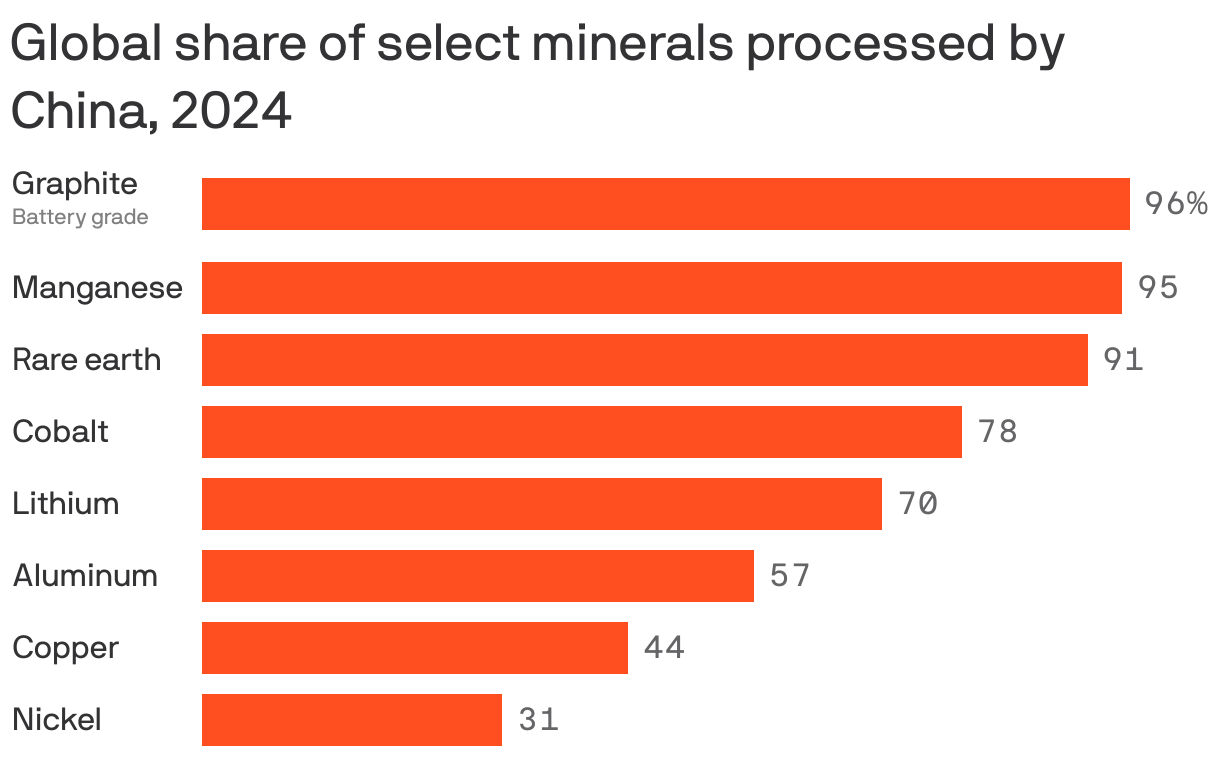
This graphic highlights just one area of China's industrial power that the SAFE report urges U.S. policymakers to counter more aggressively.
3. 🏃 Catch up quick: BP, mining, EPA
🗞️ BP said this morning it has appointed Albert Manifold, until recently CEO of building materials company CRH, as its next board chair.
- Why it matters: The decision has been closely watched as BP pivots back toward its core oil and gas business and looks to improve financial performance that has lagged peers.
- State of play: BP cited his "strong track record of strategic leadership and operational delivery with a focus on cost efficiency, disciplined capital allocation and cash flow generation."
⛏️ U.S.-based Kobold Metals has a new deal with the Democratic Republic of Congo for "large-scale mineral exploration," the parties said late last week.
- Why it matters: "The deal opens the door to US investment in what is a major global supplier of cobalt and copper," Mining.com reports.
✂️ EPA is closing down its Office of Research and Development as it reduces staffing levels.
- State of play: The agency said Friday that it's enhancing scientific expertise and research within its separate program offices. It's also creating a new "Office of Applied Science and Environmental Solutions."
- The other side: Green groups said closing ORD is dangerous. "The scientists in that office conduct work independently. They do not make decisions about regulations that industry interests lobby hard to influence," the Environmental Defense Fund's Sarah Vogel said in a statement.
4. 💬 What they're saying about Chevron-Hess

Chevron finally prevailing in its 20-month bid to acquire Hess is a big victory, but the oil giant didn't escape the battle with rival Exxon unscathed.
Why it matters: The deal that closed Friday gives Chevron a 30% stake in huge fields off Guyana's coast, among the hottest finds in decades, and other assets.
Catch up quick: An arbitration panel's ruling nixed Exxon's claim to a right of first refusal on Hess's stake in the Exxon-led and operated Guyana project.
What they're saying: The "quality, duration, and potential upside of the Guyana asset" make the decision a win for Hess and Chevron investors, Jefferies analysts write.
- And Piper Sandler's Ryan Todd said in a note: "While current market bearishness on crude price may temper this in the near-term, we see deal closure as removing the largest source of investor uncertainty and setting the stage for sustained outperformance."
Yes, but: "The delay kept roughly 180,000 barrels per day (bpd) of Hess oil, about $6-7 billion in gross sales and $3 billion in profit, just from Guyana's Stabroek Block sailing past Chevron's till in 2024, because those barrels kept flowing to Hess while the lawyers argued," Running Point Capital's Michael Ashley Schulman tells Reuters.
The bottom line: "Ultimately, all's fair in love, war and oil M&A," writes Bloomberg columnist Javier Blas of Exxon's bare-knuckled legal tactics.
5. 📡 On my radar this week: FEMA, Trump, Tesla

🌀 House lawmakers will grill FEMA's acting head Wednesday amid intense focus on the agency's future mission and funding under President Trump.
💾 Look for more signs of the White House energy-for-AI agenda when President Trump speaks Wednesday on the wider Trump 2.0 AI agenda.
- What we're watching: The White House is also slated to release an AI "action plan" in coming days that includes energy provisions.
🚗 Tesla reports earnings after the bell Wednesday during an especially rough patch for Elon Musk's company — even by its never-a-dull-moment standards.
- Why it matters: It will be the first earnings call since enactment of the budget law that ends EV tax credits. Investors will also be looking for the latest on plans to introduce lower-cost models and counter a global sales slump.
6. ⚡ Number of the day: roughly $170 billion
That's the estimated cost of a hydropower dam that China's just begun building in Tibet, per Reuters.
Why it matters: It's slated to be the world's largest hydro project.
- "Authorities have not indicated how many people the Tibet project would displace and how it would affect the local ecosystem, one of the richest and most diverse on the plateau," Reuters reports.
📧 Did a friend, colleague or an AI chatbot send you this newsletter? Welcome, please sign up.
🙏 Thanks to Chuck McCutcheon and Chris Speckhard for edits to today's edition, along with the brilliant Axios Visuals team.