Axios Generate
August 27, 2025

🧑🍳 Bon appétit! We're exploring a rising player in cleaner cooking, then offering a wide menu of news, all in just 1,159 words, 4.5 minutes.
🌀 Situational awareness: Multiple FEMA staff who signed an open letter criticizing Trump 2.0 cuts to disaster prep were placed on leave, per WaPo and other outlets. Go deeper.
🎸 Happy birthday to Rush guitarist Alex Lifeson, whose talent animates today's intro tune...
1 big thing: New backing for battery-equipped stoves
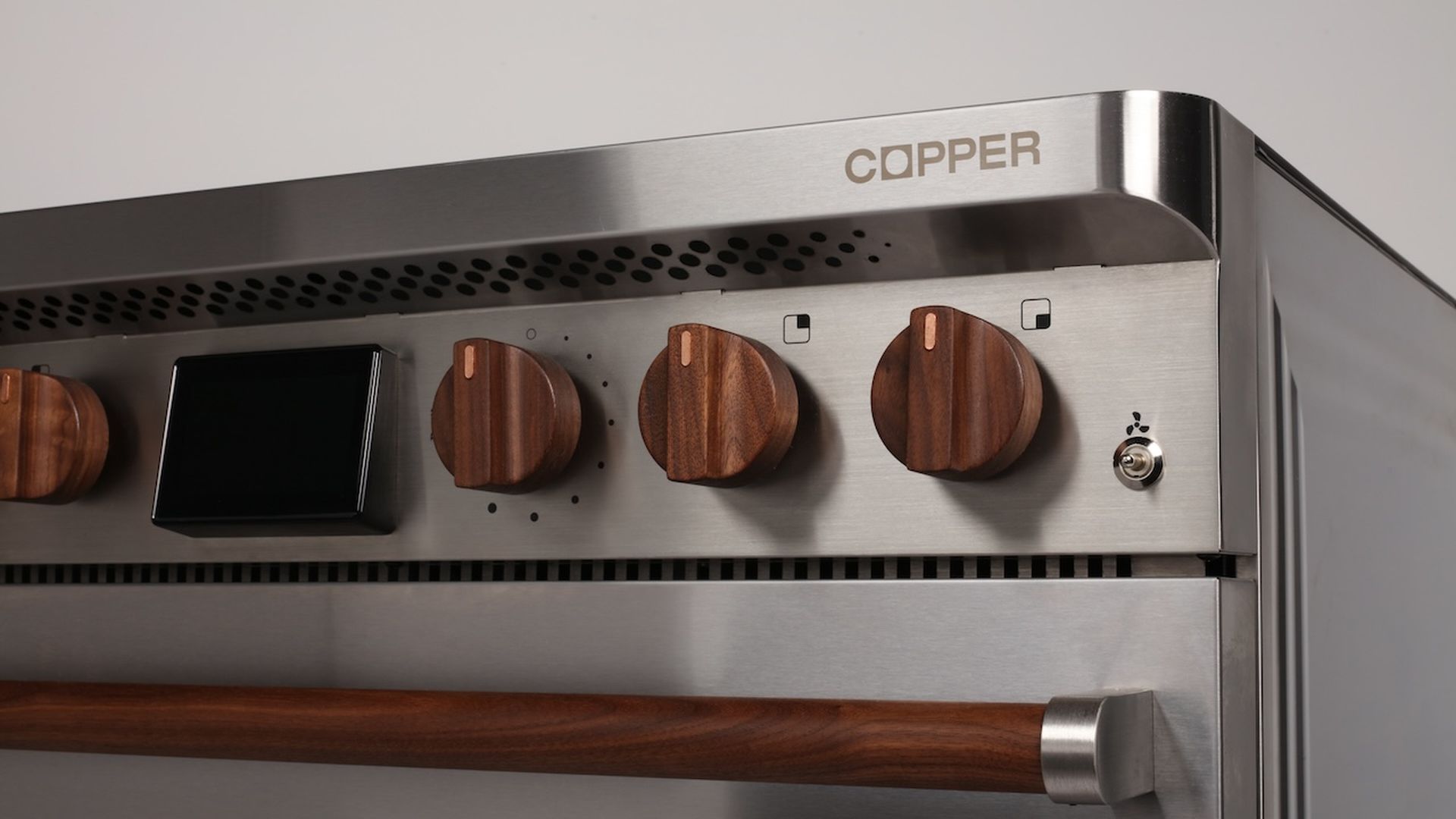
Copper, a startup that makes battery-equipped induction stoves, landed $28 million in funding led by prominent VC player Prelude Ventures.
Why it matters: It's a bet on the business-to-business market for clean appliances, even amid the wider pullback on federal climate policies.
- Copper's ranges qualify for battery investment tax credits that survived in the GOP budget law, and various local and state incentives remain for going electric, too, CEO and co-founder Sam Calisch notes.
📻 Driving the news: The $28M will help Copper scale and develop more stoves and other appliances, it said.
- Building Ventures also joined the equity and debt round, along with existing investors Voyager, Collaborative Fund, Climactic and several others.
- While it sells some of the $6,000 ranges to individual buyers, Copper's main target is B2B with owners of multi-unit buildings and real estate portfolios.
📸 The big picture: Copper's stove works with standard 120-volt outlets, so buildings don't need costly electrical overhauls, the company said.
- And for pre-1990s buildings, it could otherwise require contacting the local utility to upgrade the fuse paneling, Calisch said in an interview.
- "Induction is widely recognized by a lot of chefs as the superior cooking experience, more power, more precision. But it's been a little slow to be adopted in the U.S., and that's primarily a function of the U.S. power system," he said.
"We design our product to plug right into what you already have, so you don't have to have an electrician come to your house. You don't have to do a construction project. It's just a plug-and-play experience," he said.
- Calisch sees opportunity in sparing building owners from expensive renovations to aging natural gas infrastructure, which can run many thousands of dollars to meet codes.
🏃 Catch up quick: The Berkeley, Calif., company founded in 2022 has now raised $38M and began shipping last year.
- It has shipped roughly 1,000 units and has a multiyear contract with the New York City Housing Authority for 10,000.
- The range draws on varying levels of electricity and battery power. Internal software enables it to use exclusively battery power during blackouts or when grid power is "expensive or dirty," per Calisch.
🏈 State of play: Calisch is bullish on using battery-equipped stoves as distributed storage networks that lessen needs for gas-fired peaker plants during high demand.
- They've worked with California's Demand Side Grid Support Program to pilot the idea, he said. It offers incentives to customers that provide load reduction and backup generation to support the grid during extreme events.
💭 Our thought bubble: Copper is largely pitching itself to building owners — but it's really a consumer-facing product.
- That means not only convincing real estate companies that Copper stoves are worth paying for, but that future renters and buyers will care enough to justify the cost, Axios Pro Deals' Alan Neuhauser points out.
🔭 What we're watching: Copper's next home products.
- "I'm not totally ready to pull back the curtain on that yet, but I would say, look at places where gas is used today," Calisch said.
- He added that things like HVAC and water heating are "really good opportunities."
2. ⏸️ Net-zero banking club halts work as members bail

The Net-Zero Banking Alliance, hit by an ongoing wave of defections, is pausing work while weighing a new structure, the UN-affiliated group said today.
Why it matters: It's a stark sign of the ESG pullback on Wall Street and the financial sector more broadly, though many banks say they remain committed to low-carbon transition.
Driving the news: Remaining members will vote on a "proposed transition from a membership-based alliance to establishing its guidance as a new framework initiative," the group said.
- It's halting work during the voting process and will share the outcome at the end of September.
State of play: The NZBA is among the constellation of financial industry groups that work with members to align their lending, investment and capital markets activities with net-zero in 2050.
- Major banks and investment firms have been abandoning the affiliations, partly under political and legal pressure from U.S. Republicans.
- Bank of America, Morgan Stanley, Goldman Sachs and JPMorgan and other U.S.-based heavyweights have exited the NZBA since Donald Trump's election.
- But the defections now include banks in multiple countries. Another group, the Net Zero Asset Managers initiative, said in January it's reviewing its structure and suspending work.
What's next: The NZBA "encourages the banking sector to remain steadfast in implementing their net-zero commitments," it said.
3. ⛽ Here comes the cheapest Labor Day driving in years


Average gasoline prices over Labor Day weekend will be lower than in recent years.
Why it matters: Lots of people drive over the holiday weekend, and consumer costs will be a midterm election battleground.
- Gasoline prices have ticked up recently but could be heading back down if predictions of softening oil supply-demand balances come to pass.
- But electricity prices are rising, so the politics of energy are getting complicated.
4. ⚛️ Meet the new fusion startup with a DOE pedigree


Twilio co-founder Jeff Lawson has teamed up with two fusion scientists, including Andrea Kritcher, to launch a new nuclear fusion startup named Inertia Enterprises.
Why it matters: The team plans to turn the fusion breakthroughs at the Energy Department's National Ignition Facility into commercial power plants.
State of play: Lawson, who stepped down as Twilio's CEO in 2024, tells Axios he met Kritcher at a conference last year and started chatting with her "as a fan."
- Kritcher led the team of scientists at Lawrence Livermore National Labs' NIF that achieved the world's first fusion ignition and breakeven in 2022.
Driving the news: Inertia says it has struck deals with LLNL, working with the lab on projects, licensing 200 patents and enabling Kritcher to be a co-founder of the startup while still maintaining her work at the lab.
- Inertia's third co-founder is Michael Dunne, a professor of photon science at Stanford University, who previously led a program at LLNL to develop a power plant design based on the LLNL ignition tech.
Follow the money: Lawson says he's initially funding Inertia with "a substantial amount of capital."
Read the whole story, and unlock a steady stream of scoops and smart analysis by talking to our sales team about Axios Pro Deals.
5. 🇨🇳 Number of the day: 21 gigawatts
That's how much new coal-fired power capacity was brought online in China in the first half of 2025, the highest first six months of any year since 2016.
- The stat comes from the latest biannual analysis from The Centre for Research on Energy and Clean Air and Global Energy Monitor.
📧 Did a friend send you this newsletter? Welcome, please sign up.
🙏 Thanks to Chuck McCutcheon and Chris Speckhard for edits to today's edition, along with the brilliant Axios Visuals team.
Sign up for Axios Generate