
Axios Generate

May 06, 2021
Welcome back! Today's Smart Brevity count is 1,247 words, 4.7 minutes.
🚨 Breaking: "EQT Corp, the largest U.S. natural gas producer, said on Thursday it will buy Appalachian basin rival Alta Resources for $2.93 billion in cash and stock, expanding its position in the gas-rich shale plays of the U.S. northeast." (Reuters)
🎶 Mason Jennings' album "Boneclouds" turned 15 this month and provides today's intro beautiful and tragic intro tune...
1 big thing: China's new emissions milestone


The distribution of global greenhouse gas emissions has reached an inflection point: China's emissions exceeded developed nations combined in 2019, a new Rhodium Group analysis concludes.
Why it matters: "The shifting dynamics of global emissions — with China surpassing the developed world for the first time — means that meeting the Paris goals will require significant and rapid action from all countries," Kate Larsen, a director at Rhodium, tells Axios.
The big picture: Rhodium compared China's emissions to nations in the multilateral Organisation for Economic Co-operation and Development as of 2019 and all 27 EU members. The chart above shows totals.
- The analysis also showed that on a per-capita basis, China's 2019 emissions were close to the OECD average. The firm expects that the final 2020 data will show China's per-capita emissions exceeded the OECD average.
- Rhodium's Larsen notes China's per-capita rise stems from higher living standards, China's relatively fossil-intensive power mix and its export-focused manufacturing.
What we're watching: The steps China takes — or doesn't — in coming years to breathe life into its pledge to have its emissions peak before 2030 and reach carbon neutrality by 2060.
By the numbers: China's emissions are over a quarter of the world's total.
Their per-capita emissions were over 10 tons of CO2-equivalent in 2019, but that's still far below the world-leading U.S. at 17.6 tons, per Rhodium.
Bonus: The cumulative picture is very different


And now some perspective! The chart above is also from the Rhodium Group analysis and shows how China's emissions look very different when measured on a historical basis.
Why it matters: It helps explain why nations that industrialized first bear such responsibility for tackling warming, even as emissions growth is centered in the Asia-Pacific.
The big picture: "A large share of the CO2 emitted into the atmosphere each year hangs around for hundreds of years. As a result, current global warming is the result of emissions from both the recent and more distant past," Rhodium notes.
2. Amazon looks to help clean energy startups take flight

Illustration: Sarah Grillo/Axios
Amazon Web Services (AWS) launched a "clean energy accelerator" this morning to help advance startups with climate-friendly technologies.
Why it matters: It's the latest step in the tech sector's expanding climate work, even as the industry remains under pressure from activists over its work with oil-and-gas clients.
How it works: Amazon plans to select 10 startups for a five-week program to provide help in areas like training, marketing, business pilot opportunities and more.
- The applicants will have access to AWS computing, machine learning, analytics and other services.
- The program also offers "collaboration opportunities with AWS energy customers," it said.
- They're looking for startups working in energy storage, carbon capture, hydrogen, smart grids and other technologies.
- AWS is working in conjunction with the firm Freshwater Advisors, which helps connect startups with large corporations.
Catch up fast: In late 2019, Amazon vowed to become net-zero emissions by 2040 and has recruited other companies to join its "climate pledge."
Its overall climate efforts include a big contract with the electric vehicle startup Rivian for electric delivery vans; renewable power procurement; and venture investing.
What they're saying: Amazon, in announcing the accelerator, called it part of the path toward meeting the 2040 pledge.
"This commitment will require innovation from large scale, established organizations to startups across the energy industry," said AWS vice president of energy Shane Owenby.
3. More energy tech notes: trucks, charging, lithium
Freight: "Einride, the Swedish startup known for its unusual-looking electric and autonomous pods that are designed to carry freight, has raised $110 million to help fund its expansion in Europe and into the United States." (TechCrunch)
Charging: Canary Media reports that the firm TeraWatt Infrastructure emerged from stealth mode Wednesday with over $100 million in backing.
The money will be used to "acquire property rights and to finance and manage EV charging infrastructure for fleet owners, charging network operators and others," it reports.
Batteries: "EnergyX has raised $20 million in Series A funding to advance its direct lithium extraction technology, with the company eyeing commercialization in late 2022/early 2023." (S&P Global Platts)
Sales: "Chinese electric car upstart Nio Inc. will take its first step outside its home market, opening a showroom and beginning to sell vehicles in environmentally conscious Norway." (Bloomberg)
4. The threat of runaway Antarctic ice melt

Illustration: Sarah Grillo/Axios
Two major new studies on sea-level rise both show the benefits of limiting global warming to the Paris temperature targets.
Why it matters: The papers, published in Nature, find that limiting warming to 1.5° C or 2° C above preindustrial levels brings the greatest chance of avoiding tipping points in the Antarctic Ice Sheet.
The details: One study, led by Tamsin Edwards of King's College in the U.K., finds that by limiting warming to 1.5° C, the land ice contribution to sea-level rise would be cut in half compared to the current pace of warming.
Meanwhile, the other study looks exclusively at the Antarctic Ice Sheet and includes ice instabilities in its modeling.
- It finds that if warming follows the 1.5° C pathway, sea-level rise from Antarctica would proceed along the present trajectory through 2100, without accelerating, largely matching the other study's data.
- However, this paper, led by Rob DeConto of UMass Amherst, shows that sea-level rise from Antarctica alone could spike to 13.4 inches by 2100 if warming reaches 3° C or higher through 2100.
- This is closest to the temperature pathway the world would follow if countries' current Paris pledges are met.
- This would mean that sea-level rise from Antarctica could begin to accelerate irreversibly as soon as 2060, due to vulnerabilities of ice shelves and ice cliffs in the West Antarctic Ice Sheet.
Threat level: Much greater amounts of sea-level rise would occur beyond 2100, on the order of several meters, if emissions stay high well into this century, the study shows.
- And don't bet on carbon removal technologies halting the meltdown. The researchers modeled that, too.
- "We're not finding really any way of slowing things down" once the ice sheet starts melting rapidly, DeConto said.
5. Charting how high sea levels could rise
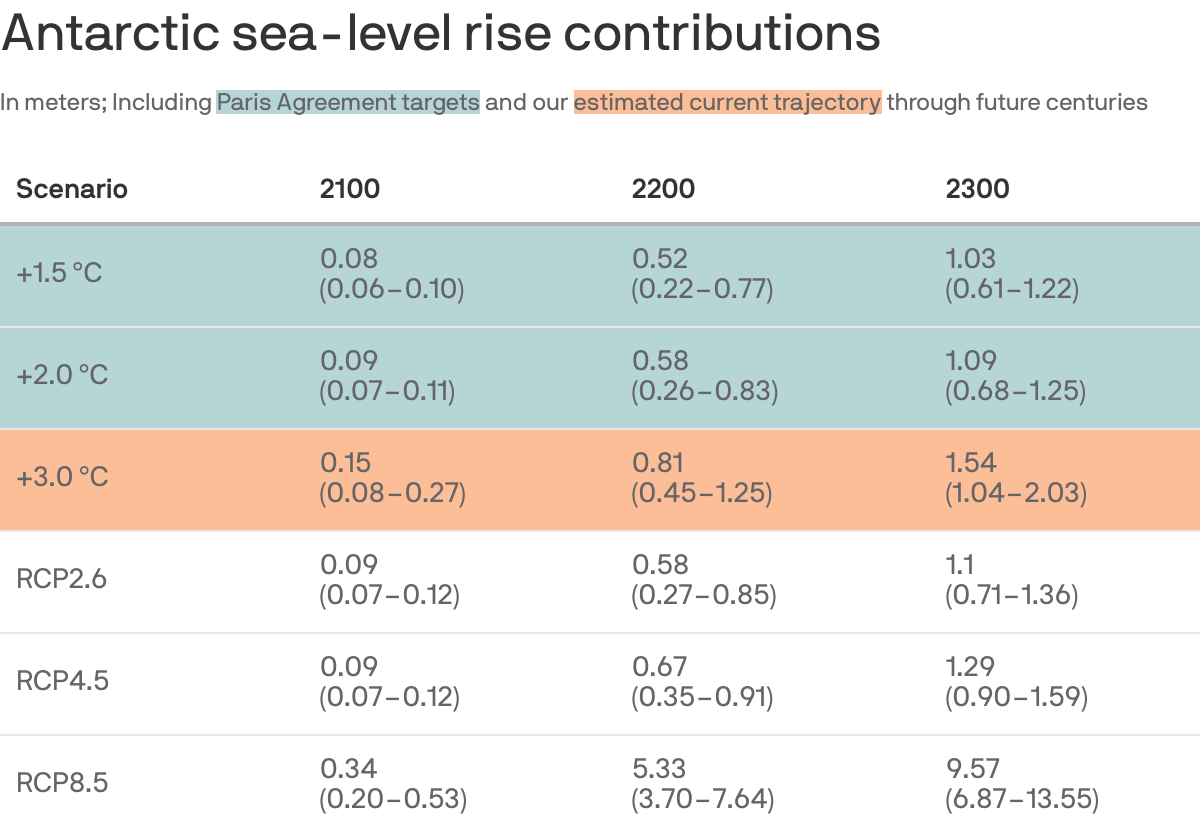
Sea-level rise from glaciers and ice sheets is closely tied to the pace and extent of global warming during the next several decades, data from the major new ice melt studies show.
Between the lines: Coastal communities might be able to adapt to the sea-level rise contribution from Antarctica alone through 2100 at lower warming scenarios.
- However, there would be big increases in that sea-level rise contribution if warming reaches 3° C and an even bigger jump if the highest fossil fuel emissions scenario (RCP 8.5), which looks less likely, comes to fruition.
- Reminder: The world has already warmed by about 1.2° C, relative to preindustrial levels.
6. Schumer aide jumps to clean energy lobbying firm
Pioneer Public Affairs, a lobbying firm focused on climate and clean energy, unveiled new hires Thursday including Charlie Ellsworth, who until weeks ago was a budget aide to Senate Majority Leader Chuck Schumer.
Driving the news: Other names include Dr. Sweta Chakraborty — whose resume includes work with the climate action social network We Don't Have Time — and Brian Willis, who spent years with the Sierra Club's Beyond Coal campaign.
- The firm was founded by Joe Britton, who was formerly chief of staff for Democratic Sen. Martin Heinrich.
- Bloomberg's piece on the firm notes that he's been "quietly building up the new venture over the past year."
Of note: A news release notes Ellsworth worked for Schumer on budget reconciliation, the process that makes certain spending and revenue measures immune from filibuster.
It's how Democrats moved the $1.9 trillion stimulus plan earlier this year and may become the pathway for moving climate-related infrastructure and tax measures.
Catch up fast: Clients include the advocacy group Climate Power, the big power company NextEra Energy Resources (with hydrogen as a focus), and Charm Industrial, a startup with negative emissions tech that converts waste biomass into an oil that's injected underground.
What we're watching: Pioneer is working with multiple clients on carbon storage matters, and Willis tells Axios that one focus is on changing the tax code so that existing storage incentives apply to carbon in liquid and solid form.
Sign up for Axios Generate

Untangle the energy industry’s biggest news stories

