Axios Generate

May 28, 2025

🍹 Summer is approaching and trade policy analysis is in the air. So are fresh looks at dangerously warming temperatures.
- We cover all this and much more in a quick 1,228 words, 4.5 minutes.
🎙️ Bulletin: A German court has tossed out a Peruvian farmer's closely watched lawsuit against power giant RWE, Reuters and AP report from Hamm.
🎶 At this moment in 1992, En Vogue were No. 1 on Billboard's R&B charts with today's hall-of-fame intro tune...
1 big thing: The energy stakes of global trade battles
The difference between trade wars and trade peace (or something close) could sway global oil demand by millions of barrels per day this decade, the research firm Wood Mackenzie finds.
Why it matters: Its oil estimates are part of a wider report that shows how trade policy is a powerful variable that will shape the energy future.
- Under its scenarios, 2030 demand would be 2.5 million barrels a day lower in a trade war compared to a low-tariffs case.
- Price differences are also quite large between the competing cases.
How it works: Woodmac models three tariffs and economic growth cases and their effects on oil, gas, power and metals.
- A "trade truce" that sees global trade barriers quickly revert back to 2024 levels.
- "Trade tensions" — the most likely — in which barriers rise but "all-out" war is avoided. Average U.S. import tariffs would be 10% in 2026-2030 vs. 2.3% last year.
- "Trade war," which means the U.S. goes ahead with President Trump's April 2 threats and things go south, bigly. Global GDP would be roughly 3% lower in 2030.
Driving the news: Woodmac sees demand rising this decade no matter what, but the amount is highly dependent on trade policies' economic fallout.
- In "truce," demand would rise 4.4 million barrels per day from 2024-2030, reaching 108 mbd, with prices healthy enough to spur growth in the U.S. and elsewhere.
- "Tensions" still brings growth, albeit slower. "War" would bring a steep decline next year before some recovery, and then growth slowly would resume before going into another late-decade decline.
The big picture: The stakes are high for other commodities, too, and U.S. companies are vulnerable.
- The "war" scenario "hits LNG demand" hard. What was already projected to be something of a supply glut from 2027 onward would get even more pronounced.
- This would squeeze the margins for U.S. LNG exporters because domestic gas prices remain "resilient."
- But trade negotiations could provide tailwinds for LNG — Woodmac points out that Trump likes to use U.S. LNG as a bargaining chip.
The intrigue: Power markets are especially tough to game out as downward demand pressure from slower growth mixes with updrafts from data centers and more.
- But Woodmac sees U.S. battery storage "hardest hit among the generation technologies" in the "war" case, given China's supply chain dominance.
- More broadly, Woodmac calls trade tensions an obstacle to global climate efforts. Tough economic times can reduce governments' financial support, and countries also prioritize energy security.
Yes, but: The nexus between trade friction, climate and clean energy is really complicated.
- Veteran Carlyle analyst Jeff Currie's recent paper argues that in a splintering world, nations will prioritize fuels that aren't traded on global markets. That boosts renewables.
The bottom line: "Even if an all-out trade war is averted, the impacts of higher tariffs on economic growth, energy demand and production costs will be complex and far-reaching," Woodmac states.
2. 🇺🇸 America's summers keep getting warmer...

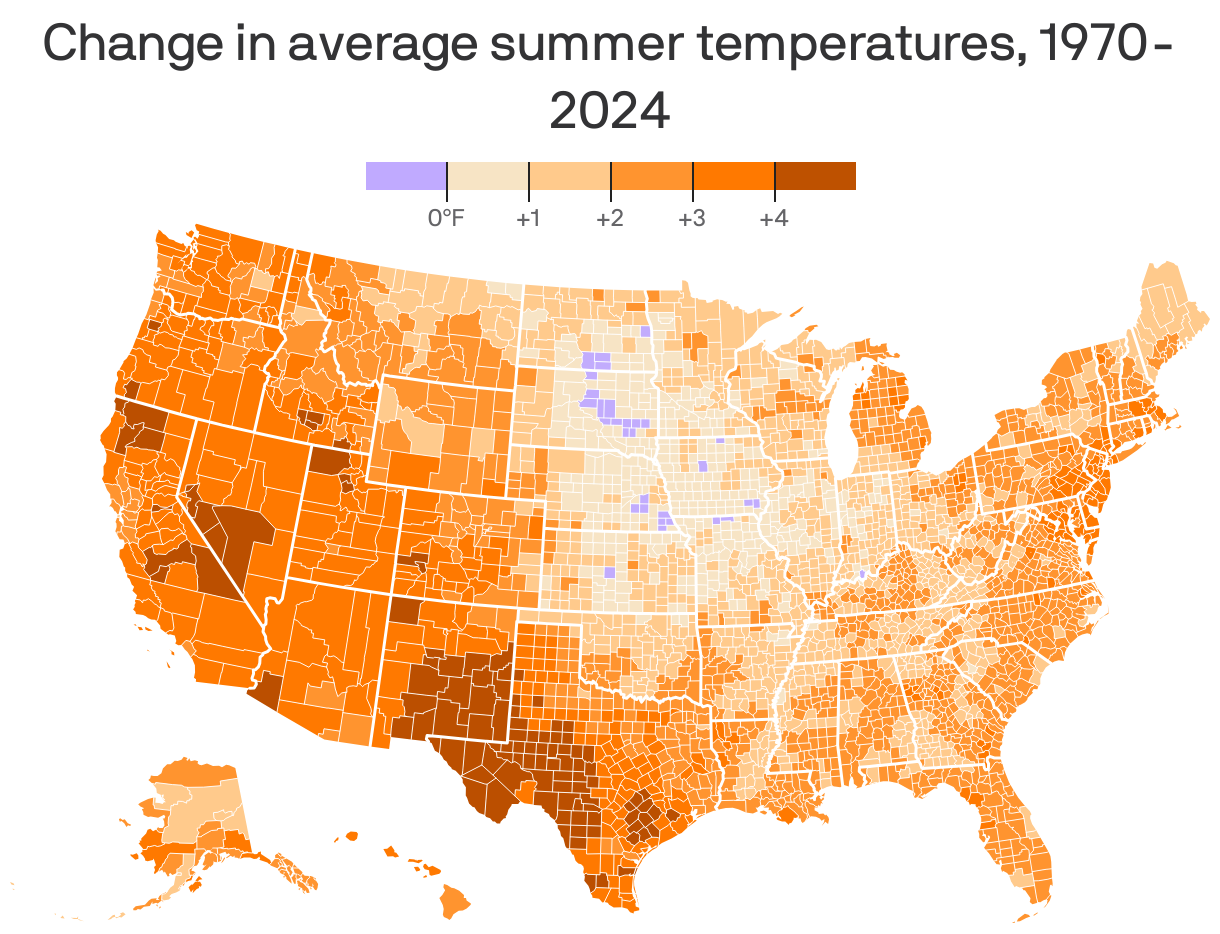
Summers are getting warmer nearly nationwide, a recently updated analysis finds.
Why it matters: Hotter summers are one of the most tangible ways we're experiencing climate change — and they're a health risk for vulnerable groups like children, pregnant women, the elderly and homeless people.
Driving the news: Average summer temperatures between 1970 and 2024 rose in 97% of the 242 cities analyzed in a new report from the research group Climate Central.
- Among those cities, summers are now 2.6°F hotter on average.
- The analysis uses NOAA data and defines "summer" as June through August.
Zoom in: Reno, Nevada (+11.3°F), Boise, Idaho (+6.3°F), and El Paso, Texas (+6.2°F) saw the greatest rise in average summer temperatures between 1970 and 2024.
Stunning stat: Over 60% of the cities analyzed now have at least two more weeks' worth of hotter-than-normal summer days compared to 1970.
Threat level: Many cities suffer from "heat islands" — areas of especially high temperatures caused by roads, parking lots, buildings and other heat-trapping features.
- Heat islands tend to be more common in low-income neighborhoods and ones with predominantly Black and Latino residents, researchers have found.
The latest: Some cities have been hiring "chief heat officers" and taking steps to keep streets cooler, like planting more trees and using reflective road coatings.
What's next: Summer 2025 is likely to be hotter than normal for much of the country, per the National Weather Service's seasonal outlook.
3. 🥵 ...and new global heat projections just landed
There's an 80% chance that at least one of the next five years will surpass 2024 as the warmest on record, the UN's World Meteorological Organization said today.
Why it matters: It's one data point in a wider new look at global warming's march.
- The report also sees an 86% chance of average temps exceeding 1.5°C above the 1850-1900 average levels for at least one year between 2025 and 2029.
- And there's a 70% chance the five-year mean exceeds that level.
The big picture: 1.5°C is a benchmark for avoiding certain climate harms.
- Holding warming to that level is the most ambitious — and very unlikely — Paris Agreement goal.
- But it's about decades-scale warming and not any specific year, WMO reminds us.
What we're watching: If the findings make their way into energy debates at this year's UN climate talks and other venues.
The bottom line: "Every additional fraction of a degree of warming drives more harmful heatwaves, extreme rainfall events" and other harms, the WMO said.
4. 👟 Catch up quick on policy: climate, congestion, copper

🛑 The White House Council on Environmental Quality is formally withdrawing an interim Biden-era guidance on weighing climate change in project reviews.
- State of play: The notice calls the guidance inconsistent with President Trump's executive order on "unleashing" American energy and other policies.
- The other side: It's "yet another reckless attempt to pretend climate change doesn't harm the environment" in order to boost fossil fuel projects, the Center for Biological Diversity said in a statement.
🚦A New York federal judge issued a temporary restraining order against Trump officials' push to cancel congestion pricing in NYC.
- Catch up quick: The federal Transportation Department had ordered the state to cease the program and threatened to withhold certain funds if it didn't.
- Why it matters: Congestion pricing is a climate policy, though state officials have emphasized other aspects.
- Go deeper: Judge's order...ABC News coverage.
⛏️ The Supreme Court let stand an appellate ruling that helps pave the way for the big proposed Resolution Copper mine in Arizona.
- Why it matters: Copper is a key energy transition metal, but the site also has major religious importance to the Western Apaches.
- What they're saying: Resolution Copper — a joint venture of mining giants Rio Tinto and BHP — said it had extensively consulted with Native American tribes to reduce impacts and that "ongoing dialogue will continue to shape the project."
- The other side: "Before allowing the government to destroy the Apaches' sacred site, this Court should at least have troubled itself to hear their case," Justice Neil Gorsuch wrote in a dissent from the decision not to hear the challenge. Justice Clarence Thomas joined him. Go deeper.
5. ⚛️ Number of the day: $750 million

That's how much investment firm C5 Capital is raising for a growth equity fund focused on the nuclear energy supply chain, Axios Pro Deals scooped.
Why it matters: It's one of the first funds explicitly targeting advanced reactors, even as they remain years from coming online.
Unlock the whole story, and for a steady diet of scoops and smart analysis, talk to our sales team about Axios Pro Deals.
📧 Did a friend, colleague or an AI chatbot send you this newsletter? Welcome, please sign up.
🙏 Thanks to Chris Speckhard and Chuck McCutcheon for edits to today's edition, along with the brilliant Axios Visuals team.
Sign up for Axios Generate


/2025/05/27/1748383106178.gif?w=3840)