
Axios Generate

May 01, 2025

🙊 Confession: I wish I'd done high school theater. But the energy beat is scratching that itch for drama!
- We open with a look at long-term corporate risk but then dive into present-day tumult, all in just 1,336 words, 5 minutes.
🎙️ Bulletin: Janet Yellen, the ex-Treasury boss and Federal Reserve chair, joined the advisory board of climate-focused VC firm the Angeleno Group, Axios Pro Deals scooped.
📻 HBD to the Ray Parker, Jr., the musician-singer-songwriter best known for "Ghostbusters" but who's got an A+ resume including today's intro tune...
1 big thing: A new, wide-angle take on corporate climate risk
Companies listed on the world's biggest stock exchanges have over $1 trillion at risk ahead in countries facing high climate vulnerabilities, a new analysis finds.
Why it matters: Verisk Maplecroft's study takes a newly expansive view of corporate climate jeopardy.
- The risk consultancy explores exposure to forces like political instability, declining workforce productivity, migration and much more.
State of play: It sees $1.14 trillion worth of market value at risk in 2050 in countries facing "very high" climate exposure in their index — up from just $34.8 billion today.
- That's based on their "intermediate" emissions scenario that projects global temps climbing 2.7°C above preindustrial levels this century.
- For context, that much warming would bring lots of harm — and it's quite plausible.
- UN climate analysts estimated in late 2024 that full implementation of nations' voluntary climate pledges at the time would bring 2.6°C.
The big picture: "While many companies report on their physical exposure to climate hazards, lesser understood socio-economic factors do not feature as part of corporate strategies, creating a blind spot for long-term resilience planning," says Will Nichols, Verisk Maplecroft's head of climate and resilience, in a statement.
How it works: The analysis graphs each country's exposure to three major buckets of risk.
- Hazards like extreme weather events and long-term, chronic changes in temperature and precipitation levels.
- The sensitivity of their populations based on health, poverty levels, farming reliance and more.
- Adaptation capacity based on factors like institutions' strength and political stability.
What they found: A "dramatic increase in the financial exposure of companies and investors" in the world's five largest equity exchanges.
- That intermediate emissions case brings the number of countries ranked "very high" in Verisk's "Climate Hazard and Vulnerability Index" to 48 by midcentury, up from 24 today.
- There are threats to corporate assets in big emerging markets, especially India, but also Nigeria, Pakistan and others.
Threat level: While the report focuses on valuations and assets, it's a reflection of global warming hitting people hard.
- It notes that fast-growing, lower-income nations "will bear the brunt of the climate crisis despite their low overall contribution to global emissions."
- Western companies headquartered in richer, more resilient countries are not insulated, given risks to their operations abroad.
The bottom line: "Markets tend to price risk at the corporate level, yet climate vulnerabilities manifest where assets are located, not just where companies are domiciled," said Franca Wolf, the firm's principal markets analyst.
2. 🏃 Catch up quick: never a dull moment edition
👀 Via Bloomberg, "The Trump administration sued Michigan, its Democratic governor and attorney general, trying to block the state from seeking damages in court from fossil fuel companies it says caused harm through climate change."
- Catch up quick: The suit comes weeks after the White House signaled a new push against state-level climate laws and lawsuits.
☕ Waking up to Tesla drama: The WSJ dropped a bombshell report last night that Tesla's board had quietly begun looking for a new CEO to potentially replace Elon Musk.
- Yes, but: Both board chair Robyn Denholm and Musk strongly denied it. Either way, Musk has recently signaled he's refocusing on Tesla and stepping back from DOGE.
- What they're saying: Wedbush Securities analyst Dan Ives wrote that he'd be surprised if the board were still planning to search and that he expects Musk to remain CEO for at least five years. Axios' Nathan Bomey has more.
🇺🇦 GOP Sen. Lindsey Graham tells the WSJ he's got a bipartisan, filibuster-proof majority for his bill that would impose 500% tariffs on U.S. imports from countries that buy Russian oil, gas and other goods.
- Why it matters: It could boost pressure on the White House to take a tougher stance with Russia on ending its war on Ukraine.
3. 🌀 Perfect storm sends crude swooning anew
Reports of a changing Saudi posture combined with weak U.S. economic signals have pushed crude oil prices to fresh four-year lows.
Why it matters: Prices are now low enough to potentially bring U.S. production declines, or at least prevent growth.
State of play: The global benchmark Brent crude is trading at $60.39 this morning. WTI, the U.S. benchmark, is at $57.44.
Catch up quick: Reuters shook markets yesterday with a report that Saudi officials are "unwilling to prop up the oil market with further supply cuts and can handle a prolonged period of low prices."
What they're saying: "The trade war directly reduces oil demand (fewer seaborne cargoes) and hinders travel by consumers. Combined with OPEC's unwinding of output cuts, the risk of oversupply is escalating," Raymond James analyst Pavel Molchanov said in comments circulated to reporters.
What we're watching: The May 5 OPEC+ meeting on June output levels.
4. ➡️ What's next for the U.S.-Ukraine resource partnership

Let's get the pulse of things after U.S. and Ukrainian officials signed the long-awaited deal that creates a United States-Ukraine Reconstruction Investment Fund.
Why it matters: The 50-50 fund gives the U.S. preferential access to Ukraine's critical minerals, oil and gas.
- Trump officials contend it will increase U.S. involvement in Ukraine's economy and serve as a partial security guarantee because the U.S. will want to secure its investments, Axios' Barak Ravid reports.
How it works: Ukrainian Deputy Prime Minister Yulia Svyrydenko's lucid walk-through on X notes it will be funded exclusively from new licenses.
- Ukraine expects that for the first 10 years, all profits and revenues will be re-invested into new Ukrainian projects or reconstruction, she notes.
Reality check: There are huge questions. In the near term, it's not clear how much it will help pressure the Kremlin to back off its assault.
- Longer term, as we wrote back in February, there are lots of hurdles to major new minerals projects in the country that now has degraded infrastructure.
- They range from dated and incomplete resource estimates, and private companies and investors may be wary of ongoing security risks.
The big picture: "Ukraine's richest natural resource deposits — the actual extent and value of which are highly disputed — are either under occupied territory or close to the front line, making peace a prerequisite for their development, rather than the other way around," Semafor's Tim McDonnell wrote this morning.
What they're saying: The deal "sends a strong signal to the world that Ukraine is open for business," Maxim Timchenko, CEO of DTEK, Ukraine's largest private energy company, said in a statement.
- "This agreement provides the framework to accelerate private investment into an energy sector with some of the largest untapped reserves in Europe. With two decades of experience in resources extraction and energy generation, DTEK is ready to partner with foreign investors to bring this agreement to life."
What we're watching: Svyrydenko expressed confidence the deal would help attract investments and tech from the U.S., EU and beyond.
Go deeper: The AP has a detailed primer.
5. 🐢 Slow but real progress on carbon capture
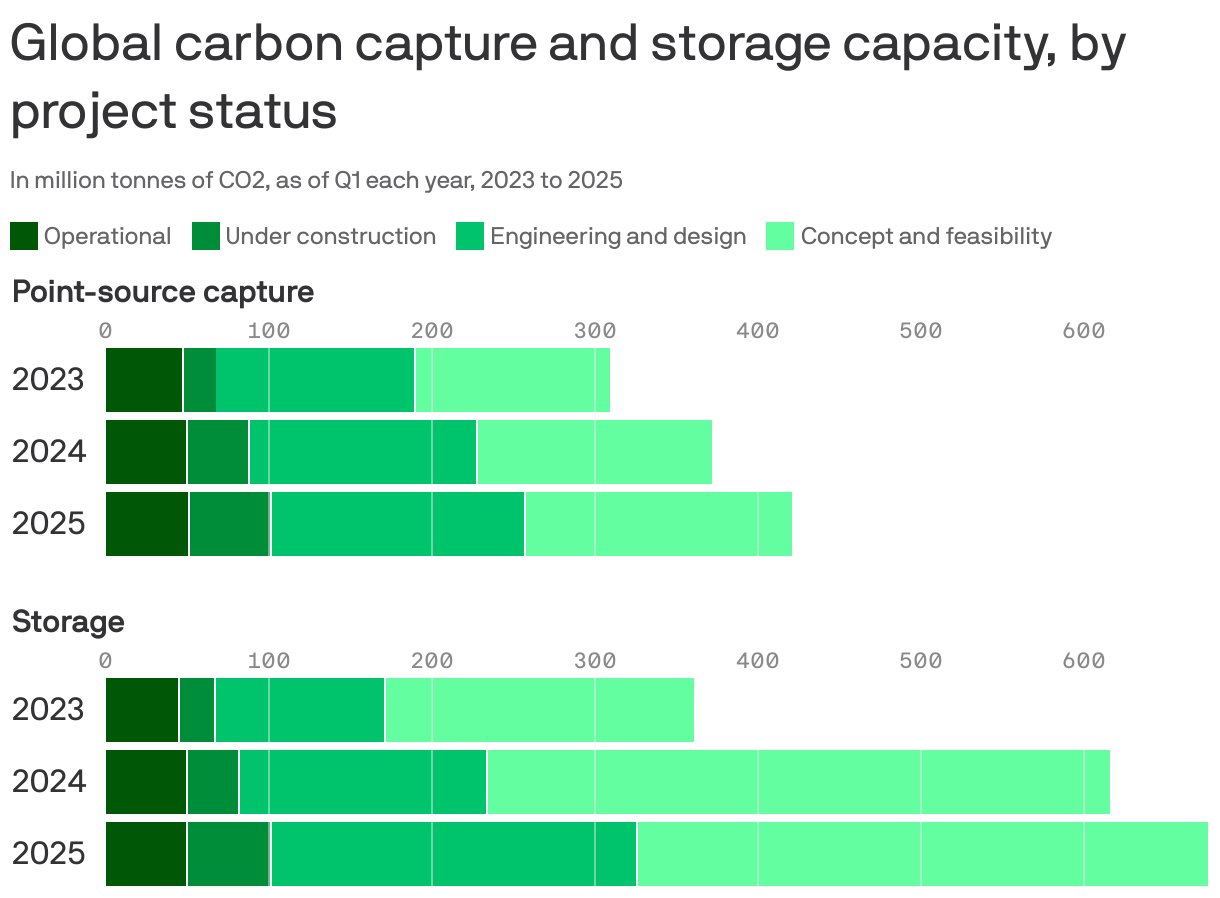
New IEA data and commentary shows growth in the global project pipeline for carbon capture and storage.
Why it matters: The tech's potential as a weapon against climate change has long outstripped real-world deployment, which has been slow.
- But last year saw several "firsts" for the sector, IEA analysts write, pointing to final investment decisions for CO2 capture at a gas plant in the U.K. and a combined heat and power plant in Sweden.
What we're watching: By 2030, if the current pipeline materializes, around 430 million tons of annual capture capacity would be operating.
- That would be an nearly 10x boost over today's operations, but consider that global energy-related CO2 emissions were nearly 38 billion tons last year.
The bottom line: "While current trends are insufficient to align with a pathway towards net zero emissions by mid-century, there are recent signs of important progress," the IEA commentary states.
6. 💬 Quote of the day: deep-sea mining edition
"[A]ny unilateral action not only threatens this carefully negotiated treaty, and decades of successful implementation and international cooperation, but also sets a dangerous precedent that could destabilize the entire system of global ocean governance."— Leticia Reis de Carvalho, secretary-general of the International Seabed Authority
That's from her new response to U.S. efforts to spur deep-sea mineral extraction outside the umbrella of the UN Convention on the Law of the Sea.
- The U.S. has never ratified the treaty.
📧 Did a friend, colleague or an AI chatbot send you this newsletter? Welcome, please sign up.
🙏 Thanks to Chris Speckhard and Chuck McCutcheon for edits to today's edition, along with the brilliant Axios Visuals team.
Sign up for Axios Generate