
Axios Generate

September 16, 2025

🌮 Happy Tuesday! We're here with a tasty 1,491 words, 5.5 minutes.
🌎 Axios House returns to NYC for Climate Week and UN General Assembly from Sept. 22-24. We'll host dynamic conversations featuring Sen. Jeanne Shaheen, Patagonia CEO Ryan Gellert, Amazon chief sustainability officer Kara Hurst & more. RSVP.
🎤 Blues legend B.B. King would have turned 100 today, so here's one of his finest: "Paying the Cost to Be the Boss."
1 big thing: Virginia voters demand answers on energy

RICHMOND, Va. — Virginia voters are raising questions about data centers and rising electricity rates as the state's November election nears — and energy officials, businesses and others are scurrying to answer them.
Why it matters: With most other states' elections happening a year from now, Virginia is a bellwether of how hot-button political issues will play out nationally.
- The Old Dominion is the world's data center capital, with hundreds clustered outside Washington, D.C., and — increasingly — around Richmond.
Driving the news: At an Axios roundtable on energy in Richmond last week, state and local officials, business executives and others said AI's growing power thirst — and hikes in electricity bills along with the potential for rolling blackouts — are at the top of voters' minds.
- "This is the first time I've really seen energy as part of the conversation during election season," said Glenn Davis, director of Virginia's Department of Energy and a former state lawmaker.
Catch up quick: Amazon Web Services in July pulled an application for a 7.2-million-square-foot data center in Louisa County northwest of Richmond after it provoked community opposition.
- And Dominion Energy has faced complaints in Chesterfield County, south of Richmond, for its plan to build a 944-megawatt "peaker" complex that would take the strain off the power grid during spikes in hot and cold weather.
- Dominion has proposed a rate increase for residential customers that would add an additional $10.51 a month starting in 2027.
Zoom in: To address growing demand and rates, participants at the forum suggested solutions such as requiring data centers to fund local needs and streamlining local permitting.
- "Virginia is probably the most difficult state I've worked in to permit a green-energy project, and that's largely because of local land-use permitting," said Erich Miarka, senior development director at Missouri-based Savion Renewable Energy.
Jennifer Ganten, chief global affairs officer for Commonwealth Fusion Systems, said Virginia could take a page from Massachusetts, which developed a special economic zone outside Boston for one of her company's projects.
- "They did all the pre-work, so there were pad-ready sites," said Ganten, whose company is building the world's first grid-scale commercial fusion power plant in Chesterfield County.
The bottom line: Participants emphasized soliciting local input, particularly when requiring data centers to earmark a portion of revenue toward community-enhancing projects.
- "Every community is so different across the state, they need to be able to allocate it intelligently, and in a way that represents their citizenry," said Laura Thomas, Richmond's director of sustainability.
2. 🛫 Confronting the chemtrails conspiracy

Climate scientist David Keith said he's at least twice called police because of threats related to his work on solar geoengineering, in which a portion of the Sun's rays are reflected into space to temporarily cool the planet.
Why it matters: The incidents reflect — no pun intended — important lessons with regard to society's debates over climate and energy.
- They show the expansive reach of negative rhetoric, particularly across social media.
In an interview, the University of Chicago professor mentioned the threats were from conspiracy theorists about so-called "chemtrails," which falsely claim that linear cloud-like formations from planes' exhausts are actually chemicals aimed at somehow controlling the weather or even biological warfare.
- In reality, the "contrails" — short for condensation trails — are clouds created by planes via water vapor and small amounts of other trace gases.
What they're saying: "It worries me," Keith told Axios in an episode of a new podcast called "Shocked."
- "I myself have been the target of people who really believe in the chemtrails conspiracy and conflate that with geoengineering, and therefore believe that I'm one of the cabal that's attempting to do extermination or mind control or what have you."
What's next: A House subcommittee is holding a hearing today on these technologies, led by Rep. Marjorie Taylor Greene (R.-Ga.), who recently introduced a bill that would ban geoengineering and similar types of tech.
3. 🧁 Bonus: A glimpse of a major direct air capture sale
More from Keith: As founder of a Canada-based direct air capture startup, he would have preferred to sell to a company there over the U.S. oil producer who ultimately bought it: Texas-based Occidental Petroleum.
Why it matters: The insight, revealed to Axios in an interview that published this week as part of the "Shocked" podcast, provides a glimpse into the sometimes-surprising factors at play in major deals.
Catch up quick: Occidental bought Carbon Engineering, a direct air capture firm, in 2023 for $1.1 billion.
- With 4% ownership in Carbon Engineering, founder and climate scientist Keith earned about $72 million, the New York Times reported in a profile of Keith last year.
- He told the Times he was "uncomfortable" with the sale to an oil company but that he would donate most of it, possibly to conservation causes.
What they're saying: "I did think about the fact that we were selling it to the Americans and if there'd been a Canadian option that was close, I would've fought hard for it," Keith, now a University of Chicago professor, said in the interview.
- His small ownership stake meant he wouldn't have had huge sway regardless, but added: "Personally, I would've been happy to take less money if there was a Canadian option."
What's next: Occidental is on track to begin capturing carbon dioxide on the world's largest direct-air capture facility — using Carbon Engineering's technology — later this year.
4. 🛢️ Meet "the elephant in the room" of oil's future
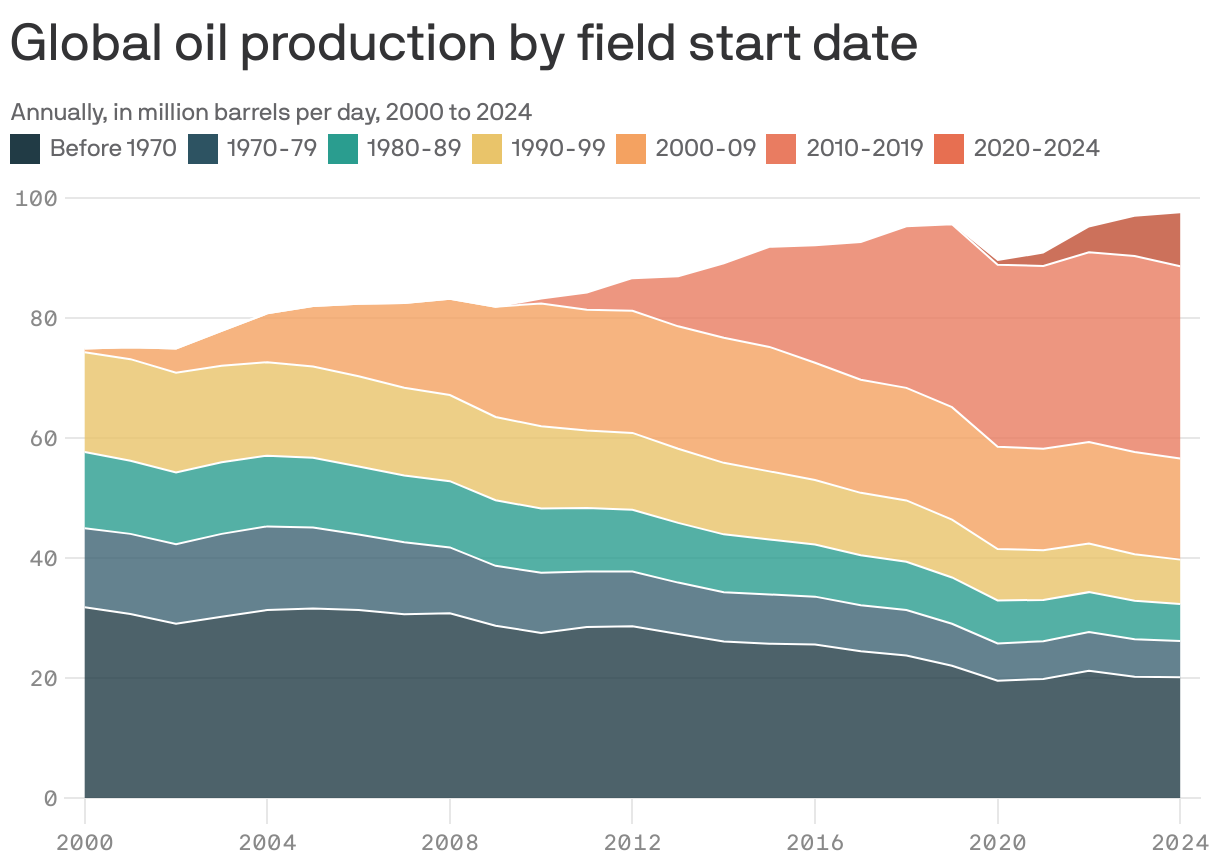
A new analysis dives into a huge global challenge: quickening production declines from existing oilfields — and the cash needed to replace that supply.
Why it matters: "Decline rates are the elephant in the room for any discussion of investment needs in oil and gas, and our new analysis shows that they have accelerated in recent years," International Energy Agency head Fatih Birol said alongside the group's new report.
The big picture: The industry has increasingly turned to onshore shale wells — where output drops really fast — and offshore fields that in some cases have rather high decline rates as well.
🧮 Stunning stat: Nearly 90% of industry investment in finding and producing new oil and gas since 2019 "has been dedicated to offsetting production declines rather than to meet demand growth," the report states.
🔭 What's next: This investment needs to average $540 billion annually through 2050 to keep oil and gas production around current levels, it finds.
- It's around $570B this year, "implying a small increase in production if this persists."

5. 👀 Several big people moves in energy world
The California Air Resources Board and two NGOs yesterday separately named new leaders.
Why it matters: CARB, the Sierra Club and American Council for an Energy-Efficient Economy all have considerable influence in shaping policy.
Driving the news: California Gov. Gavin Newsom (D) picked Lauren Sanchez to chair CARB.
- She's been a senior adviser for climate for Newsom since 2021 and previously worked on climate issues in the Biden administration and at the State Department.
Meanwhile, ACEEE named Jennifer Layke its next executive director, while the Sierra Club tapped Loren Blackford as its ED.
- Layke has been the World Resources Institute's global director for energy for the last nine years and succeeds Steven Nadel, who's led ACEEE for 24 years.
- At Sierra, Blackford replaces Ben Jealous, who was fired in August after a rocky tenure.
6. ⚛️ International nuke cooperation and other policy notes
☢️ Nuclear news: The Trump administration is "actively negotiating" agreements with other nations on civilian nuclear cooperation, Energy Secretary Chris Wright said yesterday at an IAEA conference in Vienna.
- Why it matters: Non-defense nuclear power appears to be one of the main areas in which Trump 2.0 is willing to engage with allies. Four agreements are now in place.
❇️ AI talk: EPA Administrator Lee Zeldin held a roundtable yesterday with members of Congress and industry officials to discuss ways to bolster artificial intelligence.
- Why it matters: "We will cut red tape for projects powering AI infrastructure and data centers, expedite permits, and accelerate AI integration to meet the needs of AI development nationwide," Zeldin said in a statement.
🖊️ House votes: The House is expected to vote this week on several energy bills, including legislation that would seek to address transmission backlogs, bolster cross-border energy infrastructure and reestablish the National Coal Council.
- Why it matters: Republicans are eager to have fossil-fuel and nuclear power plants skip the usual interconnection line to help meet surging electricity demand.
7. 🧮 Number of the day: 50%
That's the huge LNG demand growth that Woodside Energy boss Meg O'Neill sees over the next decade, waving off fears of U.S. expansion creating a supply glut, Reuters reports.
📬 Did a friend send you this newsletter? Welcome, please sign up.
🙏 Thanks to Chuck McCutcheon and Chris Speckhard for edits to today's edition, along with the brilliant Axios Visuals team.
Sign up for Axios Generate