Axios Future of Mobility

September 24, 2025

Wait. It's only Wednesday?
β‘οΈToday we're diving into what's next in EV charging.
- π And find out why I have a new appreciation for truck drivers.
1,470 words, a 5.5-minute read.
1 big thing: EV sales lull? Time to add more chargers
Electric vehicle sales are expected to plummet after tax credits disappear Sept. 30, but there could be a silver lining: It's an opportunity for charging infrastructure to catch up with demand.
Why it matters: Worries about where to charge have long been a hindrance to EV adoption.
- Once EV sales resume their natural, organic growth rate β which everyone in the industry expects to happen eventually β charging anxiety will likely be less of an issue.
Driving the news: EVs have been flying off dealer lots lately as consumers rush to take advantage of the expiring $7,500 federal tax credit.
- In August, new EV sales hit a record 146,332 units, up almost 18% from a year ago and accounting for 10% of all new car sales for the month. September looks to be another record, according to Cox Automotive.
- Used EVs, eligible for a tax credit of up to $4,000, have also seen strong sales ahead of the deadline.
- Inventories are shrinking because of the pull-ahead in demand, and many carmakers have indicated they'll cut EV production for the remainder of the year, further limiting availability.
The upshot: EV sales are widely expected to slow after Sept. 30.
Between the lines: A lull in EV sales could be well-timed because it can take years to get a single charging station up and running.
- Local permitting and property acquisition take time, and utilities often need to first make expensive electrical upgrades.
- Construction delays are also common.
After a slow start, the rollout of charging infrastructure is finally beginning to pick up steam.
- "The flywheel is in motion," says GM's head of public charging, William Hotchkiss.
- "We've got to make sure we don't lose momentum," he tells Axios. "A potential slowdown in EV sales will allow infrastructure to catch up."
By the numbers: A seminal 2023 study by the U.S. Department of Energy's National Renewable Energy Laboratory (NREL) estimated the U.S. will need 28 million charging ports by 2030 in order to support 33 million EVs (a "mid-scenario" EV adoption rate).
- The vast majority of those chargers would be private β Level 1 and 2 ports located at single-family homes, apartments and workplaces.
- About 1 million of them would be publicly accessible Level 2 chargers at retail stores, libraries, parking garages and other locations near high-density neighborhoods.
- Also needed: 182,000 DC fast-chargers along highways and in metro areas to accommodate EV road trips, ride-share drivers and others in need of a quick recharge.
Where it stands: We've still got a long way to go.
- The U.S. currently has about 228,000 public charging ports β less than one-quarter of the number we'll need.
- Of those, roughly 62,000 are DC fast-chargers βa third of what's needed.
Caveat: Since EV sales have been slower than expected, those targets aren't particularly urgent.
- Today, there are about 5 million EVs on the road in the U.S., per S&P Global Mobility β well short of NREL's assumption of 33 million by 2030.
What they're saying: "Regardless of future EV sales, we have to address the underlying challenge that, as it stands, charging infrastructure lags behind demand," Seth Cutler, CEO of Ionna, tells Axios.
- Ionna, a joint venture between eight automakers, aims to build 30,000 charging bays by the end of 2030.
What to watch: After a six-month freeze, the Trump administration has resumed a Biden-era federal program to fund the installation of fast chargers along major highways.
- The vast majority of chargers, however, are being built via private investment.
Cox Automotive, like Axios, is owned by Cox Enterprises.
Editor's note: This story has been updated to clarify that William Hotchkiss is head of public charging for GM (not only for GM Energy).
2. The next wave of EV charging infrastructure
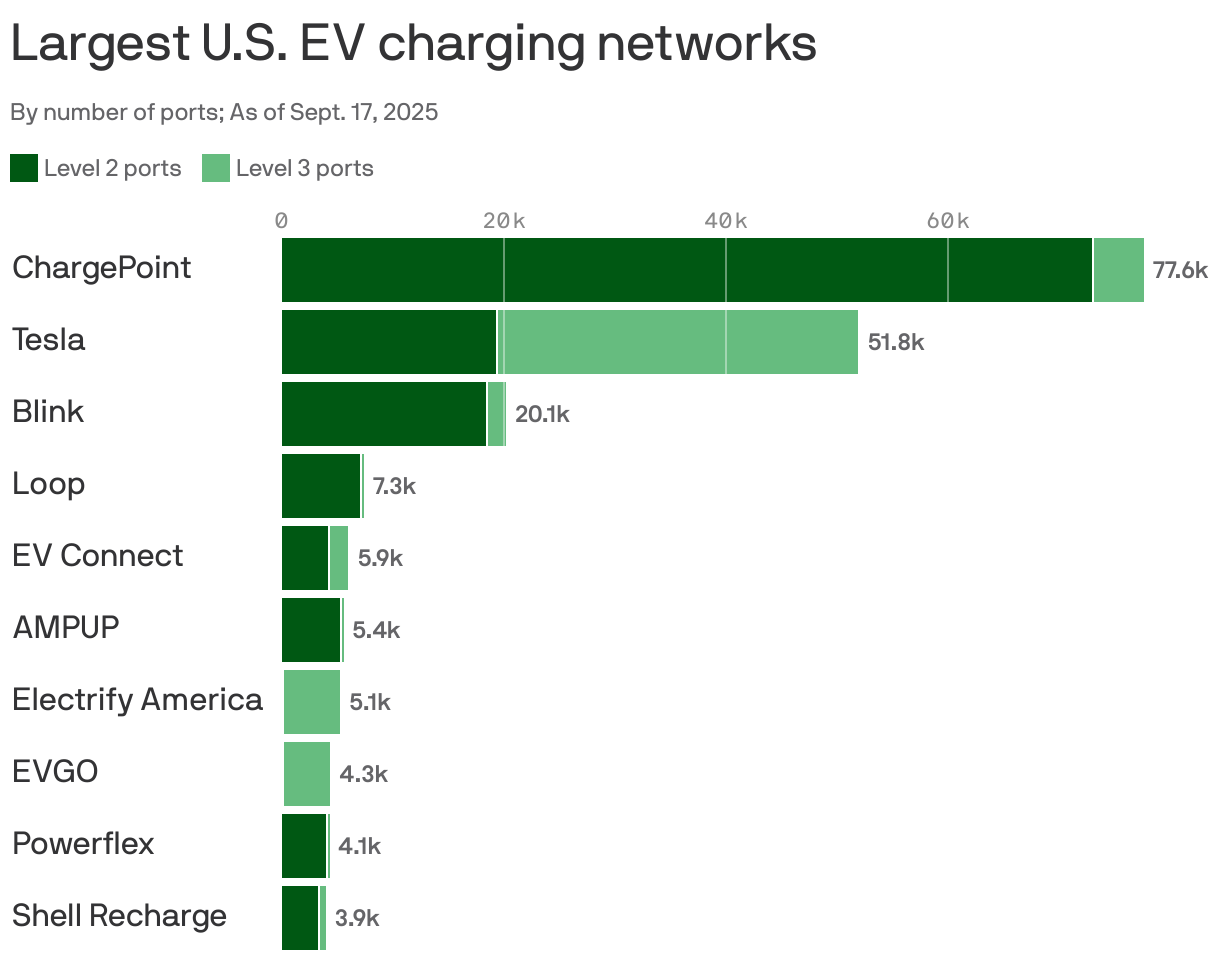
There's a shakeout coming in the EV charging industry as financial challenges mount for some of the early players, according to analysts at Bloomberg Intelligence.
Why it matters: Companies that dominated the charging business to date aren't the ones that will lead the next phase of growth, per their 2026 EV charging outlook.
- Instead, it will be vertically integrated networks owned or backed by automakers that already have billions of dollars at stake in electrification.
The growers: Tesla, with more than 32,000 ports in its Supercharger network, plus another 19,000 slower Level 2 chargers, is on track to nearly double its Supercharger network by 2030, Bloomberg estimates.
- Ionna, a joint venture between eight automakers (BMW, General Motors, Honda, Hyundai, Kia, Mercedes-Benz, Stellantis and Toyota), plans to add 30,000 fast-charging ports by the end of the decade, from 300 today.
- GM (with EVGo) and VW (through Electrify America) are also expanding beyond Ionna.
Lagging behind: Companies like ChargePoint and Blink, which have dominated Level 2 charging, the most common type of public infrastructure.
- Their growth has stalled amid lower-cost competition for Level 2 chargers, and they don't have the capital to fund DC fast-chargers. Bloomberg Intelligence argues.
What they're saying: "I don't think we need that many Level 2 public chargers, other than in public garages and apartment buildings," says the report's lead analyst, Steve Man.
- "DC charging is the way to go to increase adoption" of EVs, he told Axios.
The other side: "Level 2 charging is where we're really lacking," says Gabe Klein, former executive director of the U.S. Joint Office of Energy and Transportation in the Biden administration.
- "We desperately need more in cities now," he says.
The bottom line: Electrification is still in the early phases, and so is EV charging.
3. Chargers on every light pole
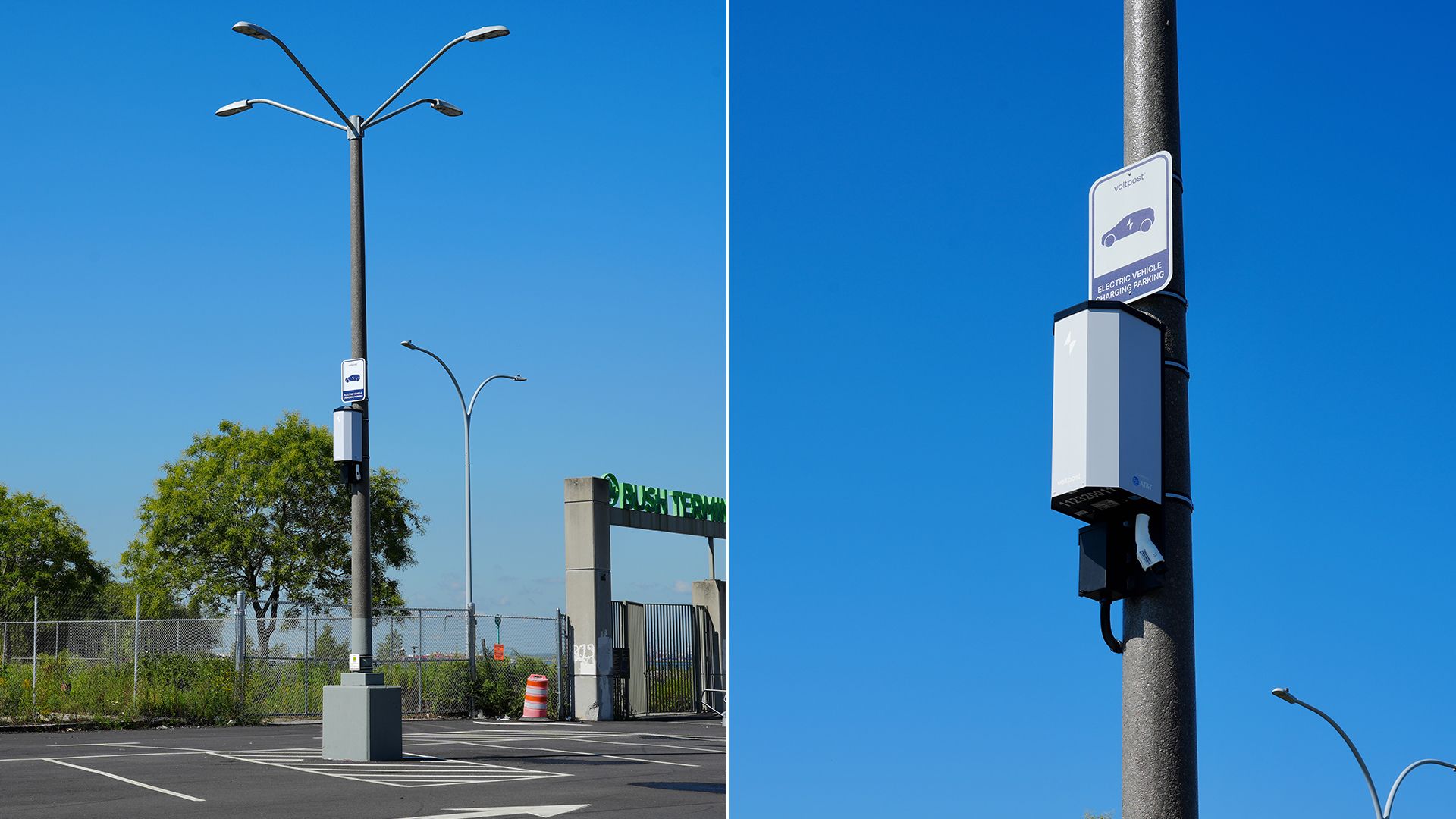
Voltpost, a startup that specializes in turning street lights into electric vehicle charging stations, is launching a sleeker, more flexible charger today in Brooklyn during Climate Week.
Why it matters: The new charging platform, Voltpost Air, allows cities to repurpose existing infrastructure to quickly expand EV access without disruptive construction or costly grid upgrades.
The big picture: With federal support for EV charging in flux, Voltpost is partnering with cities, utilities and corporations to install charging infrastructure that's relatively easy, affordable and accessible.
- Its first Voltpost Level 2 chargers are deployed in Oak Park, Illinois, and at the American Center for Mobility in Ypsilanti, Michigan, and the company has projects in the pipeline in several other states.
- "With millions of streetlights in the United States, the opportunity to convert even a fraction into chargers will make a significant positive impact," Jeffrey Prosserman, cofounder and CEO of Voltpost, told Axios.
Driving the news: The first Voltpost Air charger, part of a pilot program, is being activated in Brooklyn at the MADE Bush Terminal.
- Funding came from the New York City Economic Development Corporation (NYCEDC), the New York State Energy Research and Development Authority (NYSERDA) and Con Edison.
- It features a compact, modular design that mounts about 10 feet above ground with a retractable cable system to protect against vandalism and weather.
- A Voltpost smartphone app offers drivers real-time information about charger availability, flexible payment options and remote monitoring capabilities.
Zoom in: The Voltpost Air can be mounted on wooden and metal poles, as well as in parking garages and on traffic bollards curbside and in parking lots.
- Installation takes just a couple of hours and costs a few thousand dollars, according to Prosserman, because there's no need to dig up sidewalks or wait for utility upgrades.
- It's merely a case of pulling a cable bundle through the post's existing conduit, he said. Power to the lamp post is not affected.
- By comparison, some Level 2 chargers cost tens of thousands of dollars to install, he said.
What's next: The Brooklyn site is the first of many Voltpost Air chargers planned to be deployed across multiple states.
4. Drive-thru
π We've been measuring EV charger reliability all wrong, according to ChargerHelp. Instead of looking at reported "uptime" β which is close to 99% for most networks β a better metric is first-time charge success rate.
- It turns out that one-third of initial charging attempts fail.
βοΈ The Trump administration wants up to a 10% stake in Lithium Americas in exchange for renegotiating the company's $2.3 billion DOE loan for the Thacker Pass lithium project with General Motors in Nevada. (Reuters)
- The U.S. has already taken stakes in Intel, U.S. Steel, MP Materials and other firms seen as critical to national security.
π° Jaguar Land Rover is facing a backlog in paying suppliers, many of them smaller businesses, after a cyberattack crippled the company's systems. (Bloomberg)
5. What I'm driving: A semi-truck!
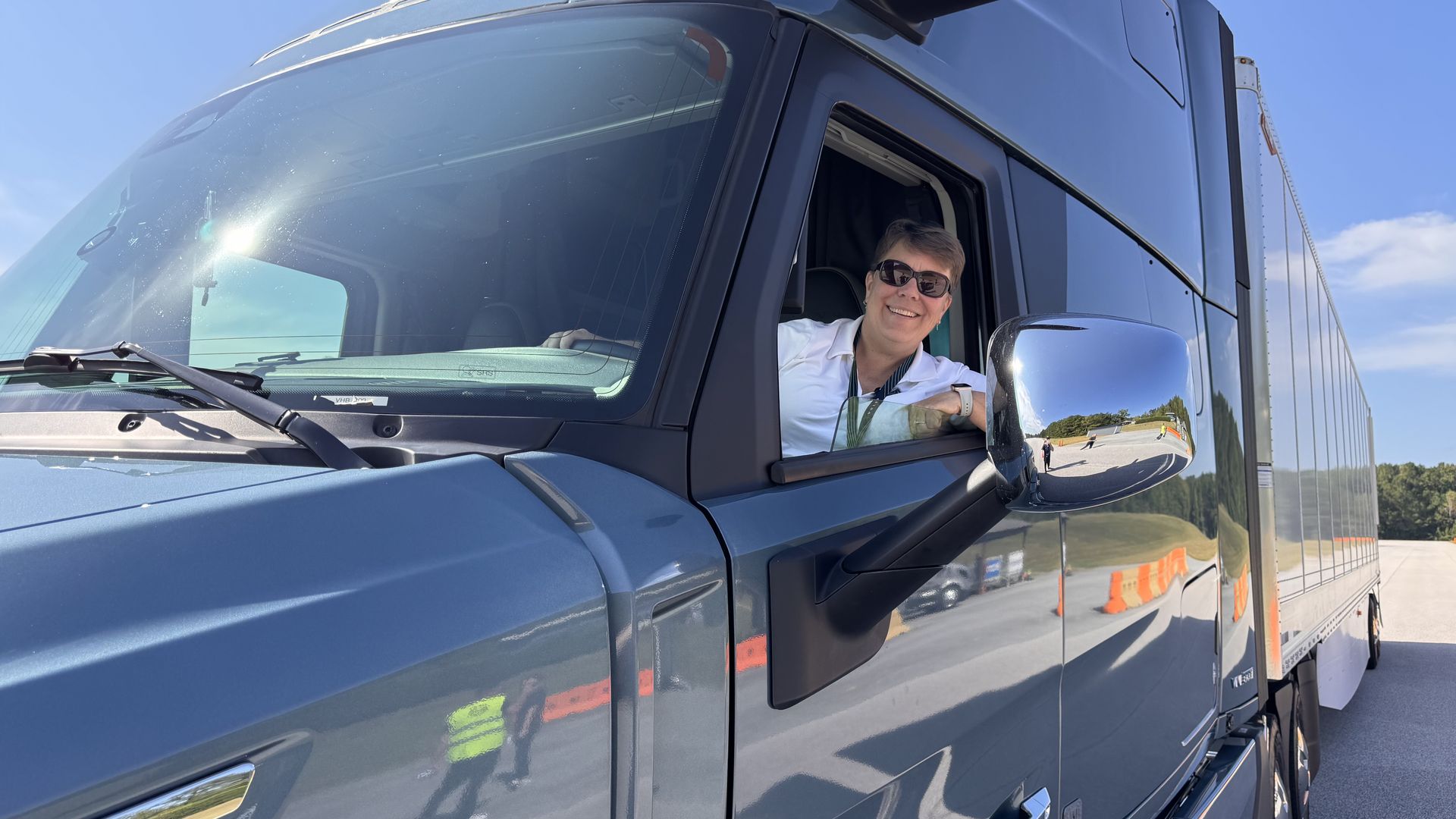
I went to Michelin's proving grounds in South Carolina this week to drive Volvo's new VNL long-haul truck, which offers huge leaps in fuel efficiency, safety and driver comfort.
Why it matters: It's just cool. Plus, I got to spend the night in the "5-star" sleeper cab!
Come back next week for a full report on the driving experience, including how well I slept.
Thanks to Ben Berkowitz and Bill Kole for editing. Sign up for Future of Mobility here.
Sign up for Axios Future of Mobility