Axios Future of Mobility

March 26, 2025

👋 Welcome back! Thank you for all the kind support and the thoughtful feedback on last week's inaugural edition. Keep the ideas coming!
I'm in Savannah, Georgia, today, getting a firsthand look at Hyundai Motor Group's new, state-of-the-art, heavily automated "metaplant," where they're building the next generation of electric vehicles and batteries. To me, factories are better than Disney World.
- Speaking of Hyundai, read on to find out how the Korean automaker waded into American politics — and won.
Today we've got 1,530 words, a 6-minute read.
1 big thing: Hyundai's Trump sales strategy

Hyundai Motor Group has found success in the United States by giving car buyers exactly what they want: desirable features packaged in a good deal.
- The Korean automaker displayed the same salesmanship in its dealings this week with President Trump.
Why it matters: Hyundai's headline-grabbing announcement of a $21 billion U.S. investment — most of which was already underway — was all Trump needed to show that his global tariff threats were working.
- In return, the president told Chairman Euisun Chung that now "Hyundai won't have to pay any tariffs."
- Everybody walked away satisfied.
The big picture: In the next four years, the parent of Hyundai, Kia and Genesis will more than double the level of investment it made in the U.S. over the past four decades.
That's a serious ramp-up in spending and includes:
- $9 billion to expand U.S. automobile production to 1.2 million units annually.
- $6 billion to expand U.S. supply chains for steel and auto components, including battery packs for electric vehicles.
- $6 billion for technology innovations, including autonomous vehicles, robotics, artificial intelligence and electric air taxis.
- The investments are expected to create more than 14,000 new jobs, and as many as 100,000 jobs in related industries, Hyundai said.
Between the lines: Those are big numbers and demonstrate the Korean automaker's commitment to the U.S.
Yes, but: Most of those projects were already in the pipeline before Trump started dangling the threat of tariffs — indeed before he even took office for a second term.
- The bulk of the $9 billion production expansion, for example, was already accounted for by Hyundai's new $7.6 billion factory in Georgia, which started building cars last fall.
- It takes Hyundai's U.S. capacity to 1 million vehicles, leaving actual growth over the next four years of just 200,000 vehicles.
- Even the $5.8 billion steel plant announced Monday at the White House had been in the works for a year.
One example: Chung told White House reporters Monday that the idea for a new U.S. factory was "initiated" during a meeting with Trump in Seoul in 2019, a year after Trump renegotiated a bilateral trade deal with South Korea.
- When the two men met again at the World Economic Forum in Davos in January 2020, Chung said he mentioned the new plant to Trump.
Reality check: It was May 2022, more than two years later, when Hyundai actually made the announcement.
- And it was President Biden's hand —not Trump's — that Chung shook in Seoul as he unveiled a $10 billion U.S. investment plan that included Hyundai's first dedicated electric vehicle plant near Savannah, Georgia.
- The announcement came a few months before Congress passed the Inflation Reduction Act, which includes lucrative production tax credits worth billions of dollars to EV and battery manufacturers.
- But Biden's EV-friendly policies were well under way by then, and the entire industry was scrambling to abide.
The intrigue: On Monday, neither Trump nor Chung made mention of those Biden-era incentives, which remain in place (at least for now) and could be worth more than a billion dollars a year to Hyundai.
- Instead, Chung made a point of closing the loop with Trump by noting that this week's Georgia grand opening event coincides with the start of Trump's second term, "making this moment even more special," while Trump nodded and smiled nearby.
The bottom line: Hyundai offered a master class for companies on managing the Trump presidency.
2. Revel expands EV fast chargers in urban areas
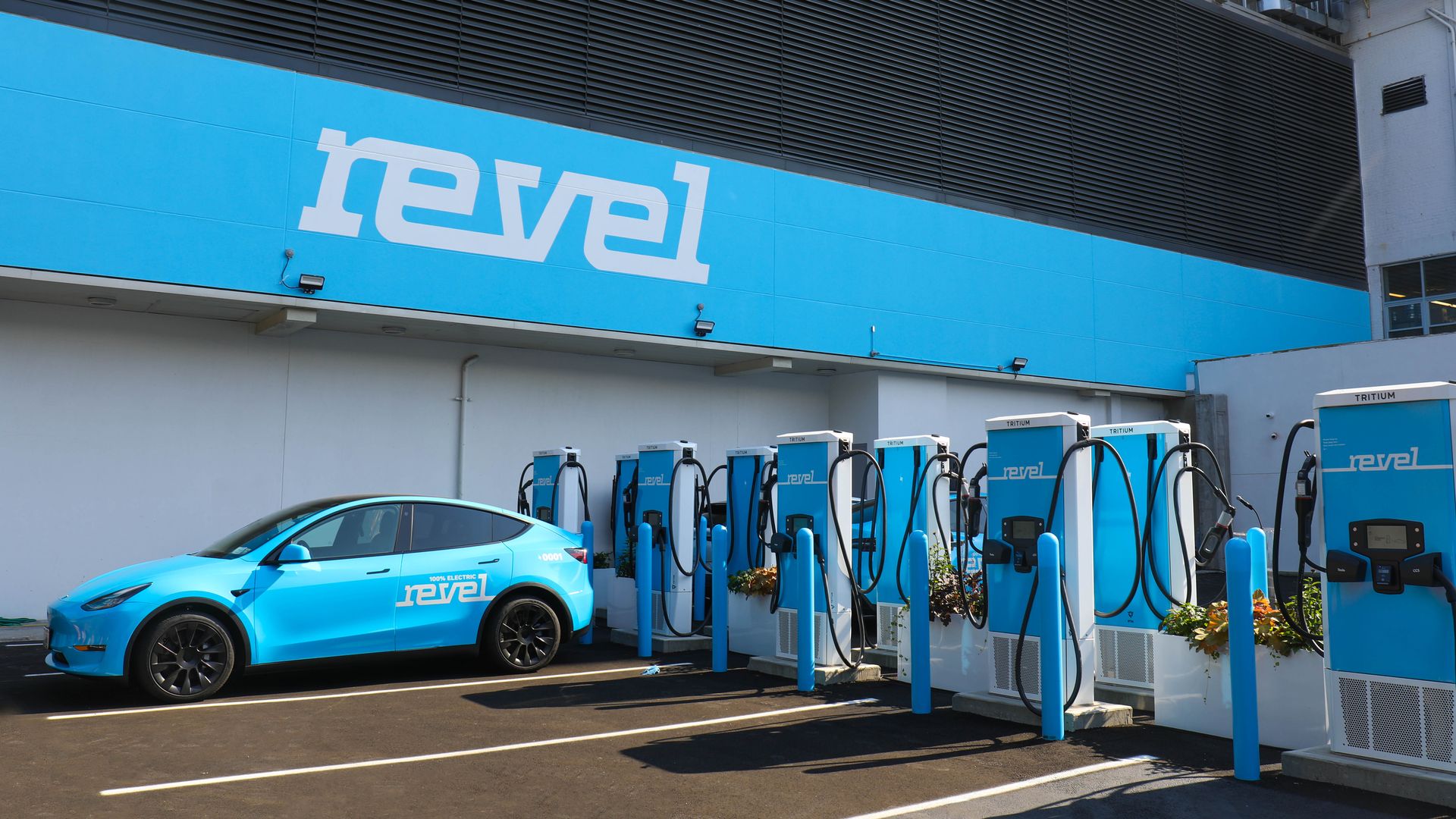
Electric taxi company Revel is rapidly expanding its public fast-charging network, focusing on cities where rideshare fleets face looming deadlines to switch to all-electric power.
Why it matters: The biggest concern of EV rideshare drivers is finding a place to quickly recharge, since many don't have access to charging at home.
Between the lines: The Trump administration has frozen taxpayer funding for EV charging infrastructure, but big cities like New York and San Francisco are still forging ahead with plans to electrify their rideshare fleets within the next five to seven years.
- They'll need a place to plug in.
- Despite the cutbacks in federal funding, there's still plenty of financing support for EV charging from local governments and state utilities, Revel CEO Frank Reig tells Axios.
- "Those rideshare electrification targets are not going away," he said, explaining the policy tailwinds that are helping Revel grow in left-leaning cities.
Driving the news: The New York-based company this week opened its first EV fast-charging station in San Francisco's Mission District, marking the first phase of its expansion outside New York City.
- The West Coast rollout follows the opening of a 24-stall fast-charging station at New York's John F. Kennedy International Airport the week before.
- Revel has spent the past few years locking up precious land in dense cities where there is sufficient power supply to build multi-stall fast chargers.
What to watch: Within the next year, it will add 125 urban fast chargers at seven sites in the Bay Area, and 170 more in New York City, in a bid to be the dominant player in urban fast charging.
3. Rivian spinout Also launches with $105M for micro EVs


Micromobility startup Also has spun out of EV company Rivian with $105 million in funding from VC firm Eclipse.
Why it matters: It's a big round to support a brand new player in the world of small electric vehicles.
Catch up quick: Micromobility is anything smaller than a car, generally vehicles like electric bikes, scooters, motorcycles, and 3-wheelers.
Driving the news: The company didn't disclose what its first product would be, but said it would develop a portfolio of products for both consumers and businesses.
- Also's first micro electric vehicle is expected to launch next year for consumers in the U.S. and Europe, followed by products for both consumers and businesses in Asia and South America.
Zoom in: Rivian developed Also as an internal project to see how the company's software and hardware could be used for smaller electric vehicles.
- Chris Yu, Rivian's former VP of Future Programs, is the president of Also. Rivian CEO RJ Scaringe sits on the Also board.
- Eclipse, a VC firm focused on industrial tech, provided the entire $105 million in funding, which includes up through Series B, per the company.
- Eclipse Partner Jiten Behl was previously chief strategy officer and chief growth officer at Rivian.
The big picture: Electric bikes and scooters have taken off globally in recent years.
- Researchers at BloombergNEF say about half of the sales of two- and three-wheelers globally were EVs by 2024. That number is expected to grow to three out of four by 2050.
The bottom line: The micromobility sector just got a new well-funded team from Rivian with big plans.
Katie Fehrenbacher covers climate tech for Axios Pro Deals.
4. Drive-thru
/2025/03/25/1742877874607.gif?w=3840)
⚠️ Traffic deaths show no signs of abating, despite years of tech advances — Automotive News
💵 EV maker Bollinger Motors is broke, and truck production has stopped, founder says in suit — The Detroit News
👀 Zoox recalls software on 258 self-driving cars over unexpected braking — TechCrunch
5. What I'm driving — GMC Hummer EV 3X Pickup
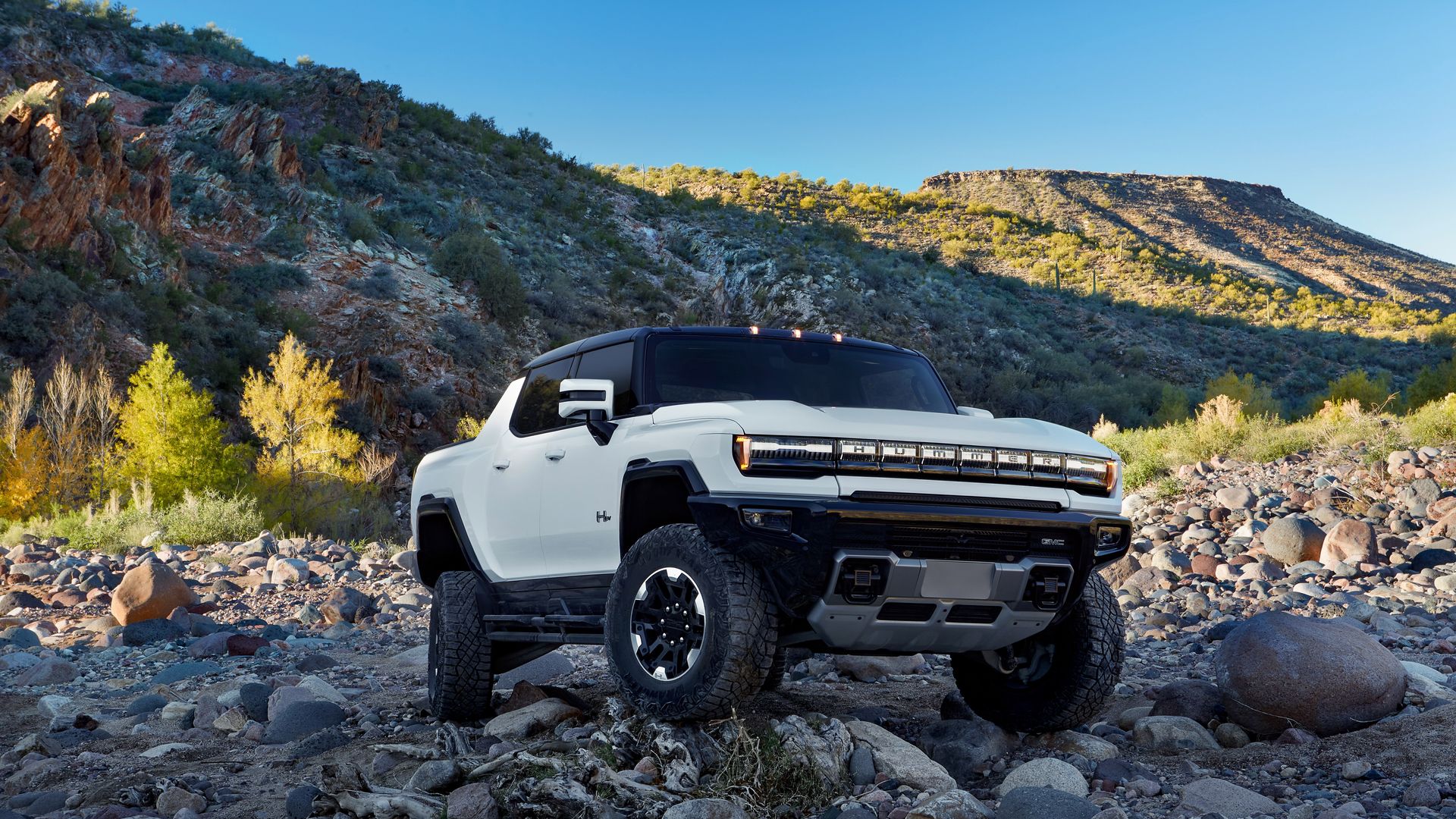
I test drive new cars in my role as a juror for the North American Car & Truck of the Year awards. (The cars are loaned to jurors for evaluation purposes and my opinions are my own.)
This monster truck is considered a "halo product" for General Motors — meant to establish GM's electric bona fides and to attract customers who might not otherwise consider buying an EV.
- But there's nothing angelic about it.
Eye-popping specs: The 1,000-hp Hummer EV weighs 9,640 pounds — almost five tons! — and yet can launch from 0-60 mph in 3.3 seconds in what GM calls WTF mode ("Watts to Freedom").
- And because it has four-wheel steering, there's even "crabwalk" mode, which allows the front and rear wheels to turn in the same direction, so the truck can actually move diagonally.
Yes, but: The problem with heavyweight EVs like this is that they're potentially dangerous for other road users.
- Car & Driver called out the Hummer EV's disappointing braking performance. It may be fast, but it's hard to stop.
And then there's the price: My test vehicle, which came with the optional extended-range battery (up to 381 miles) and extreme off-road package, topped $126,000.
- While that's out of range for most people, GM still managed to find 14,000 Hummer EV buyers last year.
💭 My thought bubble: If the Tesla Cybertruck didn't exist, the Hummer EV would be the most outlandish vehicle on the road.
6. Quote of the day
"It's not just your toddler. It turns out Saturday nights, a lot of people throw up."— Lyft CEO David Risher, on the challenge of keeping robotaxis clean, during the 2025 Axios What's Next Summit Tuesday in Washington, D.C.
Thanks to Ben Berkowitz and Bill Kole for editing. Tell your friends to sign up!
Sign up for Axios Future of Mobility