Axios Future of Mobility

April 16, 2025

🚕 Yo! I'm at the New York International Auto Show, where worries about a global trade war are overshadowing the debut of some cool new electric vehicles.
- So it's worth digging into EV supply chains to understand how the two are connected. Let's go...
1,401 words, a 5-minute read.
1 big thing: How China could stifle American EVs
America's escalating trade war with China could choke off demand for electric cars in the U.S.
Why it matters: Simply put, the U.S. can't build EVs without China. Efforts that began under the Biden administration to seed a domestic supply chain need more time to mature.
- "We do forecasts out to 2040, and China is going to remain dominant in that time frame across all stages of the supply chain," said Adam Webb, head of battery raw materials at Benchmark Mineral Intelligence.
- In the meantime, key inputs and technologies to produce electric vehicles are getting tougher and more expensive to access.
Driving the news: China isn't just hitting back with higher tariffs to match U.S. taxes on Chinese imports.
- It's also using its control of critical minerals and refining technology to disrupt American supply chains for everything from cars and electronics to missiles and robots.
- For example, Beijing this month made it harder to export rare earth minerals and magnets that are essential for electric motors.
- The move follows earlier restrictions on minerals such as germanium and gallium, which are used in semiconductors and defense, as well as stricter controls on graphite, a critical material for battery anodes.
Where it stands: A shortage of batteries or electric motors for EVs could choke off the transition away from gasoline cars just as it's getting started.
- U.S. sales of battery-electric vehicles grew 11.4% in the first quarter, accounting for 7.5% of total car sales, according to Cox Automotive.
- Cox had been forecasting sales of all electrified vehicles — including hybrids, plug-in hybrids and battery-only cars — could reach 25% by the end of 2025, but the latest trade turmoil makes that less likely.
The big picture: China is the world's top miner and processor of rare earths, a group of 17 elements used to make such things as cars, weapons, smartphones and wind turbines.
- It also controls mines in other countries with large deposits of key minerals for EV batteries, including lithium, nickel, cobalt and graphite.
- China also produces most of the cathode active materials needed to make lithium-ion batteries and is home to CATL, the world's leading manufacturer of lithium iron phosphate (LFP) batteries, a lower-cost alternative.
Zoom in: None of this is accidental.
- China has spent decades crafting a comprehensive industrial policy to protect its national security and to ensure its control of future energy and transportation technologies.
The Trump administration is scrambling to source these minerals from elsewhere, but it doesn't help that the U.S. has alienated many of its trading partners.
The bottom line: Even if the U.S. can secure raw minerals, China's grip on the EV supply chain is not easily broken.
2. U.S. supply chain still runs through China
The U.S. has been investing feverishly in recent years to create a domestic supply chain for electric vehicles, but it's far from complete.
Why it matters: Despite more than $130 billion in EV investments in the U.S., big gaps — mostly in mining and refining — have left America vulnerable to an escalating trade war with China.
Where it stands: U.S. companies trying to reshore the EV supply chain have made a lot of progress in a short period of time.
- Between 2019 and January 2025, the industry announced investments of $38 billion for new EV assembly plants and $93 billion for battery manufacturing, according to the Alliance for Automotive Innovation.
Between the lines: That rapid growth was spurred, in large part, by huge manufacturing tax credits signed into law during the Biden administration and strict battery sourcing rules tied to consumer tax credits for EV purchases.
- But some carmakers, particularly GM, also just want more control over their supply chains after getting burned by semiconductor shortages and other pandemic-related disruptions in recent years.
The latest: Battery materials company Sila on Tuesday began ramping up production of a new American-made silicon-based anode at a plant in Moses Lake, Washington.
- "This factory is exactly what is needed at this moment," Sila CEO Gene Berdichevsky tells Axios Pro's Katie Fehrenbacher.
Yes, but: There are still three missing pieces to the U.S. supply chain that can't be filled quickly or easily.
Raw minerals: Natural resources aren't distributed equally around the world.
- The U.S. has substantial lithium deposits, but it's difficult to extract them because of various regulatory, environmental and technical obstacles.
- "You can't just switch a mine on," Webb, of Benchmark Mineral Intelligence, said. "From the point of discovery, it could take 10 to 20 years to bring that into production. It's a long game."
Refining: Even if the U.S. does expand its mining capabilities, it lacks the refining capacity to turn those resources into battery-grade materials.
- Refining raw minerals is like turning raw sugar cane into fine white crystals or turning crude oil into gasoline — it requires specialized facilities that the U.S. doesn't have.
Battery components: China handles almost all midstream production of battery cathodes, anodes and foil separators as well as permanent rare earth magnets for electric motors.
- Yes, but: Various companies are aiming to close this gap with new production facilities in North America.
What's next: Battery recycling could be a long-term solution, using minerals salvaged from end-of-life EVs to create a circular supply chain. But that's still a long way off.
3. Car dealer turned senator: It's the golden age for autos
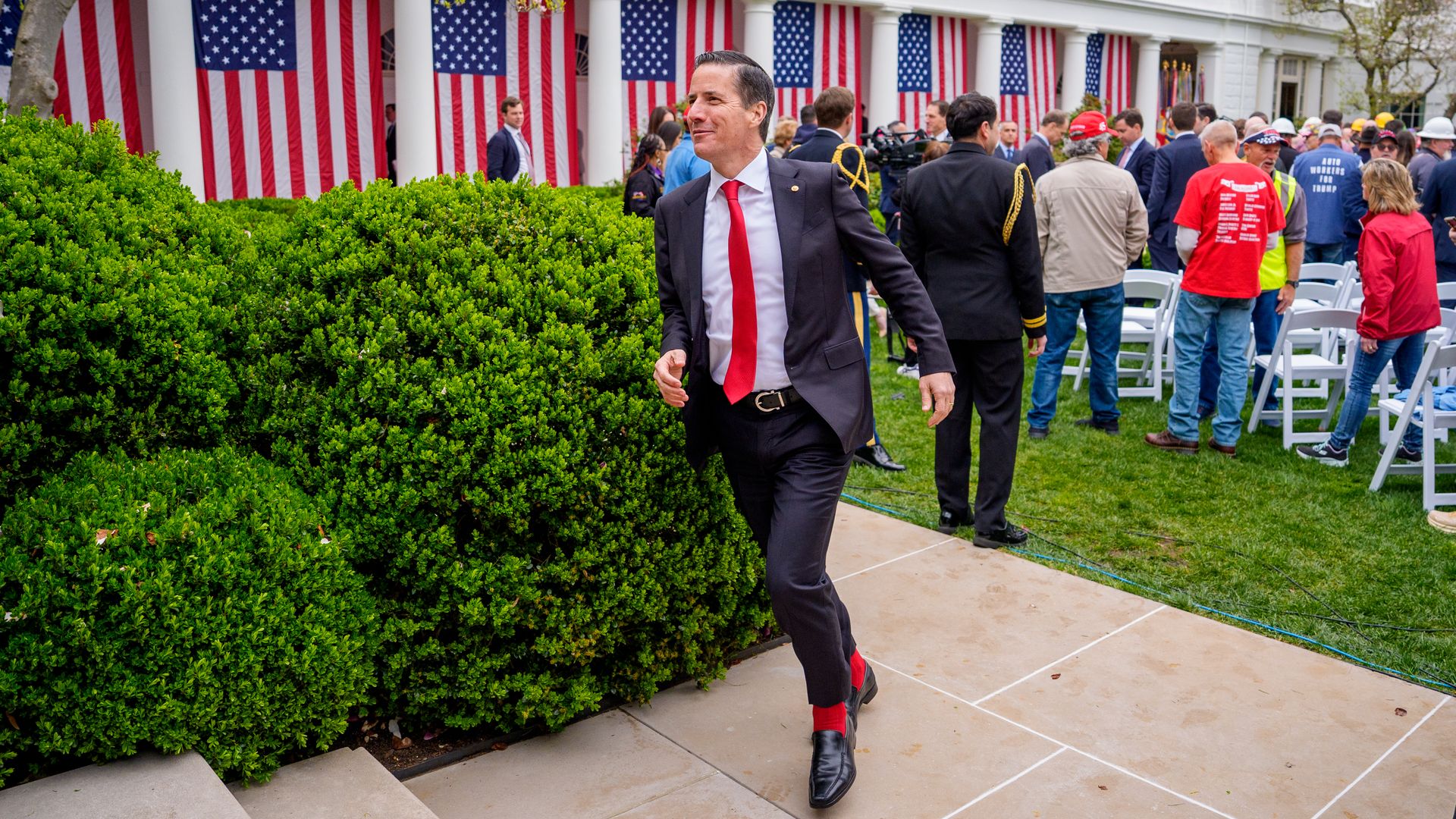
Sen. Bernie Moreno (R-Ohio) sounded a lot like the car salesman he was in a previous life on Tuesday, assuring industry professionals that the current tariff turmoil will blow over soon.
- "All this is going to create the greatest economy America has ever seen. And I'm firmly convinced that's right around the corner," said Moreno, who built an empire of auto dealerships before being elected last November.
- "I think we get this all resolved in the next 60, 90, 120 days and I do believe, not only is there a golden age for America, there's specifically a golden age for automotive retail."
Why it matters: Moreno's optimistic tone stood in stark contrast to other presenters at an annual automotive conference, who shared gloomy forecasts and bemoaned the uncertainty associated with the Trump administration's ever-changing tariff policies.
Between the lines: Moreno is a key supporter of President Trump's anti-EV crusade and a strong voice in the Senate for car dealers who he said are stuck selling electric vehicles that consumers don't want.
- "We'll make it through this," he said of the tariff controversy. "This will be a blip. We won't remember. We won't even be talking about this next year at the auto show. We'll be talking about, 'Wow, man, we can't keep up with the volume of sales.'"
My thought bubble: Show me a car dealer who isn't optimistic.
4. The hottest cars in New York
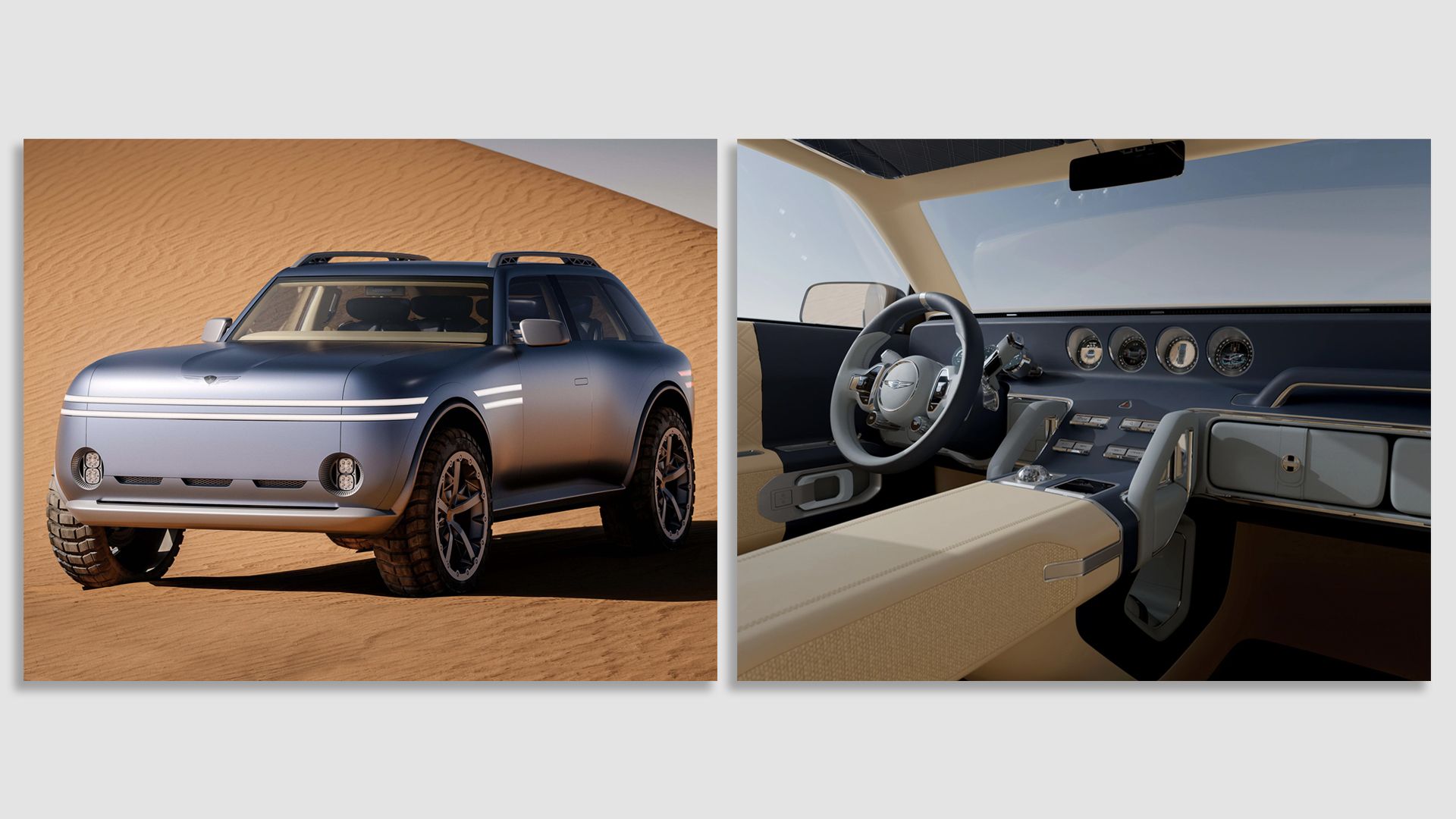
Everybody talks about the death of auto shows, but a few international automakers are still making a splash at this week's annual showcase in New York.
Genesis' X Gran Equator is the South Korean luxury brand's first adventure vehicle concept, combining its typical elegance with the rugged spirit of overlanding. (They're looking at you, Land Rover!)
Other highlights include:
- 2026 Subaru Trailseeker, the Japanese brand's second electric SUV, with more cargo space than the Solterra and 260 miles of battery range.
- 2026 Kia EV4, a compact addition to Kia's expanding EV lineup, with up to 330 miles of range.
- A sporty hatchback body style joining the compact Kia K4 sedan.
- Next-generation versions of the Subaru Outback and the Hyundai Palisade (including a new hybrid).
5. Drive thru
/2025/04/15/1744747432253.gif?w=3840)
Catching you up on worthy news you might have missed....
♿️ Detroit Metro Airport rolls out autonomous wheelchairs to transport passengers — Detroit News
🚛 Autonomous trucking startup Kodiak Robotics to go public via SPAC — TechCrunch
⚡️ Tesla launches stripped-down base Cybertruck at $72,235 amid disappointing sales — Automotive News
🛵 Lime will recycle bike and scooter batteries with Redwood Materials — The Verge
6. Quote of the day
"Our plan is to sell cars. Sell, sell like hell. That's what we're going to do during this tariff situation."
- — Randy Parker, CEO of Hyundai and Genesis Motor North America, speaking Tuesday at the Automotive Forum New York, an industry conference ahead of the New York auto show.
Thanks to Christine Wang and Jay Bennett for editing. Please tell your friends and colleagues to subscribe!
Sign up for Axios Future of Mobility