Axios Future of Mobility
August 26, 2026

Hooray! It's 🐪 day!
Today we're taking a closer look at the types of delivery drones that could soon be swarming your neighborhood. 🚁 🐝
- 🎤 And I've got an exclusive interview with the head of Waymo's AI strategy, who shares what he believes it takes to deploy robotaxis safely.
- 🇨🇳 Plus, the Center for Automotive Research has some fresh insights on why China's automakers are leaving everyone else in the dust.
1,891 words, a 7-minute read
1 big thing: Don't mind the delivery drones
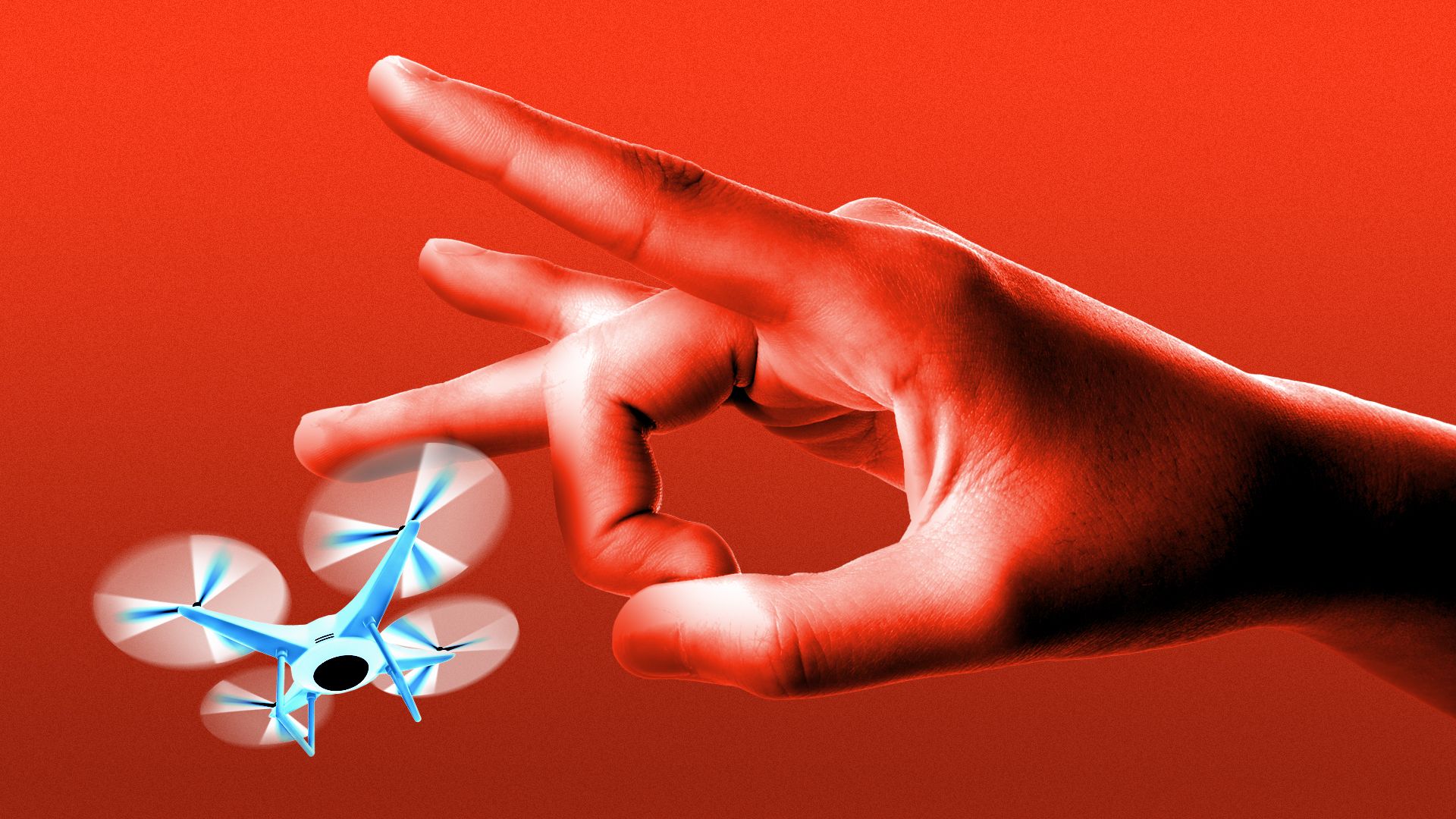
The drone-delivery race is taking off, setting up a real-world test of which flying machines people will tolerate buzzing around their neighborhoods.
Why it matters: Amazon, Wing and Zipline are taking dramatically different engineering approaches to drone delivery — differences that will determine how much they can carry, where they can put your package and, perhaps most importantly, how much you'll hear them.
Driving the news: Drone delivery is about to become mainstream across the U.S.
- Amazon plans to expand its Prime Air service sixfold, reaching nearly 500 U.S. cities and towns by the end of 2026.
- Uber is investing in Zipline, with an ambitious goal of reaching 1 million Uber Eats drone deliveries per day by the end of 2029.
- Alphabet-owned Wing expects to be operating from more than 270 Walmart stores by 2027, within reach of more than 40 million people.
Between the lines: As those fleets multiply, consumers are going to encounter three very different visions of drone delivery — like three different cars in the showroom:
- Wing: the Toyota Prius of drones, lightweight and efficient, optimized for frequent deliveries.
- Amazon's MK30: like a Hummer EV — big, heavy and technologically elaborate; you can't miss it.
- Zipline: closer to a Mercedes S-class — sophisticated to the point of over-engineering, but designed for precision.
Amazon's MK30
The chunkiest aircraft, with a boxy frame and six rotors.
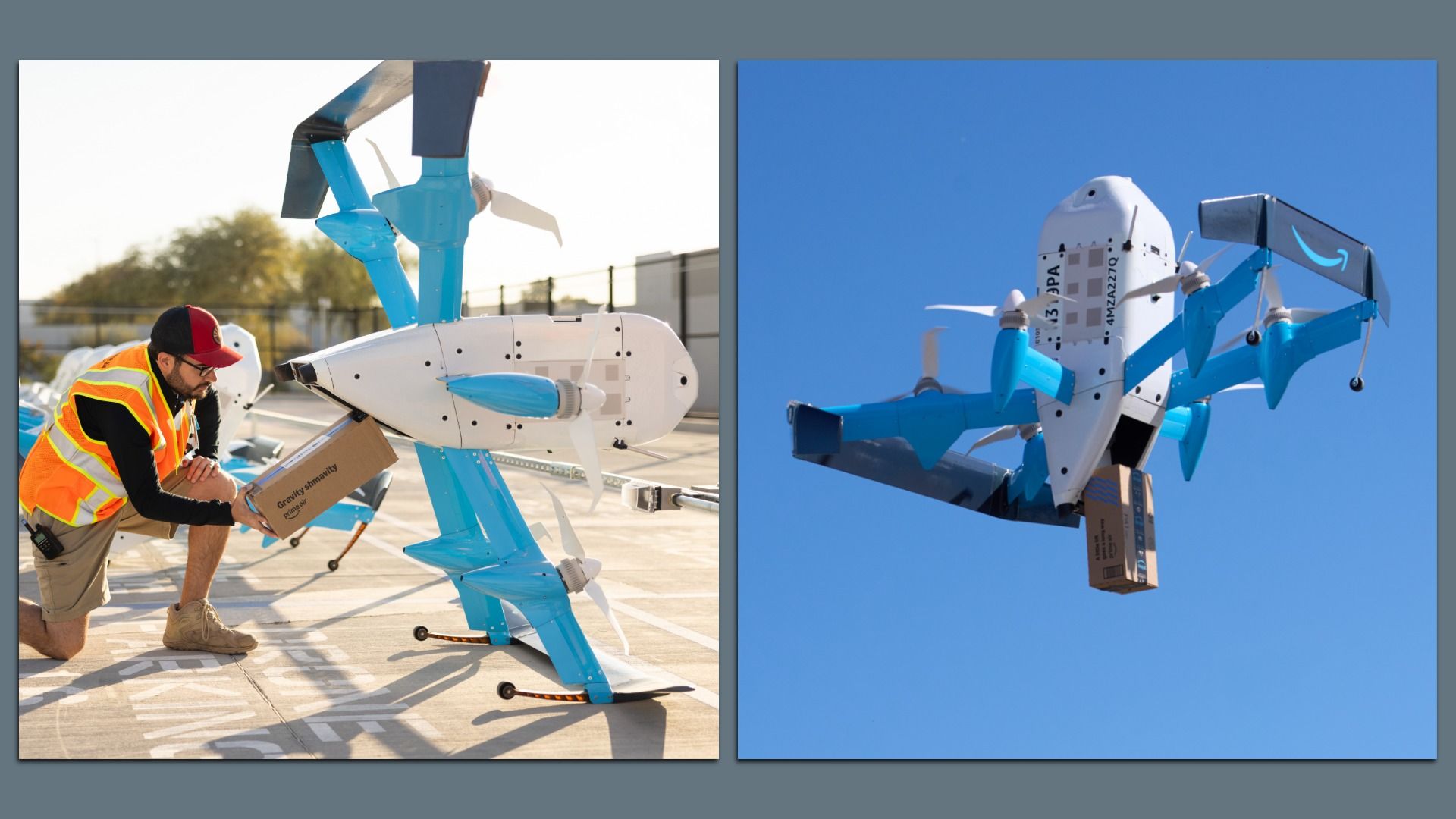
- Dimensions: About 6 feet tall with a 5.5-foot wingspan. 78 pounds.
- Service parameters: 7.5-mile operating radius, packages up to 5 pounds. Top speed 73 mph.
- How it works: Takes off and lands vertically, then flies horizontally to its destination, where it descends to about 13 feet. Package is dropped to the ground (or into a hot tub, by mistake) before returning to the Amazon fulfillment center.
Zipline's Platform 2
A fixed-wing aircraft with five propellers and a smaller droid inside its belly — a drone within a drone.
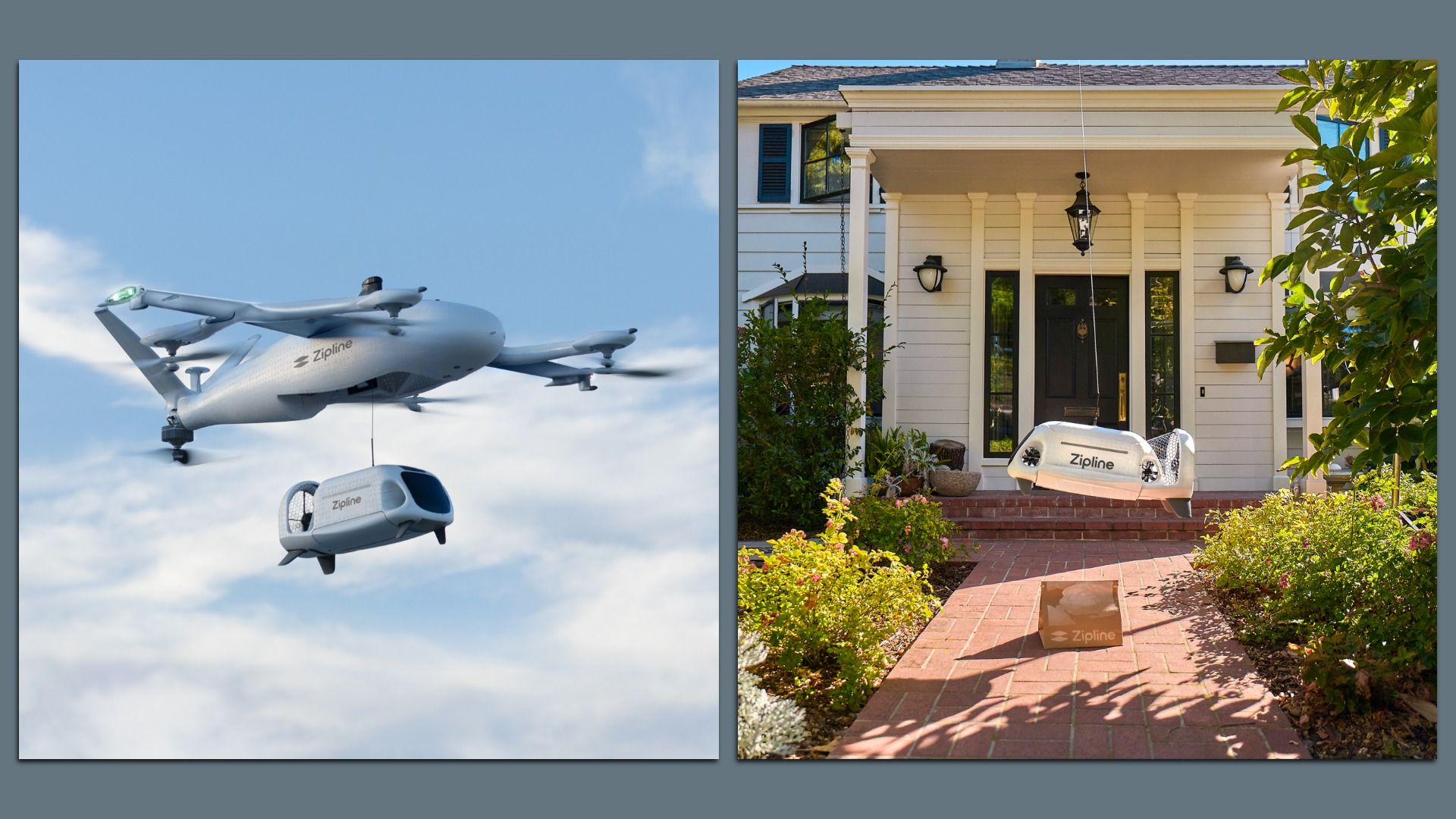
- Dimensions: 8 feet long, with a nearly 8-foot wingspan. 55 pounds.
- Service parameters: 10-mile operating radius; packages up to 8 pounds. Top speed 70 mph.
- How it works: The Zip hovers above the trees around 300 feet in the air, then lowers the tethered droid, which has its own sensors and thrusters for a more precise landing. After releasing the package, the droid returns to the belly of the Zip, which flies away.
Wing's Hummingbird 8000-A
The smallest and lightest of the three drones with 12 propellers and a slim body.
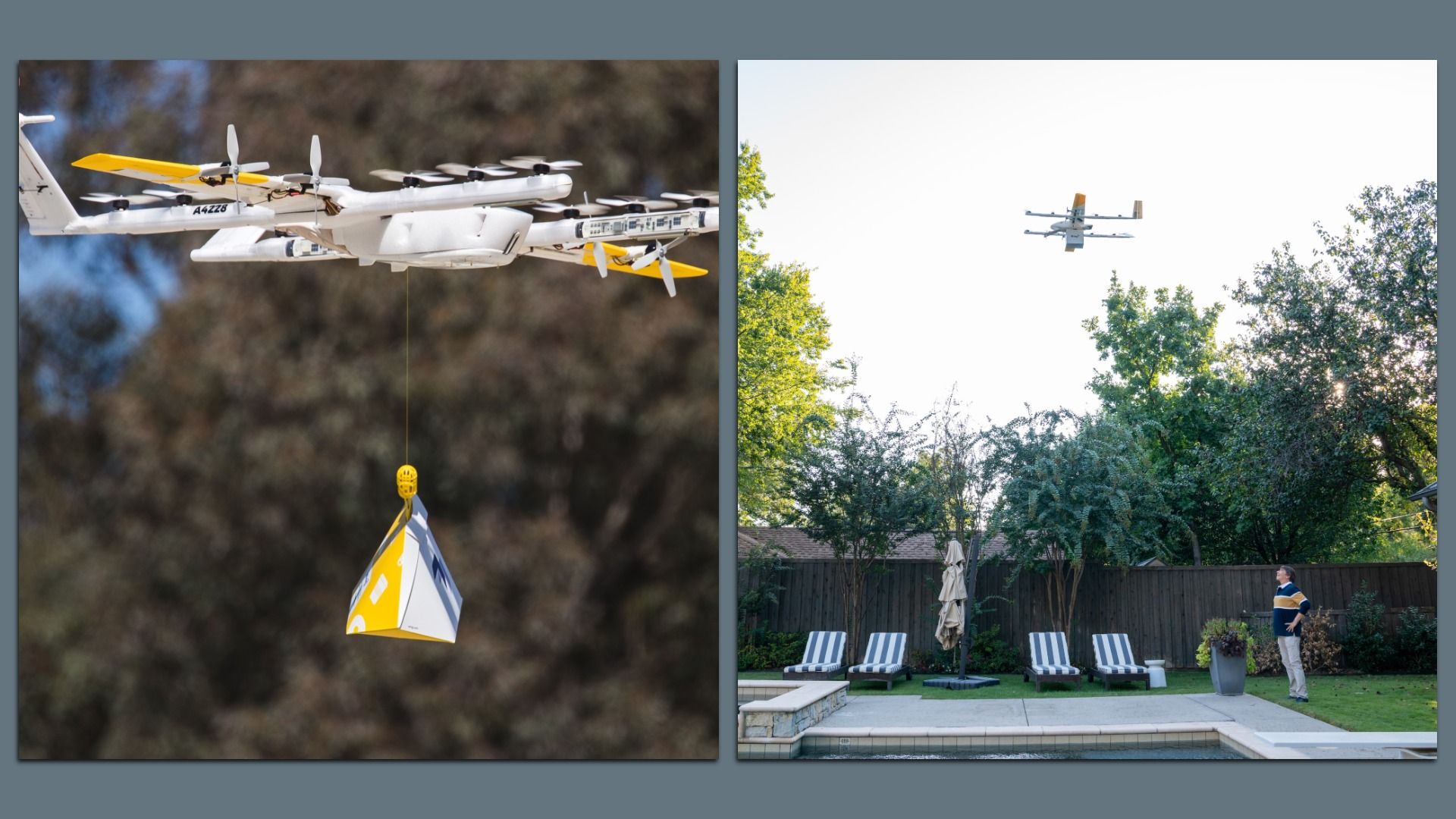
- Dimensions: 6 feet long, with a 6-foot wingspan; about 17 pounds.
- Service parameters: 12-mile operating radius; the newest version can handle packages up to 5 pounds. Top speed 60 mph.
- How it works: The drone hovers about 25 feet in the air, and uses a tether to lower a lightweight carton that looks like a McDonald's Happy Meal. After releasing the package on the ground, the tether recoils and the drone flies away.
Hoping to be seen, not heard
As delivery drones proliferate, weather and noise could prove to be among the most important differentiators.
- All three companies say they have designed their drones to be quiet, no worse than a delivery truck barreling through the neighborhood or a vacuum cleaner or home air conditioner.
- But the nature of their operations affects how much noise people on the ground will hear.
Zoom in: Amazon's drone, for example, is larger and comes down closest to the customer to drop the package, while Wing's drone stays higher and lowers it on a tether.
- Zipline's drone stays way above the trees while it lowers its droid, whose fan noise is "negligible," according to the Federal Aviation Administration.
By the numbers: FAA testing suggests Zipline is quietest during delivery (79 decibels), followed by Wing (84) and Amazon (88), measured from 50 feet away.
The bottom line: The drone-delivery winner might not be the aircraft that flies farthest, fastest or carries the most.
- It could be the one neighbors barely notice.
2. Waymo exclusive: No AI shortcut to autonomy
Breakthroughs in AI are fueling hopes that more data and smarter models can provide a shortcut to self-driving vehicles. Waymo, after more than 15 years and 200 million driverless miles, says there is none.
Why it matters: The answer could determine whether the robotaxi race is a long, expensive slog that rewards Waymo's head start — or a new track that lets newer rivals hit the road faster.
Driving the news: Srikanth Thirumalai, Waymo's vice president of onboard software, tells me in an exclusive interview that it takes more than just better AI to safely deploy AVs at scale.
- Waymo's goal from the start, he says, has been "demonstrably safe AI." But a growing reliance from competitors on single "end-to-end" AI systems introduces risks.
- "Even the best AI models with trillions of parameters still hallucinate... We don't have a choice to say, 'Let's hit refresh' ... There is no click reboot or reload or refresh [in] physical AI. You have to deal with the consequences of it."
- In a blog post published today, Thirumalai goes deeper on 10 AI lessons Waymo has gleaned from its first 200 million autonomous miles.
Catch up quick: Waymo got its start as Google's self-driving car project in 2009, well before the modern deep-learning revolution.
- In the early days, it relied on many specialized models — one for pedestrian detection, another to tell when a light turns green, for example. Gradually it shifted toward fewer, larger foundation models, "riding the AI wave," Thirumalai says.
- Now companies like Tesla, Wayve and Waabi are going even further, developing AV 2.0 systems they say are capable of humanlike reasoning — "end-to-end" neural networks that process raw sensor data and directly output steering commands.
Waymo says it has tried the same tools but concluded that there aren't enough safety guardrails.
- "What we found is that just pure end-to-end systems are not able to meet our safety bar at the scale that we operate," Thirumalai says.
Reality check: Waymo says it published the blog post to counter a narrative that AI can provide a shortcut to safe self-driving, with public trust in the AV industry on the line.
- At the same time, it's a flex. The safety standards Waymo wants the industry to embrace — not to mention regulators and rulemakers — also play to its biggest competitive advantage: a big head start built on years of testing and real-world driving data.
- While it didn't name specific competitors, it laid out reasons why newer approaches to building AV systems could carry risks — effectively raising the bar those companies would have to clear.
Zoom in: Waymo takes a direct jab at Tesla, weighing in on one of the industry's biggest debates — whether cameras alone can solve full autonomy.
- When training its models, Waymo found that visibility was far better when cameras, lidar and radar worked together rather than when one or more sensors were eliminated.
- "The AI can only make sense of what it sees, and if you just can't see it, the AI can't do much," Thirumalai says. Better AI can't fully compensate for inadequate sensing.
- He says the same is true for high-definition mapping, which some rivals say is unnecessary.
The bottom line: Waymo spent more than 15 years building a commanding lead in robotaxis, and Thirumalai argues now that there is no "one silver bullet" to reaching safe autonomy.
- Waymo's experience as the industry leader gives its argument weight — but it doesn't settle the debate. Rapid advances in AI could still prove there's a faster path to autonomy.
3. Chinese automakers leave U.S. in the dust
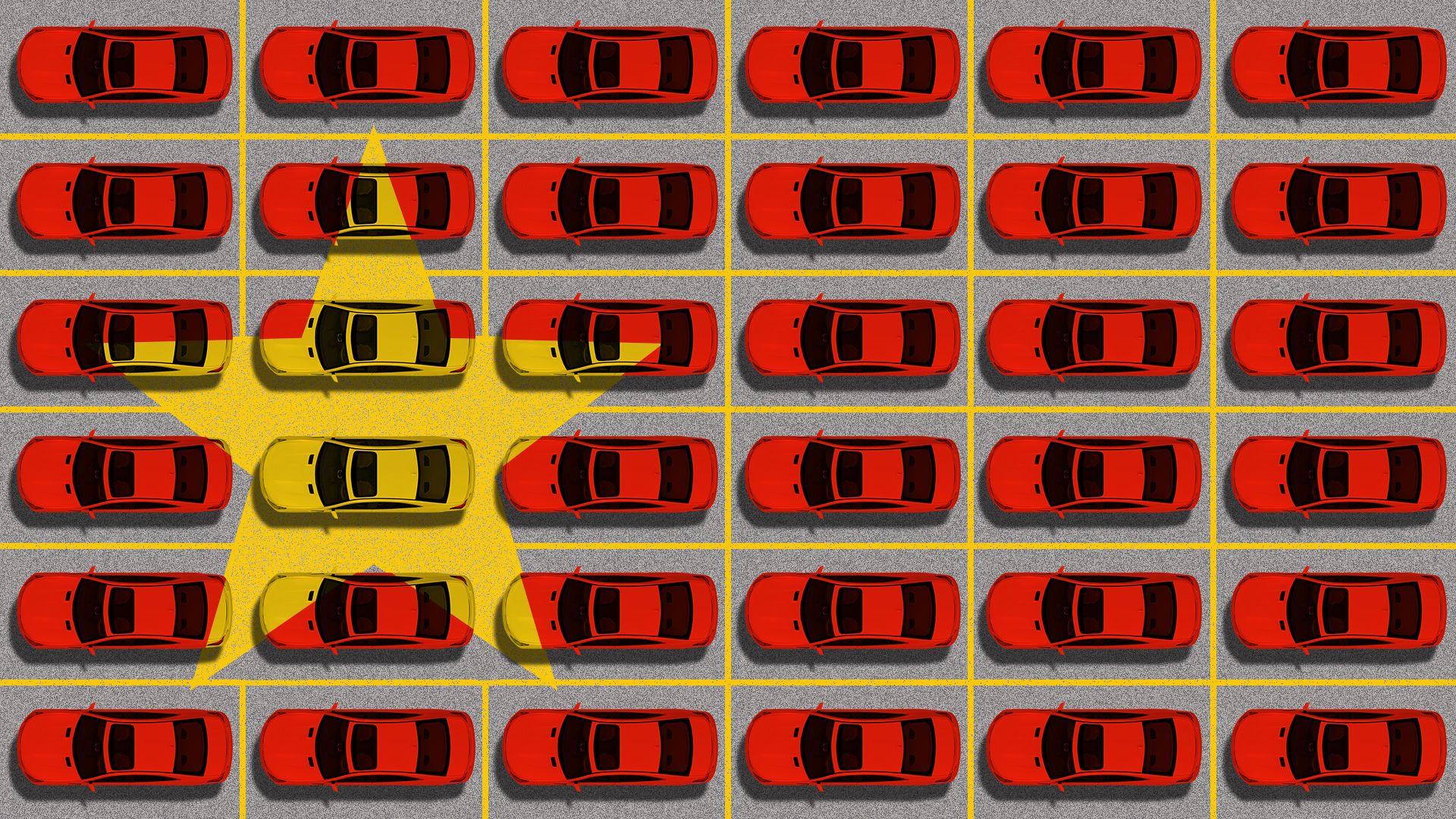
Protectionist trade policies may buy Detroit automakers some time, but they can't hide the U.S. auto industry's deteriorating global competitiveness forever.
Why it matters: American consumers don't see Chinese brands like BYD, Geely, Chery or Xiaomi in dealerships, so the rise of Chinese competition can feel theoretical.
Driving the news: A new analysis from the Center for Automotive Research shows how the explosive global growth of Chinese brands has left U.S. automakers in the dust.
- Chinese carmakers' share of the global market increased from 14% in 2020 to 25% in 2025, approaching Japan's 26%.
- U.S. global share is essentially flat, at 12%.


Zoom in: China had excess production capacity of about 15 million vehicles in 2025 — equivalent to an entire year of U.S. auto sales — giving its companies a powerful incentive to keep exporting.
- Chinese automakers' sales have already tripled in Western Europe and increased sevenfold in other markets since 2020.
- In Mexico, sales of Chinese cars soared to 14.5% of the market in 2025, up from less than 1% in 2020.
Between the lines: The common refrain from U.S. industry executives is that China's advantage comes from government subsidies.
- But CAR's analysis found a more complex story.
- China's entire industrial system — strong supply chains, massive scale, fast development speed, intense domestic competition and yes, favorable government policy — works together to reinforce that advantage.
The bottom line: America has largely succeeded in keeping Chinese cars off U.S. roads. It hasn't stopped China from remaking the global auto industry.
4. Drive-thru

🚛 Self-driving truck company Gatik raised $200 million, its largest funding round so far, as interest in driverless commercial freight surges in North America and Europe. (Reuters)
🚦Nevada gave the green light to as many as 7,000 robotaxis in Las Vegas, including up to 5,000 for Tesla, and 1,000 each for Waymo and Uber. Vegas is shaping up as a major AV battleground. (TechCrunch)
⛴️ Vessev, a New Zealand startup making electric hydrofoil boats, raised a $19 million Series A and is bringing its vessels to the U.S., Axios Pro Deals scooped. (Subscribe here)
🚁 Archer Aviation and AEG plan to open a vertiport at L.A. Live, the huge sports and entertainment district in downtown Los Angeles, as part of Archer's planned LA air taxi network. (Los Angeles Times)
5. 🚘 What I'm driving
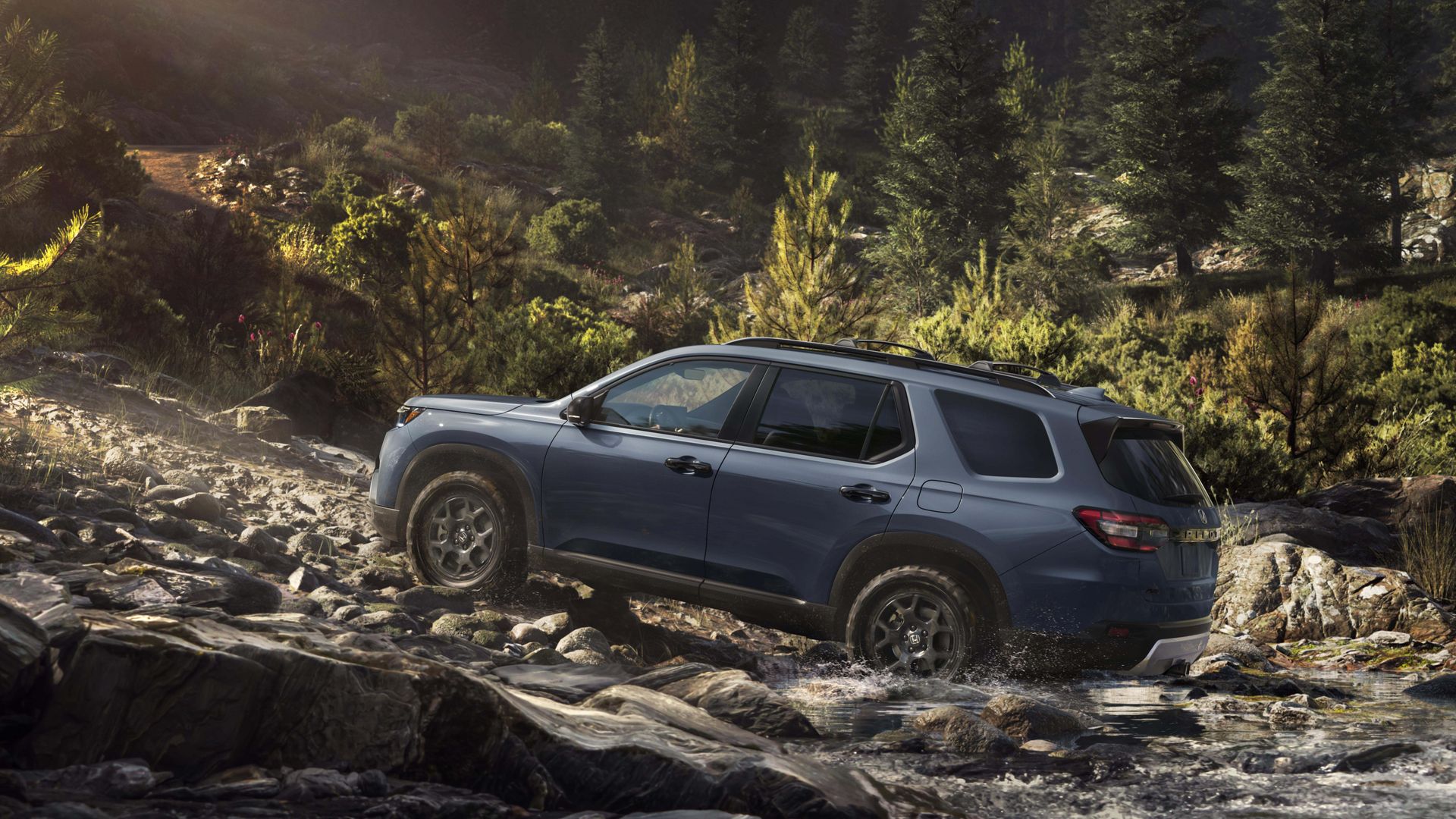
2026 Honda Pilot
- MSRP: $43,890 starting price including destination fee; I tested the $52,345 Trailsport and $54,990 Elite trim levels.
- Under the hood: 285-hp, 3.5-liter V6, 10-speed automatic transmission. All-wheel-drive. 21 mpg.
- Manufacturing site: Lincoln, Alabama
What's new: A few exterior tweaks and a nicer interior, including larger touchscreens, plus improved steering feel and a quieter cabin. Wireless Apple CarPlay, Android Auto and Google built-in technology are now standard.
What I loved: Lots of cubbies to store things, and decent cargo room, even with all three rows of seats up. The back row is tight, but not as cramped as some three-row family haulers.
- Safety is a priority, with a full suite of standard crash-avoidance technologies.
- Pilot is tried-and-true, and Honda doesn't stray far from its successful formula.
What I didn't love: That's the same reason the Pilot lacks pizzazz compared to competitors like the Hyundai Palisade and Kia Telluride.
The bottom line: Honda fans will be happy with the improvements in the 2026 Pilot.
I test-drive vehicles in my role as a juror for the North American Car and Truck of the Year awards. Opinions are my own.
Thanks to editors Pete Gannon and Amy Stern. If you're a fan of this newsletter, please ask your friends to sign up, too.
Sign up for Axios Future of Mobility