Axios Future of Mobility

August 27, 2025

Welcome back! Have you noticed that the autonomous vehicle hype machine is cranking up like it's 2017 again?
- π Today we dive deeper into the potentially trend-setting robotaxi partnership between Uber, Lucid and Nuro.
π Good news for travelers in the Northeast: Amtrak's next-gen Acela train debuts tomorrow.
All in 1,637 words, a 6-minute read.
1 big thing: Turning robotaxis into cash cabs
Uber has placed a lot of robotaxi bets lately, but the three-way deal it struck last month with Nuro and Lucid could be the most consequential β not just for the partners, but for the entire industry.
Why it matters: Developing cars that can safely drive themselves is a monumental task. Turning that technology into a sustainable business is an entirely different challenge.
- Uber's licensing deal with Nuro and Lucid is a high-profile experiment to figure out the economics of robotaxis and, perhaps more importantly, to identify a business model that can be profitable for all.
Catch up quick: Uber said last month it would buy 20,000 Lucid electric robotaxis over six years and pay Nuro a per-mile licensing fee for its robot driver.
- Uber is also taking a small stake in both companies.
The big picture: Uber is trying to defend its ride-hailing business from the growth of robotaxis by folding small fleets of autonomous vehicles into its network, alongside human drivers.
- It already has deals with 18 AV partners, including Waymo, the market leader, whose driverless taxis can be summoned on the Uber network in Phoenix, Austin and Atlanta.
- The so-called platform strategy lets Uber embrace robotaxis without spending a lot of money to build them.
Between the lines: With Lucid and Nuro, however, Uber has more skin in the game.
- "Uber has a Waymo risk," explains AV strategist Grayson Brulte, founder and CEO of The Road to Autonomy.
- "If Waymo decides to walk away from Uber, then Uber has an AV problem," he tells Axios. "Uber is hedging its bets by putting these vehicles on their balance sheet."
Yes, but: Wall Street analysts worry Uber's "asset-light" business model will get bogged down by the extra costs of managing a vehicle fleet.
- CEO Dara Khosrowshahi, on a recent quarterly earnings call, tried to quell the concerns, saying "it's early days" for autonomous vehicles and Uber is just gathering data to better understand the economics of the market.
- "Once we prove out the revenue model, how much these cars can generate on a per-day basis, there will be plenty of financing to go around" from banks, private equity firms and other third-party financing sources, Khosrowshahi said.
- "While it will take some time, we're very confident that these assets are going to be financeable."
Zoom in: The deal helps establish a potential ecosystem for AVs, with benefits for all three players.
- It's the first licensing agreement for Nuro, an AV pioneer that pivoted from building and deploying delivery bots to licensing its technology for robotaxis.
- With EV subsidies disappearing, Lucid gets to broaden its market opportunities while it develops its next wave of lower-cost models, Lucid's interim CEO Marc Winterhoff says via email.
The intrigue: Saudi Arabia's sovereign wealth fund, the Public Investment Fund (PIF), is a major investor in both Uber and Lucid, so the deal certainly props up the storyline around both companies.
- Plus, Uber just joined a late-stage funding round for Nuro, which raised $203 million at a $6 billion valuation.
What they're saying: "If you look at this model, it does allow each party to really do what it is absolutely best at," Nuro co-founder Dave Ferguson tells Axios.
- "This is the future," says Brulte. "Over time, you will see more and more deals structured this way and expanded to include real estate assets to manage the fleets."
The other side: Critics say the focus on extracting profits from robotaxis distracts from the massive technical challenges that still remain.
- "There is no business case for unsafe autonomous technology, and publicizing business cases, partnerships and licensing deals before the technology is safe and ready puts the cart way ahead of the horse," says John Krafcik, former CEO of Waymo.
The bottom line: The industry still has to prove robotaxis are safe.
2. Inside Uber's deal with Lucid and Nuro
Many AV partnerships are nothing more than press releases β vague promises to work together in some capacity in the future.
- But a Lucid regulatory filing shares key details that suggest the three-way pact between Uber, Lucid and Nuro is more substantial.
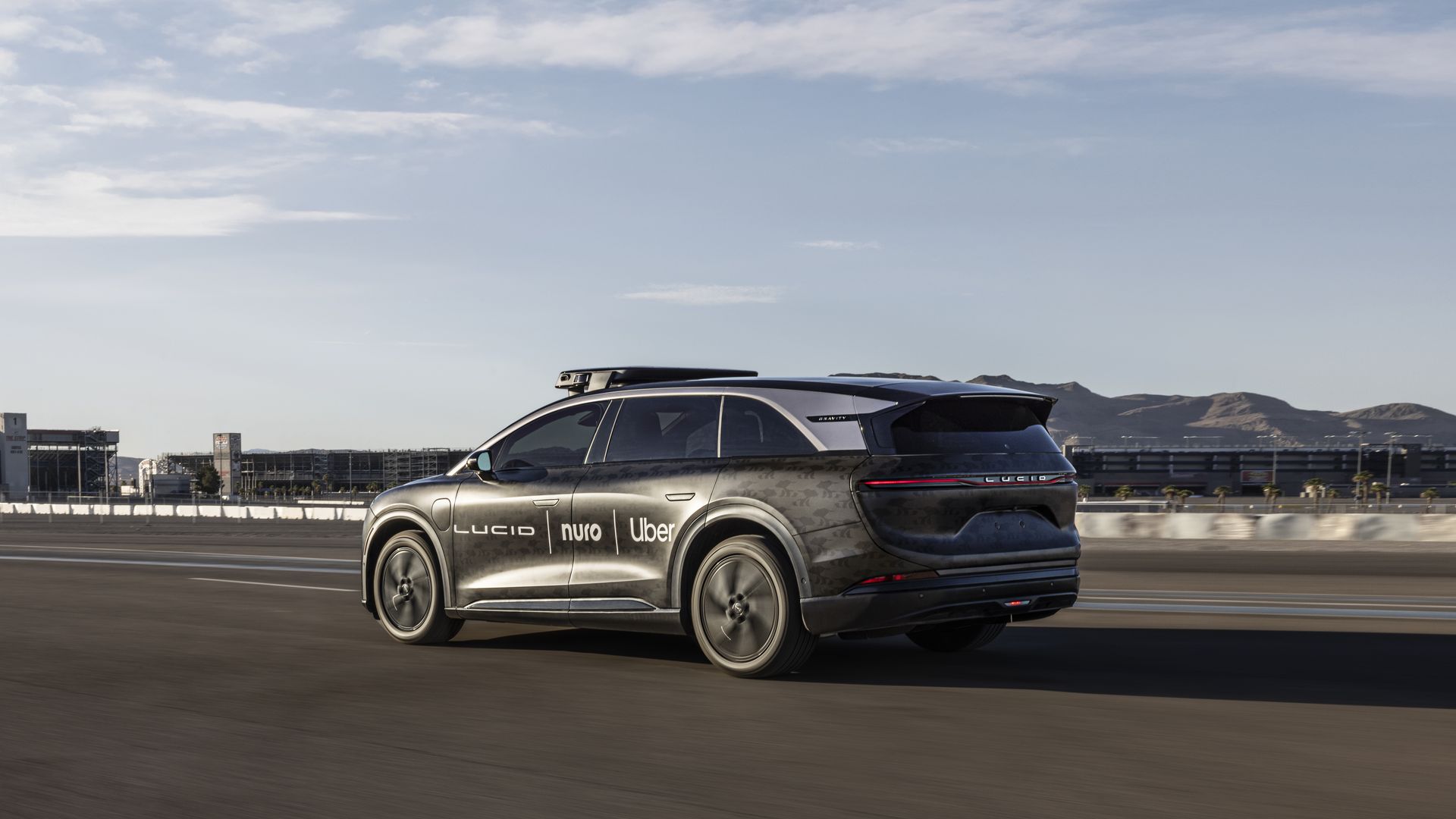
What's inside: The vehicle production agreement says Uber will buy "not less than 20,000" Gravity Plus vehicles from Lucid.
- That includes 10,000 vehicles shortly after the start of production and another 10,000 within six years.
- Uber's cost per vehicle is redacted, but the retail price of a Lucid Gravity SUV is $80,000 to $95,000 β absent any extra self-driving technology.
- The Gravity Plus is a modified version of that new SUV and includes Nuro's hardware and software, including a roof-mounted sensor pack, that will be installed at Lucid's factory in Arizona.
Between the lines: In a robotaxi, high utilization is more important than speed or performance.
- Thus, the Gravity Plus is optimized for robotaxi use by pairing the 123 kWh battery pack from the $95,000 Grand Touring model with the less powerful motors in the $80,000 Touring version.
- The larger battery, good for 450 miles of range, means less downtime for charging β and more time collecting fares.
What to watch: Production is to begin next year, and the first Gravity Plus robotaxis will be deployed on the Uber network in late 2026.
3. Gig drivers earn less in robotaxi markets


A new report measuring the early effects of autonomous vehicles on the rideshare industry should worry gig drivers, whose earnings are lower in robotaxi markets.
Between the lines: Gridwise Analytics collects driver data to track the gig economy.
- "Our data shows that in markets where autonomous vehicles are operating, some metrics indicate a decline in driver earnings," Gridwise CEO Ryan Green tells Axios.
For example: Across the U.S., per-trip driver earnings increased slightly in July compared to last year.
- But in some cities with AVs, per-trip earnings fell year-over-year.
- Austin saw a 5.3% decline; Phoenix dropped 2.4% and San Francisco fell 3.1%. Los Angeles held nearly flat with a 0.4% gain in driver earnings.
- Drivers' hourly gross pay also fell in AV cities, as the chart above shows.
Yes, but: "This doesn't suggest widespread displacement in the near term," Green noted.
- "Human drivers will remain essential for years to come, though they may need to adjust when and where they drive," he said.
- "AVs are likely to be better suited for specific times of day, certain parts of a city, or particular ride types β but many trips simply won't be viable for autonomous vehicles.
- "As rideshare demand continues to grow, we expect AVs to carve out their role in the ecosystem while human drivers adapt and remain in strong demand."
4. Drive-thru

ICYMI ...
πΌ Waymo CEO Tekedra Mawakana is everything Elon Musk is not, according to an in-depth profile in Vanity Fair.
- "I can be found with roller skates and a beach tent in my trunk at all times."
π°π· Hyundai Motor Group said it would increase its U.S. investment by $5 billion, on top of the $21 billion pledged in March, as the U.S. and South Korea close in on a trade deal. (Wall Street Journal)
π Honda tapped Silicon Valley startup Helm.ai to develop advanced driver assistance systems for its mass market vehicles by 2027. (Bloomberg)
5. What I'm driving: Ford Mustang Mach-e
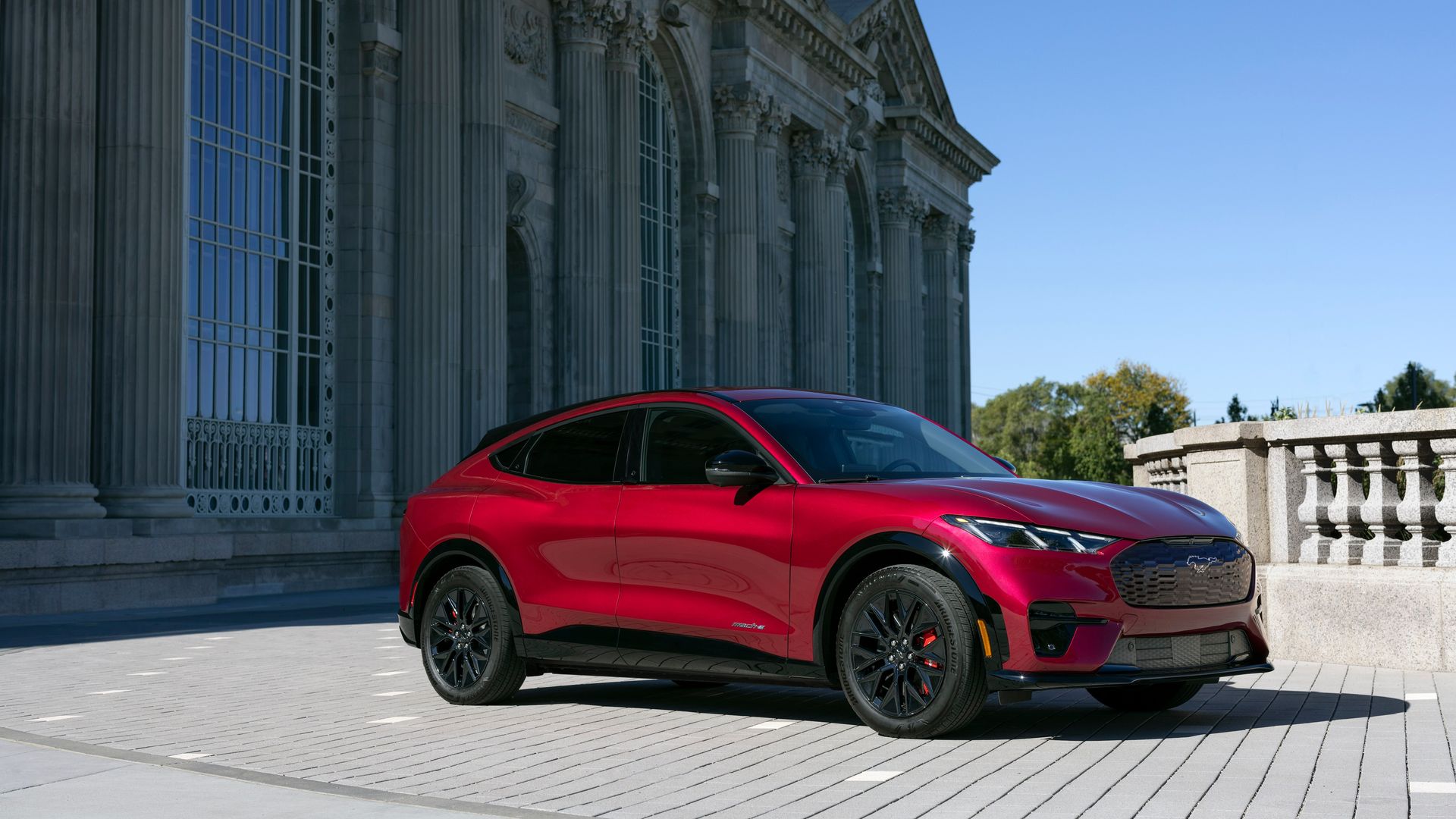
The Ford Mustang Mach-e gets better with age, and that's not true for most vehicles.
- It has more features, an improved battery range and costs less than it did when it was introduced for the 2021 model year.
My goal was to try the latest version of Ford's Blue Cruise assisted-driving system, but a week behind the wheel of the Mach-e reminded me why it's so much fun to drive.
- Its sporty styling and responsive acceleration provide a teeny jolt of adrenaline, even if the electric powertrain lacks the growl of a traditional V-8 Mustang.
- The standard 73-kWh battery provides 325 horsepower and 240 miles of driving range, but you can go up to 300 miles with the 88-kWh extended-range battery available on all trim levels.
- The 2025 models adds a heat pump for improved range, especially in cold weather.
- Fortunately, you can now charge the Mach-e at many Tesla Superchargers, making charging less of a hassle.
- Ford is even offering buyers a free home charger through Sept. 30.
Ford's Blue Cruise technology, which enables hands-free highway driving, is vastly improved from the version first introduced on the Mach-e back in 2021.
- It's smoother and more confident on curves, and even knows enough to give trucks a little extra room in the next lane.
- The latest version adds automatic lane change capability βΒ it will pass slower vehicles without any input from the driver.
Yes, but: I tried it briefly during a short trip along I-94 on Detroit's east side.
- I was in the center lane, intending to exit two miles ahead, but unexpectedly, the car moved to the left lane to pass, then couldn't move back because of heavy traffic.
- I ended up having to take control of the wheel and force my way over so I could exit in time.
Pricing starts around $38,000 and goes up to $58,500 for the new high-performance Mach-e Rally.
- I drove the $43,000 Mach-e Premium all-wheel-drive version, but with $5,300 worth of options β including a new $3,000 "sports appearance package" β and $2,000 delivery charge, the final sticker price topped $50,000.
The bottom line: Ford needs to keep the excitement going for the Mach-e while it develops a new family of EVs arriving in 2027.
I test-drive vehicles in my role as a juror for the North American Car and Truck of the Year awards. Opinions are my own.
Thanks to Ben Berkowitz and Bill Kole for editing. Ask your friends to sign up!
Sign up for Axios Future of Mobility