Axios Future of Mobility
January 07, 2026

⏩ Welcome back. I hope you enjoyed some rest during the holidays, because 2026 is coming on fast!
- I'm not big on New Year's resolutions, but one of my goals is to declutter my life. If only I had a humanoid robot to help.
🤖 Today's issue offers a reality check on humanoids, plus all the mobility highlights from CES.
👋 But first, say hi to Business Editor Pete Gannon, the new editor of this newsletter.
1,383 words, a 5-minute read.
1 big thing: Humanoids need better hands
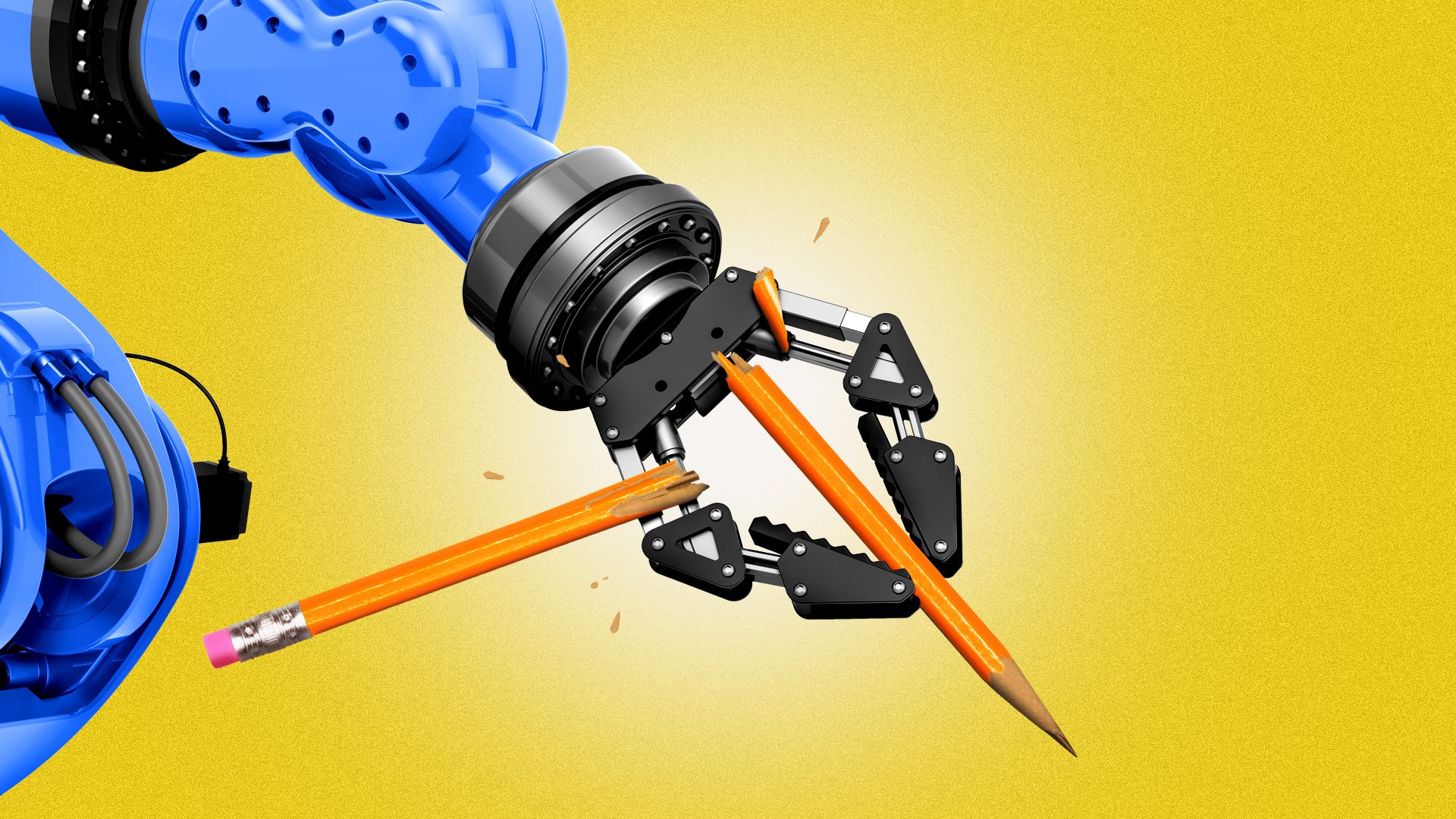
My dog is smart, but without an opposable thumb, he still can't open the door to let himself out. Humanoid robots have a similar problem.
Why it matters: Despite huge breakthroughs in artificial intelligence that enable these clever machines to learn from human feedback or their environment, their clawlike hands are still too clumsy for most jobs.
- Until engineers can design robotic hands that are as intricate and sensitive as their own, humanoids will be relegated to basic, repeatable tasks like carrying totes or grasping and sorting parts.
The big picture: In the coming decades, humanoids are forecast to revolutionize everything from manufacturing and logistics to elder care and home services like laundry or cooking.
- Nvidia CEO Jensen Huang predicts humanoids will be "one of the largest industries ever," while Tesla CEO Elon Musk says its Optimus robot could be "the biggest product of all time."
- Wall Street is on board with that narrative, with some analysts predicting global revenue from humanoid robots between $5 trillion and $10 trillion by 2050.
- Eventually, humanoids deployed could outnumber cars on the road, says RBC Capital Markets analyst Tom Narayan.
Reality check: None of this will happen quickly, due to a slew of technological, financial and societal hurdles.
The biggest technological challenge isn't training robots to think like humans — AI can do that. Rather, it's designing hands that are dexterous enough to properly complete a task.
- As adroit as humanoids appear running or doing cartwheels, their robotic hands are holding them back.
Zoom in: Human fingertips are remarkably sensitive, with thousands of sensors that enable people to apply just the right amount of force to pick up an egg, manipulate an object or lift a 20-pound bag of dog food, for example.
- "The more you study the human hand, the more incredible you realize the human hand is and why you need four fingers and a thumb, why the fingers have certain degrees of freedom, why the various muscles are of different strengths, the fingers are of different lengths," Musk explained on an investor call in October.
- "Designing the Optimus hand and forearm is an incredibly difficult engineering challenge," he said.
What they're saying: "What's missing, apart from all the software, are the tiny motors and actuators to get you that level of motion and precision. Those motors don't exist today," Erik Nieves, founder and CEO of Plus One Robotics, tells Axios.
- "There's a reason you have only tendons in your hands, and muscles in your arm," he said. Robots would need tiny motors in every knuckle to match human dexterity.
- Instead, they've got the motor skills of a toddler stacking blocks, he said.
- "You can't tie your shoe if you're wearing an oven mitt."
The bottom line: When it comes to most jobs, humanoids are all thumbs.
2. Hyundai to deploy robots in Georgia
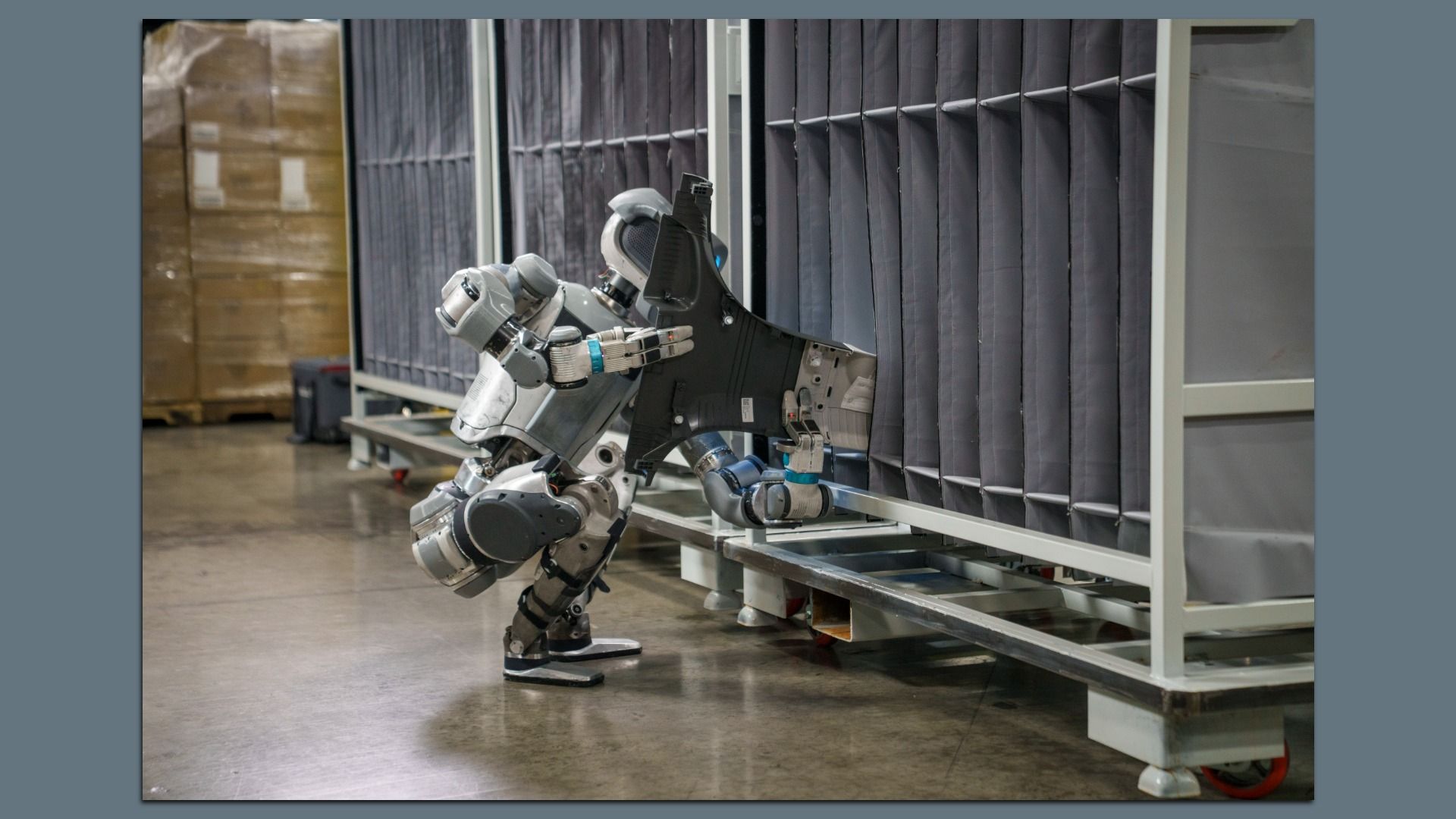
Hyundai Motor Group says it's ready to take its three-fingered Atlas robots from the lab to the factory floor by 2028.
Why it matters: Hyundai's accelerated push into automation signals a new phase in the AI revolution by applying artificial intelligence to the physical world.
Driving the news: Hyundai's Boston Dynamics unit unveiled the latest iteration of its Atlas humanoid robot this week at CES.
- Hyundai aims to produce as many as 30,000 Atlas robots annually by 2028.
- They'll do simple tasks in the carmaker's manufacturing plants starting that same year.
- Over time, they'll take on more complex jobs that involve repetitive motions and heavy loads — easing the burden on human employees.
Where it stands: Other carmakers, including Tesla, BMW and Mercedes, aim to put humanoids to work in their factories, but none have advanced past early pilots.
For more on Atlas, check out Sunday's "60 Minutes" segment.
3. Nvidia's "ChatGPT moment for physical AI"
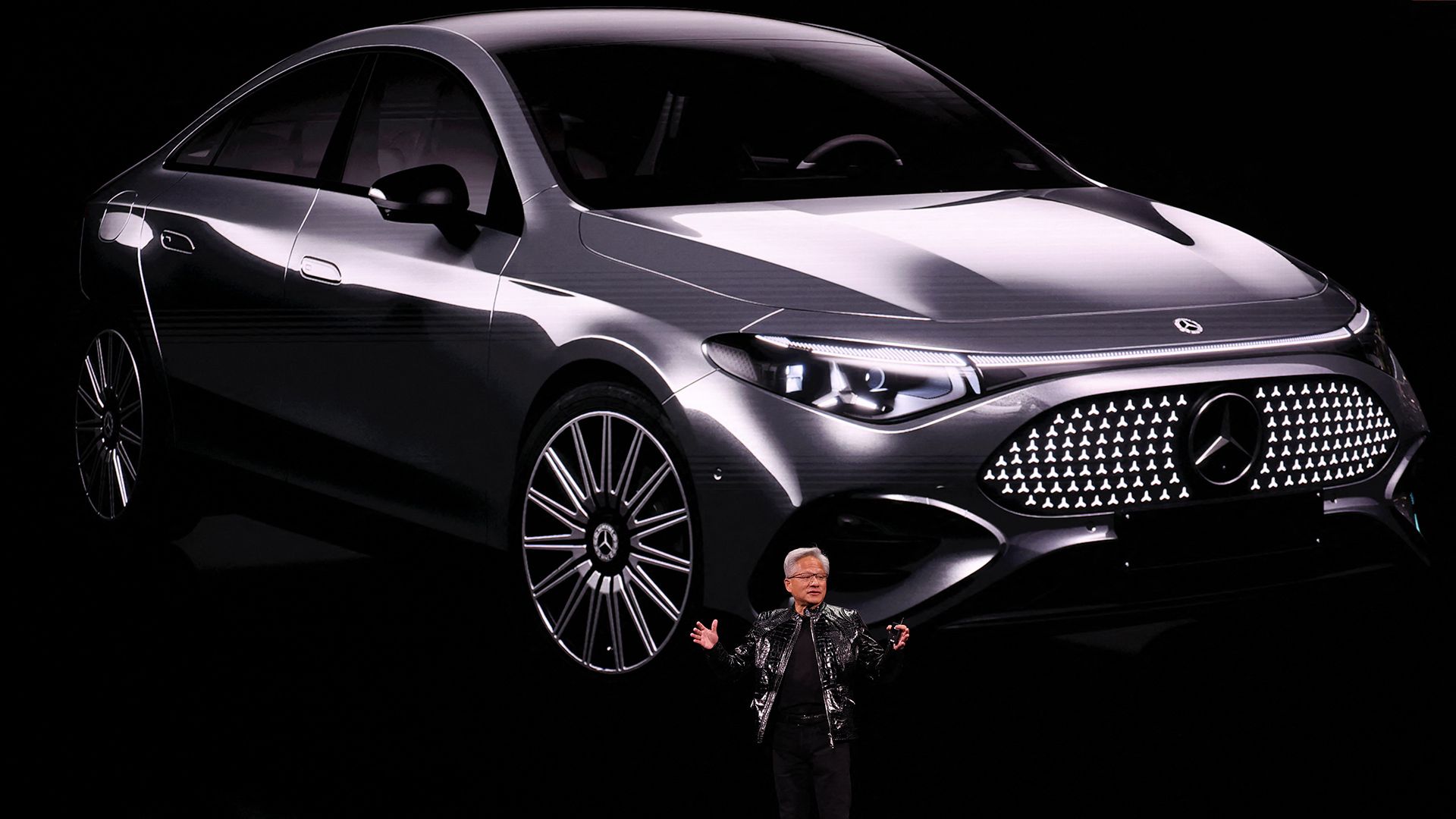
Nvidia CEO Jensen Huang unveiled open-source AI models for autonomous vehicles at CES and said the company's own driver-assistance software will debut in the new Mercedes-Benz CLA later this year, Axios' Kerry Flynn writes from Las Vegas.
The big picture: Robotics, including self-driving cars, is the next growth area for Nvidia beyond AI infrastructure.
- "The ChatGPT moment for physical AI is here — when machines begin to understand, reason and act in the real world," Huang said in a statement. "Robotaxis are among the first to benefit."
Between the lines: Nvidia has long provided chips and other technology to carmakers, but now it's going much deeper by developing its own autonomous driving systems.
- Companies that don't have the money or talent to develop autonomous systems in-house can license Nvidia's AV stack instead.
- Or, developers can build their own AV systems using Nvidia's new Alpamayo AI technology, which introduces "human-like reasoning" to AVs so they can better handle rare or complex scenarios and, importantly, explain their driving decisions.
The intrigue: By providing open access to Alpamayo's AI models, simulation tools and datasets, the company aims to lock many automakers into the Nvidia ecosystem, while Tesla's Full Self-Driving (FSD) software remains proprietary.
What to watch: Nvidia's driver assistance technology in Mercedes' new CLA is designed to enable "point-to-point" hands-free driving and navigation on city streets, similar to Tesla FSD.
- Caveat: Neither system is fully autonomous; drivers must pay attention and be prepared to retake the wheel.
4. Drive-thru: CES edition

At CES, it's all about AI, autonomy and robots.
📅 Cerence, a leader in voice technology, showcased an agentic AI platform which is like having a personal assistant in the passenger seat.
- In a demo, the AI agent reviewed the driver's calendar, checked who was attending an upcoming meeting and summarized related emails.
- It even brainstormed potential discussion topics, preparing a list in Microsoft OneNote that went straight to the driver's laptop.
🚘 SoundHound showed AI agents that can order food, make dinner reservations, pay for parking, book tickets, travel and more.
- It also debuted Vision AI for vehicles, which unites the car's cameras with voice recognition for contextual awareness.
- Drivers can ask questions like, "Hey, can you tell me more about that building on the right?" or "What exit did we just pass?"
🚜 Caterpillar introduced intelligent bulldozers, excavators and other construction machines that can operate autonomously on work sites.
- Cat's mining trucks have operated autonomously for years, but construction sites are more complex and chaotic than mines.
- "Eighteen to 24 months ago, full construction autonomy felt like a fantasy," Chief Technology Officer Jaime Mineart tells Axios, but breakthroughs in AI, sensors and edge computing enabled the leap.
🚚 Oshkosh also displayed smart vehicles, including an electric articulated boom lift that can autonomously perform welding, painting and ductwork at height so workers aren't put at risk.
- A new AI-powered refuse truck detects contaminants in your recycling bin, while an autonomous, electric robot will collect your trash on demand.
👁️ Boston-based startup Teradar, which just raised $150 million, introduced a high-resolution, all-weather sensor that could ultimately replace traditional radar and LiDAR sensors for AVs.
- Founder and CEO Matt Carey tells Axios the low-cost terahertz sensor could unlock "hands-off, eyes-off" driving in personally owned cars. Several automakers are already testing Teradar's chip.
📦 Neolix, with 15,000 autonomous delivery vans operating in China, made its U.S. debut, showing off its two bestselling robo-vans and a new sidewalk robot designed for urban deliveries.
5. 🧭 1 fun thing: Google Street View goes off-road
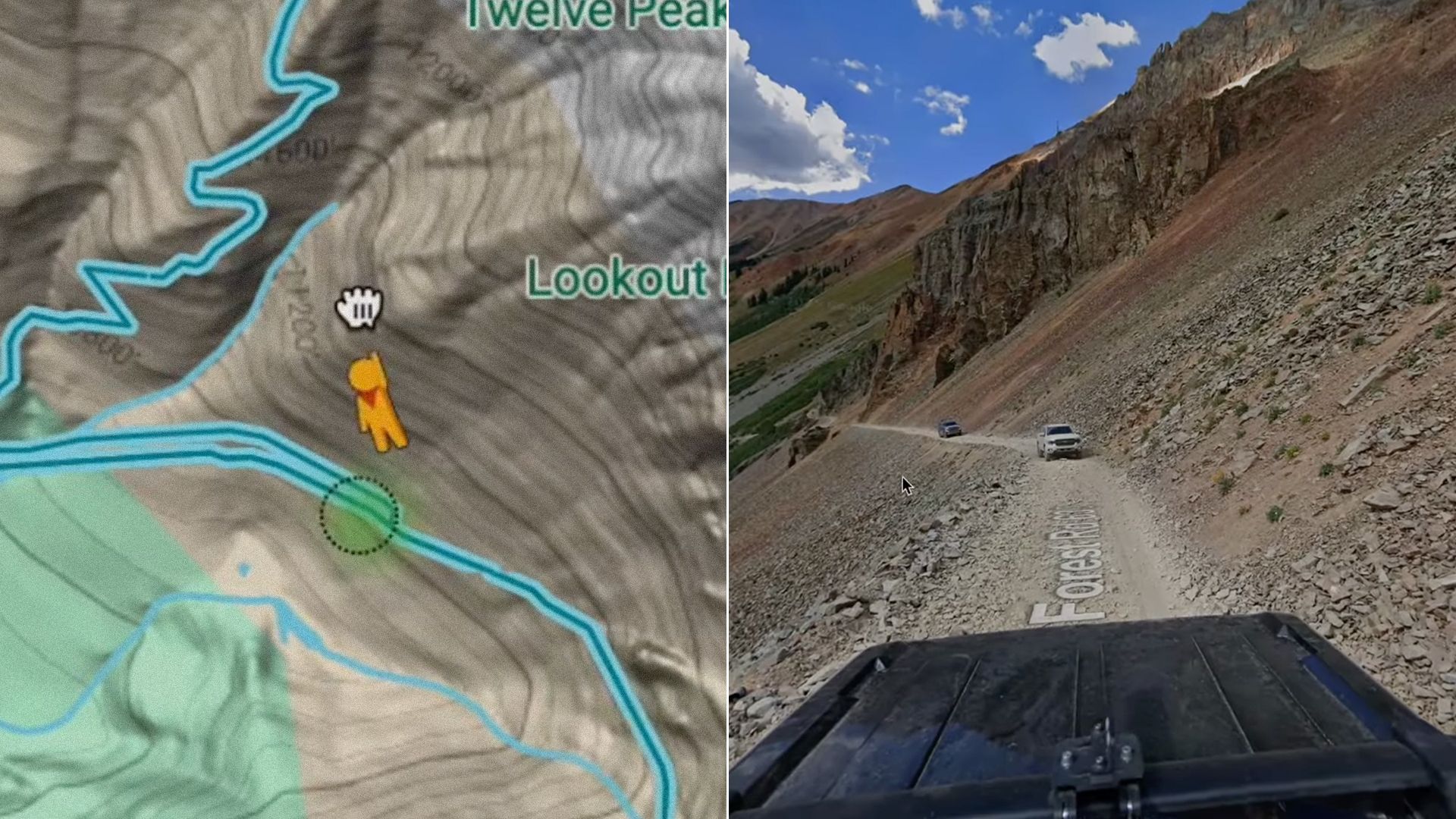
Ford partnered with Google Maps to bring the entire 5,900-mile TransAmerica Trail to Google Maps Street View.
Why it matters: Now anyone, anywhere, can access one of America's most iconic all-terrain adventures, even from their living room couch. With Street View, off-roaders can preview the trail and plan their route before heading out.
How it happened: A Ford Bronco equipped with Google's Street View camera spent 32 days crossing 13 states — navigating remote deserts, mountains and rugged backcountry roads.
💭 My thought bubble: I like the idea of knowing what I'm getting into before I commit to crazy ideas.
Thanks to Pete Gannon and Bill Kole for editing. Share this newsletter with your friends and colleagues here.
Sign up for Axios Future of Mobility