Axios Future of Mobility

April 29, 2026

🐪 Hello Wednesday! I'm glad to see you.
- 🚖 We spend a lot of time focused on robotaxi technology, but today we're diving into the less sexy, but critical infrastructure needed for them to operate.
- Plus, we're looking at the mismatch in how cars and software age.
All in 1,718 words, a 6.5-minute read.
1 big thing: Robotaxi depots are all the rage
Robotaxis are hitting a very analog bottleneck: real estate. The next phase of autonomy isn't about better AI — it's about land, electricity and logistics to keep fleets on the road.
Why it matters: The race for autonomy is becoming an infrastructure battle, one that will demand billions for urban land, grid upgrades and high-throughput service hubs.
Between the lines: Like any fleet business, the key to operating a successful AV network is maximizing vehicle "uptime."
- Robotaxis plugged into an EV charger, or waiting to be serviced, aren't earning fares.
- Making money requires operating at scale — fanning out in large numbers across many cities with highly efficient pit stops for cleaning and charging.
Think of it like a WiFi mesh network, but for an entire city, says Ming Maa, co-founder and CEO of Moove AV, which manages and dispatches Waymo's robotaxis in Phoenix and soon Miami.
- In any "mid-tier market," a robotaxi company needs four to six facilities where vehicles can be charged and serviced, he told the audience at the recent Ride AI conference in San Francisco.
- And that infrastructure has to be planned efficiently to minimize "dead miles" between rides and to shorten customer wait times, he said.
"The challenge is trying to find sites in and around urban areas with the right zoning and pathways to power," Brett Hauser, CEO of fleet charging company Voltera, told Axios in an interview.
- A robotaxi depot doesn't demand as much electricity as an AI data center, but it still needs anywhere from 4 to 12 megawatts of power, Hauser says, "and that's hard to find in an urban core."
One option is to repurpose an industrial site as Revel did in Brooklyn for EV rideshare drivers.
- Revel converted a former Pfizer manufacturing complex with 7 megawatts of power into a 25-stall charging hub. Robotaxi hubs could use the same model.
Follow the money: The tech and auto industries have spent billions to develop AV technology, but it's new players that will build the AV ecosystem to support robotaxis.
- Lyft's Flexdrive unit, for example, just started construction on an 80,000-square-foot depot in Nashville to support Waymo's robotaxis.
- Uber plans to spend $100 million on AV depots in three cities to support a flurry of new robotaxi partners.
- Terawatt Infrastructure plans to raise up to $1.5 billion later this year to develop dozens of AV charging hubs, Axios Pro's Alan Neuhauser scooped earlier this month.
What we're watching: Securing that necessary capital is another challenge.
- There's more of it than there are companies to invest in right now, said John Casesa, a longtime automotive analyst and former Ford executive who now leads the Autos and Mobility Investment Banking team at Guggenheim Securities — but investors want to see profitable business models first.
- The first AV charging depots are just being built, Casesa tells Axios. "No investor will invest $1 billion unless they know that it will work," he added.
💭 Our thought bubble: Robotaxi charging occupies an uncomfortable space between real estate investment and venture investment, Alan notes.
- The former got burned in the climate-tech boom-bust cycle of roughly 2019-2023; the latter tends to avoid real estate altogether.
The bottom line: AV infrastructure is like the early days of railroads.
- The first investors were speculators, and many got burned. The real fortunes came later when industrialists consolidated rail lines and introduced operating discipline.
2. Of course, robots will charge the robotaxis
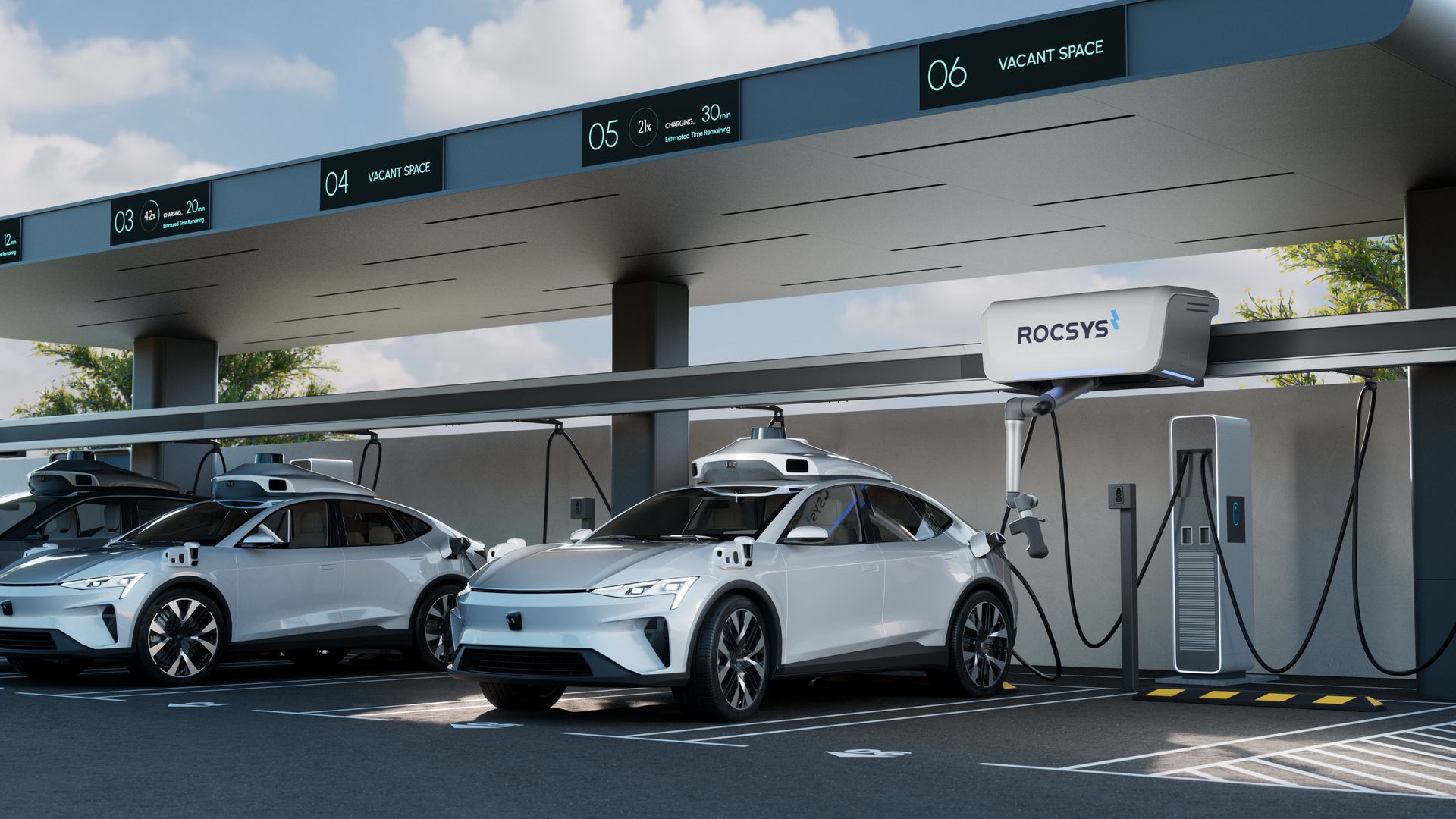
If robots can drive cars, it shouldn't take an army of humans to clean, charge and inspect them.
Why it matters: As robotaxis proliferate, infrastructure — including charging — could become a critical bottleneck. Automation is a no-brainer for large-scale, efficient robotaxi operations, fleet managers say.
Driving the news: Today Rocsys is unveiling the world's first robotic, multi-bay charging system that can manage up to 10 robotaxis at once, Axios is first to report.
State of play: The system, currently in pilot deployment, will begin large-scale rollout in 2027 with an unnamed robotaxi partner, says Crijn Bouman, CEO and co-founder of the company headquartered in The Netherlands and Portland, Ore.
- Over the next five years, Rocsys plans to support thousands of robotaxi charging bays across North America and Europe.
- To support that expansion, the company also announced a $13 million Series A extension led by Capricorn Partners, with participation from Scania Invest and others, bringing total funding raised to date to $56 million.
How it works: The overhead rail-mounted system uses a long, flexible robotic arm to plug and unplug robotaxis, relieving workers of the chore of managing heavy cables.
- At scale, in a depot with 50 parking bays, the Rocsys technology can improve labor efficiency by as much as 75% and deliver up to $1.7 million in annual savings, the company says.
What's next: The overhead design frees up space for workers to do other jobs, like cleaning and inspection while cars are being charged.
- But longer term, Rocsys also plans to automate these activities, Bouman tells Axios.
What they're saying: Automated depots are "table stakes" says Maa of Moove AV.
- Terrawatt Infrastructure co-founder and CEO Neha Palmer agrees.
- "It is pretty amazing. You see these vehicles out there driving themselves, and then they come into the depot, and you have a human charging them, plugging them in."
- "The technology is there," she says of automated charging. "It's not very complicated to open the flap and then plug it in. And so certainly that will be something that you will see pretty ubiquitous, I think, fairly soon."
3. Early Teslas are like old phones you can't update
Tesla's admission that millions of its older cars can't support full self-driving underscores a new reality: software-driven vehicles are starting to age like smartphones — but without an easy upgrade path.
The big picture: AI software is improving much faster than the chips and sensors behind it — an expensive hardware ceiling for automobiles that could soon hit millions of non-Teslas, too.
- The risk is that your car's capabilities might expire before the car itself is ready for the junkyard.
What they're saying: "This is just an early sign of a bigger, forever problem that will affect any privately owned autonomous vehicle technology," autonomy expert Phil Koopman, professor emeritus at Carnegie Mellon University, told Axios.
- "Cellphones and laptops get tossed when the technology ages out in perhaps five years," he said. "Cars still have a dozen or two years left on the road with obsolete computers. What's the plan for that?"
Driving the news: For this week, it is a Tesla problem. CEO Elon Musk has long envisioned a world in which cars get better with age through regular software updates.
- He's assured Tesla owners that cars produced since 2019 have all the hardware they need to eventually drive themselves.
- Last week during the company's quarterly earnings, he reversed course, telling investors the computers in Teslas built before 2024 lack sufficient memory to achieve fully autonomous driving.
The broken promise has already triggered an avalanche of lawsuits from Tesla owners, many of whom paid thousands of dollars upfront for a feature they'll never get to use.
Tesla is offering two solutions, and both could be expensive, considering an estimated 3.5 million vehicles — 40% of all Teslas on the road worldwide — have the older hardware.
- Customers can get a discount to trade in their car for a new one equipped with the latest hardware.
- Or they can upgrade their car by having the computer, cameras and wiring replaced, requiring a quasi-rebuild of the vehicle.
Reality check: Upgrading the hardware is the equivalent of major brain surgery, a process that Musk previously acknowledged would be painful and difficult.
- Tesla hasn't said how much the hardware upgrades will cost, or when retrofits will be available.
- As a stopgap, it's planning an "FSD v14 Lite" software update for older cars to provide improved assisted-driving capability that's still short of full autonomy.
What we're watching: For a while, expect manufacturers to offer a "mid-life upgrade strategy" for cars, similar to Tesla's current plan, Koopman said.
- Eventually, though, carmakers have an incentive to stop providing software updates in older, but perfectly operable, vehicles.
The bottom line: After all, manufacturers would probably rather sell a new car than upgrade an old one.
4. Drive-thru

🚛 California approved new AV regulations this week, clearing the way for the testing and deployment of driverless trucks, after a contentious battle with the Teamsters union.
- Also under the new policies, driverless cars are no longer exempt from traffic tickets and face serious consequences for interfering in emergency situations. (The San Francisco Standard)
🤠 As AVs proliferate in Texas, researchers are calling for dynamic safety certification, which would evaluate how vehicles perform over time — not just at deployment.
- Check out my colleague Nicole Cobler's deep dive into AVs in Texas and then sign up for the Axios Austin local newsletter.
🏨 Uber is adding hotel bookings to its app as it bundles rides, food, shopping and now travel into one "everything app." (Axios)
💸 Plus.ai canceled its SPAC deal with Churchill Capital Corp. IX, citing financial market conditions. The autonomous trucking company says it's still focused on its commercial rollout. (FreightWaves)
Michael O'Leary, CEO of Ireland-based budget carrier Ryanair, yesterday told CNBC that "you'll see European airlines fail" if jet fuel prices remain at $150 per barrel or higher as the Iran war crisis continues.
5. What I'm driving
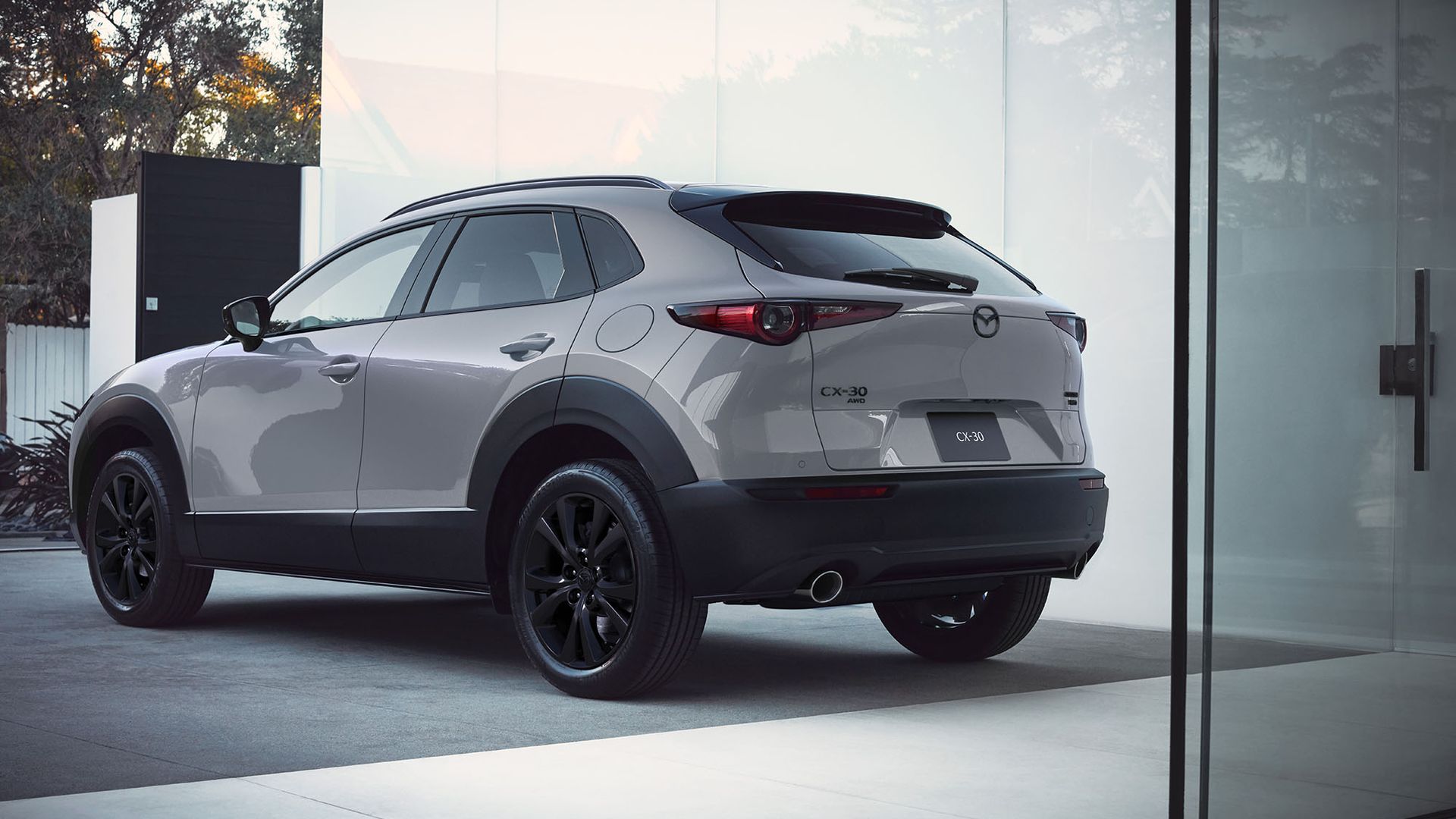
2026 Mazda CX-30
- MSRP: Starts at $25,975
- As tested: $32,535, for the mid-range 2.5 S Aire Edition (includes $1,200 in options, plus delivery)
What I loved: Great Mazda looks, premium interior and fun to drive, even with the 186-hp base engine. (A more powerful turbocharged engine is available.)
What I didn't love: There's not much room for rear seat passengers — or cargo, for that matter.
Thought bubble: It's a stylish choice for young buyers on a budget, as long as you don't plan to haul your friends around a lot.
I test-drive vehicles in my role as a juror for the North American Car and Truck of the Year awards. Opinions are my own.
Thanks to editors Pete Gannon and Amy Stern. If you like this newsletter, please share it and ask your friends to sign up!
Sign up for Axios Future of Mobility