Axios Future of Mobility

April 15, 2026

👋 Hi from San Francisco, where I got to take my first highway Waymo ride, straight from SFO. Driverless at 65 mph — it really is remarkable.
- I'm here for the Ride AI conference and meeting with lots of companies mapping out the future of mobility. Stay tuned for more on what I learn!
1,571 words, a 6-minute read.
1 big thing: Waymo, Tesla, Uber are the ones to beat
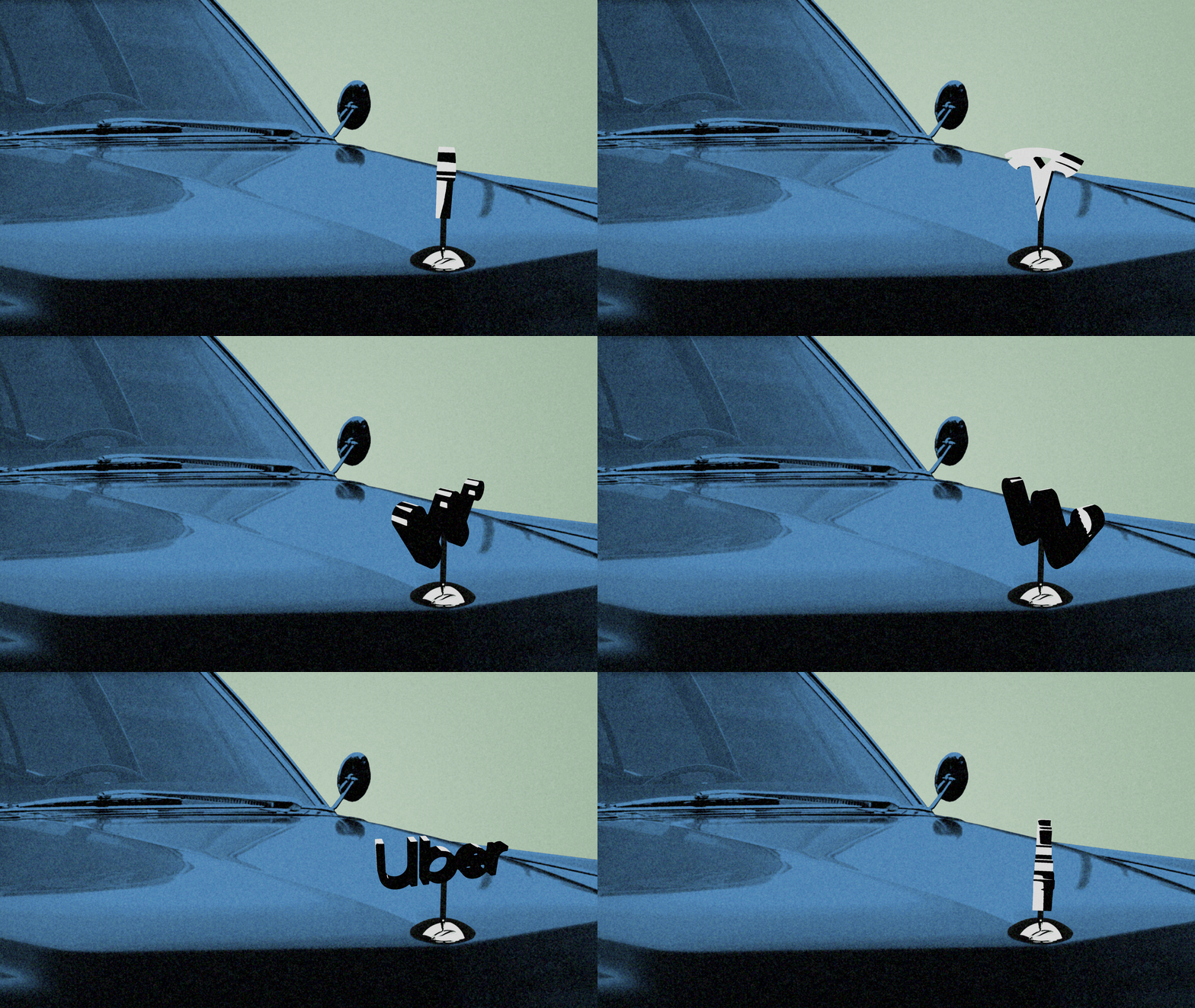
As the race toward autonomy unfolds, a new U.S. "Big Three" in mobility is emerging: Instead of GM, Ford and Chrysler, it's Waymo, Tesla and Uber.
Why it matters: Automotive and tech giants, along with many well-funded startups, are vying for a slice of the self-driving future.
- "Waymo is probably less than a year from becoming a verb," says Grayson Brulte, founder of The Road to Autonomy.
The big picture: Autonomous driving technology is no longer science fiction. It's here.
- Robotaxis are operating in about a dozen cities — with tests underway in many more — and driverless semi trucks are hauling loads across Arizona and Texas.
- Traditional automakers that have dominated the mobility landscape for decades are focused on closer targets: selling more cars and trucks to today's buyers while gradually adding automated-driving features.
- But the Big Three leading the U.S. autonomous landscape will have a different set of challenges, and safely deploying AV technology is only the start — the next phase of the AV race is about who can operate networks at scale.
This will require building the infrastructure and large-scale operations needed to support a viable robotaxi service.
- That means depots for charging, cleaning and vehicle maintenance, plus route optimization technology to deploy vehicles efficiently to meet fluctuating demand.
Between the lines: Waymo, Tesla and Uber already have distinct advantages in these areas that will make it hard for others to catch up.
- Each has bet its stake on an autonomous future, although with different paths to get there.
- And while none of them possesses all the pieces needed for a successful AV business, each has a solid foundation and the resources to do so better and faster than others.
Waymo, the clear robotaxi leader, has operations in 11 cities and 500,000 paid trips per week.
- It has $16 billion in fresh capital, much of it from parent Alphabet, to keep spreading across America, as well as to London and Tokyo.
Yes, but: The company's a tech supplier, not an operator — its product is the Waymo driver, the hardware and software suite added to vehicles so they can drive themselves.
- Nor does it build cars. Instead, it buys them from other manufacturers.
- And while it has experience running depots in San Francisco, it mostly relies on fleet management partners for cleaning and maintenance.
Uber — definitely a verb already — has a superpower that standalone AV companies don't: a sophisticated tech platform that's been efficiently matching riders and vehicles for 15 years.
- Rather than a threat to its ride-share business, CEO Dara Khosrowshahi sees robotaxis as an opportunity.
- On the infrastructure side, it's spending $100 million to develop new AV charging hubs in San Francisco, Los Angeles and Dallas.
Its challenge, though, is that it needs carmakers and tech companies to supply the robotaxis, and other operators to clean and charge them.
- Uber is partnering with every AV developer under the sun — even investing in a few of them — to ensure there's a healthy mix of players.
Tesla's advantage is the data collected by nearly 3.2 million Tesla vehicles driving around the U.S. every day, including 1.1 million subscribers to its FSD (Supervised) hands-free driver assistance package.
- That enables the company to continually improve its autonomous technology.
- The company's vast Supercharger network and low manufacturing costs will also be big advantages as it scales a robotaxi service.
But for all the hype about FSD (which stands for full self-driving), the technology still requires human supervision — and Tesla has not yet deployed a meaningful fleet of robotaxis.
- Nor has Tesla sought regulatory approval for its much-ballyhooed Cybercab, a two-seater with no steering wheel or pedals.
What we're watching: If Tesla manages to get over the current hump on FSD, it could be game over.
The bottom line: The U.S. race to autonomy has only just begun, but its new Big Three are well out in front.
2. Lyft's secret weapon
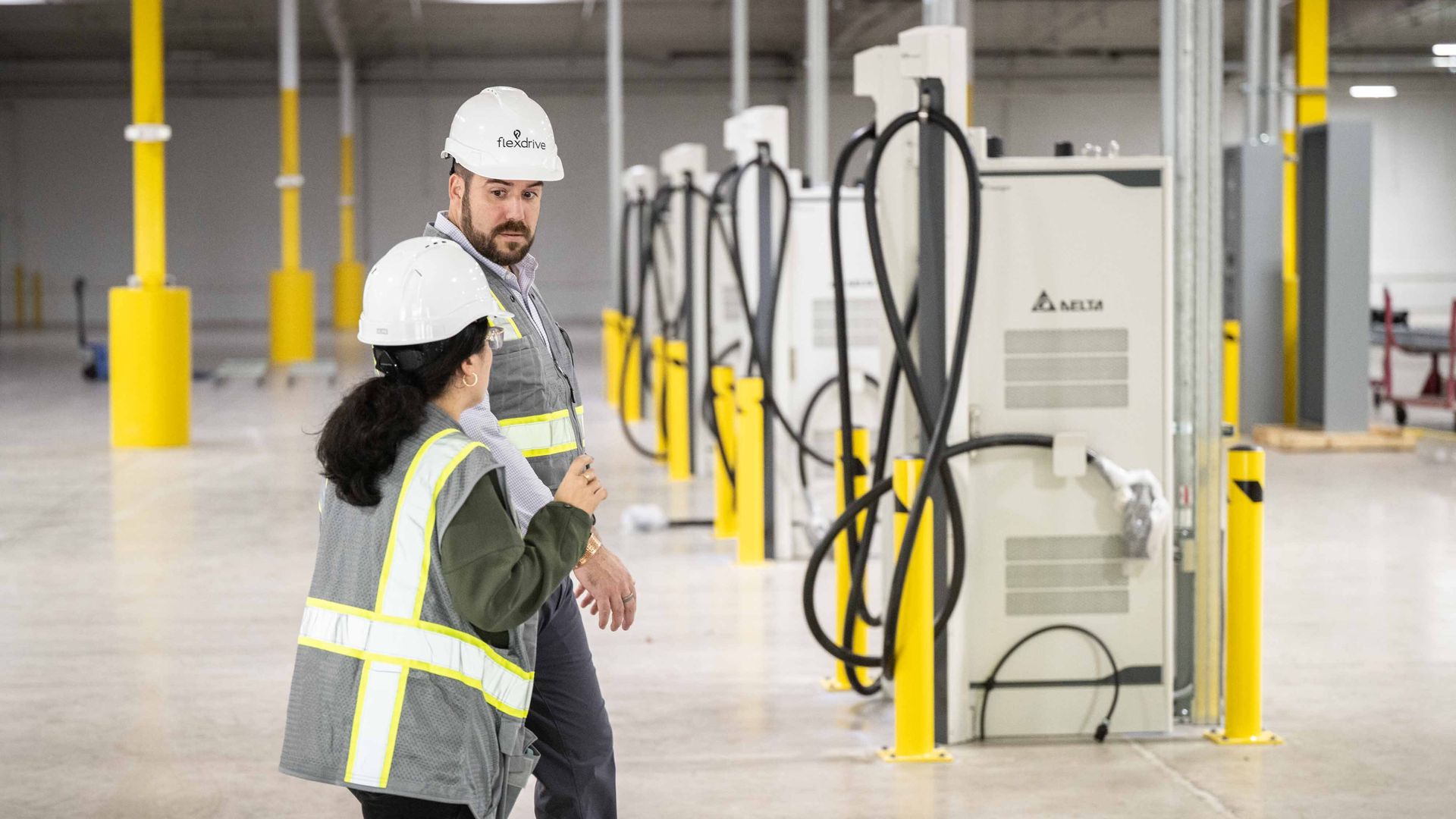
Lyft and Waymo might be ride-hailing rivals, but they're also partners in Nashville, where Lyft's Flexdrive subsidiary will manage Waymo's newly deployed robotaxi fleet.
Why it matters: It's the latest example of frenemies working together to deliver on a shared vision for an autonomous future.
- Longer term, riders in Nashville will be able to hail a Waymo on the Lyft app, too.
Driving the news: Lyft said today that Flexdrive has begun construction in Nashville of "one of the most sophisticated autonomous vehicle fleet management facilities ever built."
- The 80,000-square-foot depot will service, charge and maintain Waymo's AVs starting this fall.
- Flexdrive is hiring more than 70 full-time technicians, operations managers, fleet coordinators and maintenance specialists, many of them Lyft drivers.
Zoom out: Flexdrive began in 2016 as a fleet management company and found a niche renting cars to rideshare drivers who didn't own a car.
- Today, it has 130 employees and manages about 15,000 vehicles at 24 locations across North America.
Lyft acquired Flexdrive for $20 million in February 2020, as part of a broader strategy to develop its own robotaxis, Flexdrive CEO John Parks tells Axios.
- "One of the driving components of the Flexdrive acquisition was if AVs were going to be part of our rideshare future, we believed at the time we needed to manage the fleets in-house," he said.
- Lyft abandoned its AV development effort but tapped Flexdrive's expertise to improve operations and optimize fleet uptime.
- "Now in 2026, we're reaping the rewards of that foresight," Parks said.
The intrigue: Uber, Lyft's biggest rival, is spending $100 million to build fleet management hubs in three cities.
- Although Lyft is one-third the size of Uber, Flexdrive might turn out to be its secret weapon in the global AV race.
What to watch: Flexdrive is already scouting AV depot locations in Europe as Lyft and China's Baidu prepare to launch robotaxis there later this year.
3. Drive-thru
🚖 Lucid has a new CEO, Silvio Napoli, and new investments from Uber and Saudi Arabia's Public Investment Fund.
- Uber committed another $200 million, bringing its total investment in the EV manufacturer to $500 million.
- Uber also agreed to buy 25,000 more Nuro-equipped robotaxis from Lucid, for a total of 35,000 vehicles.
- An affiliate of the PIF, meanwhile, agreed to purchase $550 million of Lucid's convertible preferred stock.
- Lucid is also offering an additional $300 million in public shares.
⚡️ Ionna, the EV charging network owned by eight major carmakers, is partnering with Circle K convenience stores to open 350 high-speed Rechargeries across the U.S.
4. What's driving me: Waymo
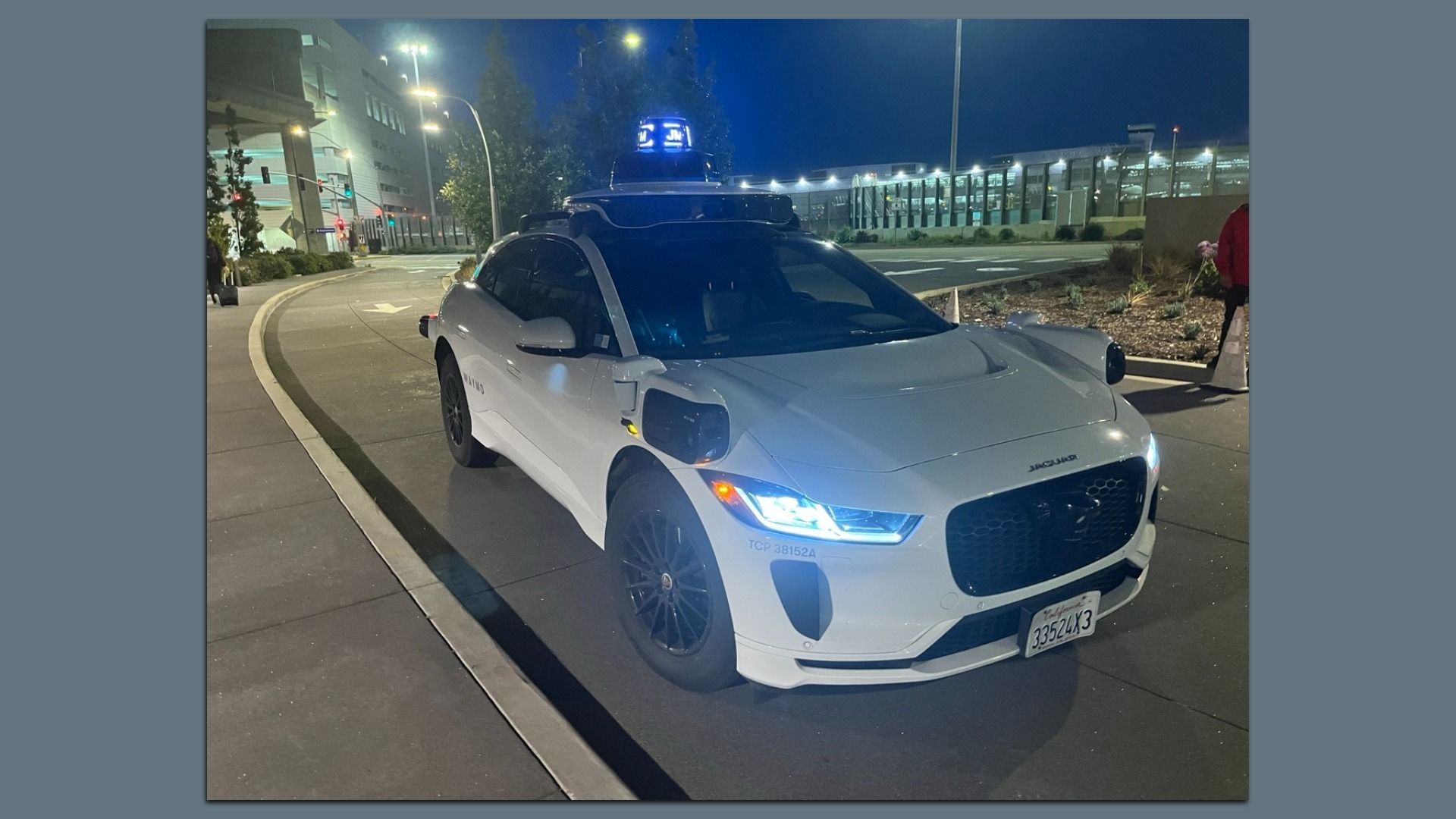
I took my first Waymo robotaxi ride on the highway, from San Francisco International Airport to my hotel in Palo Alto.
Why it matters: I've ridden in a lot of Waymos that never go above 35 miles per hour — so many times that the experience is now unremarkable.
- But stepping off an airplane and into a driverless taxi that drove me 24 miles to my hotel at 65 miles per hour was thrilling.
OK, it wasn't quite that seamless.
- Waymo doesn't do curbside pickup and dropoff at SFO yet.
- I'd heard you have to go to the rental car lot for pickup, but the Waymo app directed me instead to the Grand Hyatt SFO hotel.
- A lot of walking and escalators and then three stops on the Air Train got me to the hotel, where I watched for about 10 minutes while three Waymos dropped off passengers.
- The third one waited a minute and then changed the light on the roof to "JM" which was how I knew it was mine (though it could have been picking up Joe Montana or Julianne Moore, I guess).
- The app advised me my car had arrived, and I had six minutes to load my luggage and climb in before it would depart. The helpful hotel valet opened the trunk and loaded my luggage.
The ride itself was smooth and enjoyable.
- The Jaguar EV accelerated smoothly onto the 101 heading south, reaching a top speed of 65 mph.
- The car stayed in the right lane for the most part, shifting over one lane to make room for merging cars or to pass a slow-moving vehicle.
💭 My thought bubble: I've used hands-free automated driving systems many times, but I was always in the driver's seat, ready to grab the wheel or brake if necessary.
- It was a bit unnerving to realize I had to trust the machine.
When I arrived at the hotel, the Waymo hesitated for a moment as it selected the drop-off spot.
- Instead of driving under the hotel portico to the hotel reception, where most guests arrive, it drove outside the portico to drop me off. (20 extra steps, but who cares?)
- When I opened the door, the trunk automatically opened so I could retrieve my bags. (My biggest fear wasn't going driverless on the highway; it was Waymo driving off with my luggage!)
It cost $75. An Uber X would have been about $61. (It was worth the extra $14.)
The bottom line: There's still some work to do on airport pickups and drop-offs, but my Waymo experience was promising.
Thanks to Pete Gannon and Bill Kole for editing. If you like this newsletter, please ask your friends to sign up!
Sign up for Axios Future of Mobility