Axios Future of Mobility

April 02, 2025

It's "Liberation Day," according to President Trump, who will be in the Rose Garden this afternoon to dish up more tariffs. Automakers are biting their nails. 😬
Meanwhile, I'm in Los Angeles this week, gathering insights from autonomous vehicle experts at the inaugural Ride.ai Summit in Hollywood. And I plan to be tooling all over LA in a driverless Waymo — I'll let you know how it goes.
In 1,280 words, a 5-minute read.
1 big thing: The auto industry's math problem
/2025/04/02/1743599552842.gif?w=3840)
Here's the dilemma that automakers face as President Trump's tariffs pile up: They can raise car prices, sacrifice profit margins or redirect R&D spending to expand U.S. manufacturing.
- But somebody, somewhere, has to pay the bill for the higher costs that compounding tariffs bring.
Why it matters: The auto industry can't absorb the costs of tariffs and invest in electrification and autonomy and software-defined vehicles and new factories, all while fighting off rising Chinese competitors.
- The math just doesn't add up.
Between the lines: If car prices go up, Americans will buy fewer of them, meaning less revenue to fund U.S. growth.
- If companies hold steady on pricing, their modest profit margins will vanish, replaced by red ink — another limitation on growth.
- If they build a new factory in the U.S., they'll have less to spend on innovations like electric vehicles and automated driving, slowing their historic transformation and falling behind China.
Context: Compared to the pandemic supply chain crisis or the semiconductor shortage, the cost burden automakers face now is bigger, says Neal Ganguli, partner and managing director in the automotive and industrial practice at AlixPartners.
- "This takes your margin completely away," Ganguli told Axios.
- The industry's largest trade group is concerned, too.
- "Additional tariffs will increase costs on American consumers, lower the total number of vehicles sold inside the U.S. and reduce U.S. auto exports — all before any new manufacturing or jobs are created in this country," said John Bozzella, president and CEO of the Alliance for Automotive Innovation.
What to watch: In the short term, there are certainly things automakers can do in response to Trump's tariffs, including shifting some foreign production to underutilized U.S. factories.
- There are a dozen unionized GM, Ford and Stellantis assembly plants in the U.S. that aren't operating at full capacity, according to UAW President Shawn Fain, who is vocal in his support of tariffs if it means more union jobs.
Yes, but: Shifting production to the U.S. is costly and can't happen overnight.
- Building a new plant costs at least $1 billion — usually two or three times that — and takes three to five years. Retooling an existing factory is faster but would still cost several hundred million dollars.
- U.S. autoworkers also earn far more than their Mexican counterparts, which means higher labor costs.
More likely, companies will try to squeeze a little more production out of existing factories by adding overtime or speeding up assembly lines.
- That can help around the margins, but would not significantly change their manufacturing footprint.
- They could also use their Canadian and Mexican plants to supply products for export to other countries.
What they're saying: In messages to their workforces, GM and Ford are trying to reassure employees that they'll work through the challenges, and that they should stay focused on their jobs and watch expenses.
Longer term, however, companies need to find new ways to do business in order to survive.
2. Throw out the old playbook

It's more than just tariffs causing the auto industry to buckle at this moment.
- Carmakers face a litany of issues, including regulatory pressures, technological change, powerful Chinese competition and a stagnant sales market.
Why it matters: For decades, the answer to such challenges has been consolidation. But bigger doesn't necessarily mean better, as recent troubles at Stellantis and Volkswagen Group suggest.
- "When an organization grows to a scale of 10 million units, in selling and producing cars, it becomes really troublesome," Toyota Motor Corp. Chairman Akio Toyoda told Automotive News.
- "When you're at that scope, nothing can be decided. Mass production is focused on areas of the lowest cost, and the product becomes a commodity," he said.
Reality check: The old playbooks aren't enough anymore to ensure a sustainable, profitable auto industry, says Lenny LaRocca, U.S. auto sector leader for the consulting firm KPMG.
- "This is a watershed moment for OEMs [original equipment manufacturers] and suppliers to rethink their business models," he tells Axios.
- "The low-hanging fruit has already been done. They knew what to do with COVID, semiconductors and the slowdown in EV sales. Eventually, they have to rethink their structure."
What's next: Instead of outright mergers, carmakers are more likely to form loose alliances to share parts or supply chains, allowing more speed and flexibility, on top of shared cost savings.
- They're also furiously trying to engineer costs out of their vehicles by reducing the number of components and employing new manufacturing techniques like giga-casting, which uses high-pressure die-casting machines to produce big chunks of a car in a single piece.
- Carmakers are also adopting new business models to turn car buyers into lifetime customers — software subscriptions and services, for example, or aftermarket performance parts for car enthusiasts.
One example that's already working is Ford Pro, the automaker's growing commercial fleet business, which has nearly 650,000 subscribers that use Ford software to boost the productivity of their fleets.
- With $9 billion in EBIT profit on $67 billion in revenue last year, Ford Pro is a "hidden gem" that the rest of the industry covets, analysts say.
The bottom line, says AlixPartners' Ganguli: "You have to change to exist."
3. Drive-thru

Catching you up on worthy news you might have missed ...
🚘 Four Tesla dealers said they sold 8,653 cars in 3 days in Canada. Did they? — New York Times
💪 The UAW's risky path to finding common ground with Trump on tariffs — Washington Post
🚚 The Chevrolet BrightDrop van gets a massive $25,500 discount — InsideEVs
😠 Dude, where's my car? Toyota buyers face long waits amid hybrid boom — Reuters
- 💭 My thought bubble: Toyota was right all along about EVs.
4. What I'm driving: 2025 Nissan Rogue
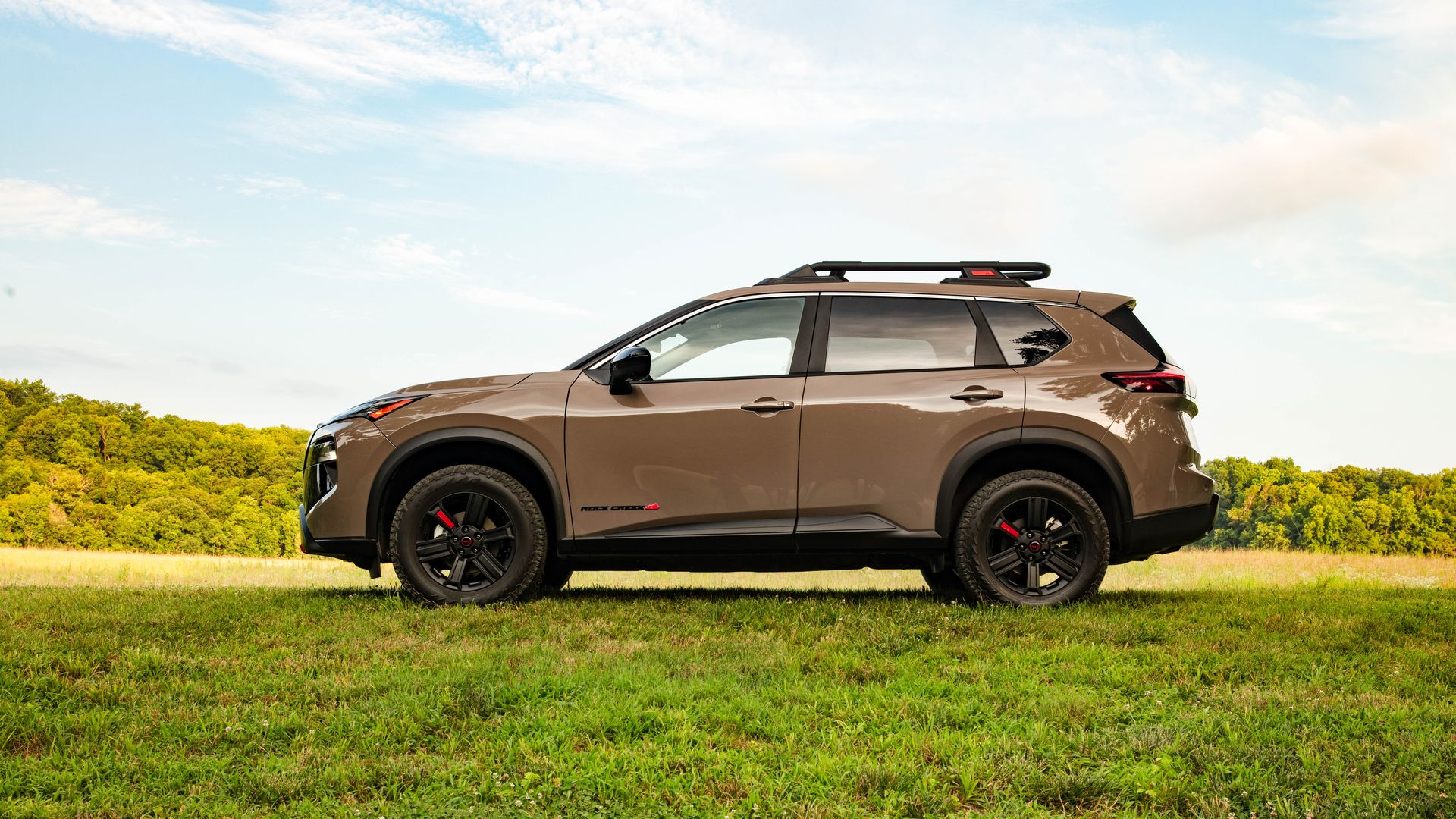
The Rogue is Nissan's most popular model, but faces tough competition from big sellers like the Toyota RAV4 and Honda CRV.
Starting price: $29,230; Price as tested: $40,920
Pros: Sharp exterior styling, along with comfortable leather seats, a heads-up display, heated rear seats and an upgraded infotainment system in the Platinum AWD version I tested.
Cool tech options: Nissan's Pro Pilot Assist 2.1 allows hands-free highway driving.
- A nifty 360-degree camera system includes "invisible hood view" that lets you see under the car to avoid curbs or steer the tires into a car wash track, for example.
Yes, but: The Rogue's 201-hp turbocharged three-cylinder engine is a disappointment compared to rivals.
The bottom line: The Rogue is attractive, if somewhat uninspiring to drive.
I test drive new cars in my role as a juror for the North American Car & Truck of the Year awards. (The cars are loaned to jurors for evaluation purposes and my opinions are my own.)
5. Malaprop of the day

"I know these are swing-for-the-moon opportunities, but I think we should pursue them."
😂 H/T to Mike Colias, of the Wall Street Journal's Detroit bureau, for his fun story about Mike O'Brien, a recently retired Ford sales executive, who since 2014 kept a log of mixed metaphors and malaprops uttered in company meetings.
- Over the years, O'Brien filled six whiteboards with 2,229 linguistic flubs like "Let's not reinvent the ocean" or "too many cooks in the soup" alongside the name of the offending colleague.
- "We weren't being mean," O'Brien told the Journal. "It was just funny."
Thanks to Ben Berkowitz and Bill Kole for editing. Please tell your friends and colleagues to sign up!
Sign up for Axios Future of Mobility