Axios Future of Energy

November 19, 2025

🐪 Happy hump day. Let's climb aboard in 1,382 words, 5 minutes.
🚨 Situational awareness: As COP30 talks hit crunch time, an unusual visitor is expected today: Brazil's President Luiz Inácio Lula da Silva, Bloomberg reports.
✔️ Whether permitting: Our editor Chuck moderates a Center for Climate and Energy Solutions forum on permitting tomorrow at 9am ET with Reps. Gabe Evans and Scott Peters. Register to attend or listen online here.
📻 This week in 1993, U2 released a jarring yet beautiful song that's today's intro tune...
1 big thing: Think of global warming like a fever
Global warming is like a fever, says well-known climate scientist Katharine Hayhoe — even a small rise is serious.
Why it matters: Adapting to the warming already underway is a top focus at the UN climate talks.
- Hayhoe has one of the world's largest social media followings of climate scientists, with nearly a quarter-million followers on LinkedIn alone.
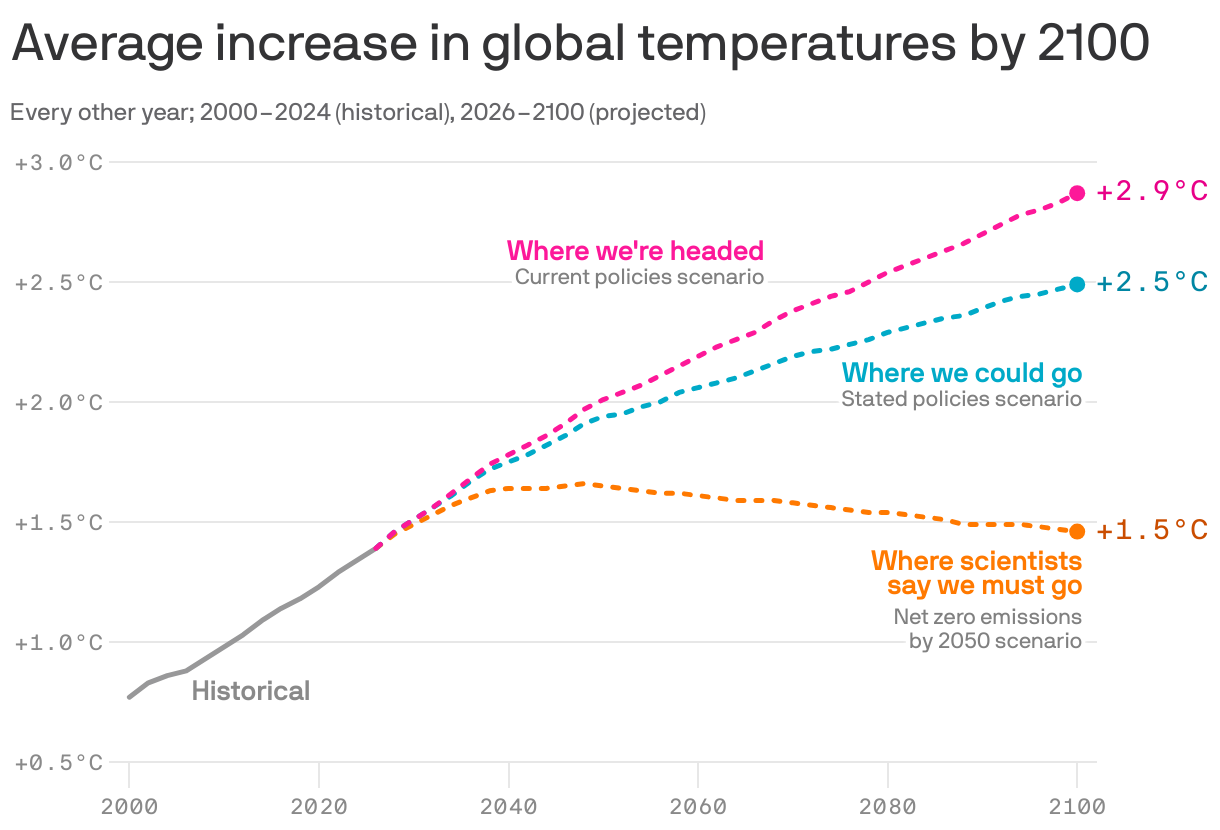
Where it stands: The planet is on track to warm around 5°F (just under 3°C) by the end of the century, according to the International Energy Agency's annual outlook released last week.
- If governments enact current policy proposals, that increase could drop slightly — by roughly half a degree Celsius.
- Reaching net-zero emissions by 2100 would keep the rise to about 2.7°F (1.5°C) — the goal set under the Paris Agreement, though such a goal is already largely out of reach, scientists say.
Between the lines: To many people, a two- to five-degree change sounds insignificant — just normal weather variation. But weather isn't the right frame.
- The better comparison is the human body, says Hayhoe, chief scientist at The Nature Conservancy, in the latest episode of the "Shocked" podcast.
How it works: "If our body temperature spiked by 2 degrees Fahrenheit in a very short period of time, which is exactly what the Earth's temperature has done, then we'd be feeling really achy," said Hayhoe, who's also a Texas Tech professor.
- "Imagine if your body is running a 5, 6, 7-degree fever," she said. "That is life-threatening."
Catch up fast: Last year was the hottest on record, and 2025 is likely to rank among the hottest as well.
Flashback: A decade ago, the world was on track to warm closer to 9°F (5°C) by the end of the century, but efforts to scale cleaner energy have helped temper that.
Zoom out: Negotiators at the UN meeting in Brazil are trying to hash out a global goal on adaptation, but how to fund it is proving to be a sticking point, Semafor reports.
- Another question is whether COP30 ends with an agreement to draft a "roadmap" away from fossil fuels and a process for drawing it. Over 80 countries have endorsed it, per summaries from analysts and press reports.
What we're watching: "The most important thing anyone needs to know about future scenarios is that the No. 1 source of uncertainty in terms of what will happen in the future is us," said Hayhoe, referring to humanity collectively.
Editor's note: This article was written partly based on content from the "Shocked" podcast, which was created by a team including experts at the University of Chicago's Institute for Climate and Sustainable Growth and producers at Magnificent Noise. Amy is also the institute's inaugural journalism fellow.
Disclaimer: Amy is a volunteer board member of The Nature Conservancy's Washington state chapter.
2. ⚛️ Data center CEO: AI speeds fusion by decades
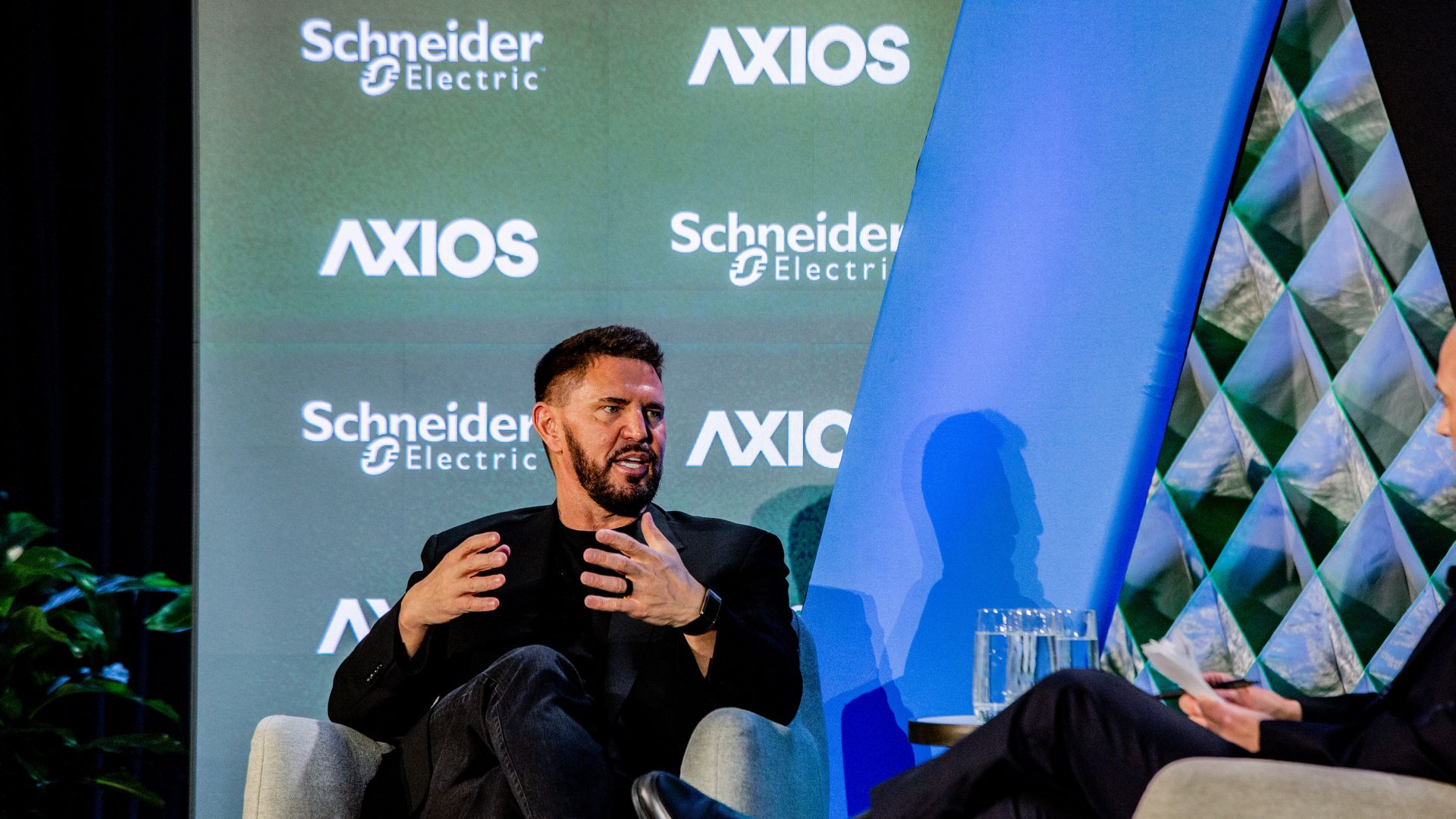
LAS VEGAS — AI energy needs will accelerate commercial fusion power by "two or three decades," said Rob Roy, founder and CEO of data center heavyweight Switch.
Why it matters: Tech and data center heavyweights are helping fund and signing power deals with fusion startups, in addition to other nuclear agreements.
State of play: "Where [AI] really changes the world is that it's going to speed up fusion by, really, two or three decades," Roy told me onstage at Schneider Electric's innovation summit here.
- "The No. 1 source of poverty globally is energy poverty. If you could get to the point where energy is free, you can solve all food issues, you can solve all water issues," he said, noting huge energy needs for desalination.
The bottom line: Roy, whose firm has a power deal with reactor startup Oklo, also called AI-related investments a huge catalyst for fission power.
- "It's the only thing in the world that has really trillion-dollar expenses coming due being paid by trillion-dollar companies that can actually pay the bill," he said of AI.
3. 👀 Exclusive: Grid vets launch data center efficiency startup

Hammerhead AI, founded by grid startup vets and focused on data center power efficiency, has launched out of stealth with a $10 million seed round, CEO and founder Rahul Kar tells Axios Pro exclusively.
Why it matters: Access to energy is the biggest barrier for data center developers, but software can help unlock more efficiency.
Driving the news: Buoyant Ventures led the round, which also included Schneider Electric's VC arm, Aina Climate AI Ventures, MCJ Collective, WovenEarth Ventures, and CoreWeave board member Jack Cogen, and others.
- Kar is former chief operating officer of AutoGrid, a virtual power plant developer.
How it works: Hammerhead AI says it has developed algorithms that can optimize any data center gear that draws power.
- Hammerhead's software acts like an air traffic controller, maximizing power utilization, unlocking more AI compute capacity, and boosting the revenue and tokens from AI inference that can be generated.
- "Most data centers run at about 30% to 40% power utilization. So there is this tremendous headroom that lies there that we can optimize and bring in for supporting AI revenue," Kar tells Axios Pro.
What's next: Hammerhead AI plans to announce customer deployments "very soon," Kar says.
Subscribe to Axios Pro Deals for a steady diet of exclusives and smart analysis.
4. 🏃 Catch up quick on policy: Clean Water Act, litigation, nuclear

⚡ First look: A coalition of industry groups urged congressional leaders to overhaul a section of the Clean Water Act it says is blocking much-needed energy and infrastructure projects.
- Why it matters: The letter — viewed first by Axios — signals that major industry groups see a political opening to win long-sought changes to the bedrock law.
- State of play: The Interstate Natural Gas Association of America and the National Hydropower Association led the effort. Other signees include the American Petroleum Institute and U.S. Chamber.
- Zoom in: Republicans have long sought to overhaul the act's section 401 to prevent states from blocking pipeline infrastructure that moves across their waterways.
⚛️ The Energy Department finalized a $1 billion loan to Constellation Energy to help finance the restart of the undamaged reactor at Three Mile Island in Pennsylvania.
- Why it matters: This is an AI story, too. A power purchase deal with Microsoft is playing a big role in enabling the project. CNBC has more.
🛢️The Sierra Club and several other groups filed a lawsuit yesterday challenging a planned Trump 2.0 oil lease sale in the Gulf of America (renamed by Trump administration from the Gulf of Mexico).
- Why it matters: The case will test Interior Department efforts to avoid fresh environmental studies as it greatly expands offshore oil auctions under the GOP budget law.
- Friction point: The groups allege Interior is dangerously claiming that lease sales required under the law don't need new NEPA studies.
- The other side: Interior, in a statement, said "Congress directed the timing, size, terms, and stipulations of these sales," leaving it "no discretion." But it added that NEPA "will continue to apply to post-lease actions and approvals."
⚖️ A federal appeals court halted California's looming corporate climate risk disclosure mandate while litigation plays out. Go deeper
5. 📈 Charted: The fitful mainstreaming of EVs
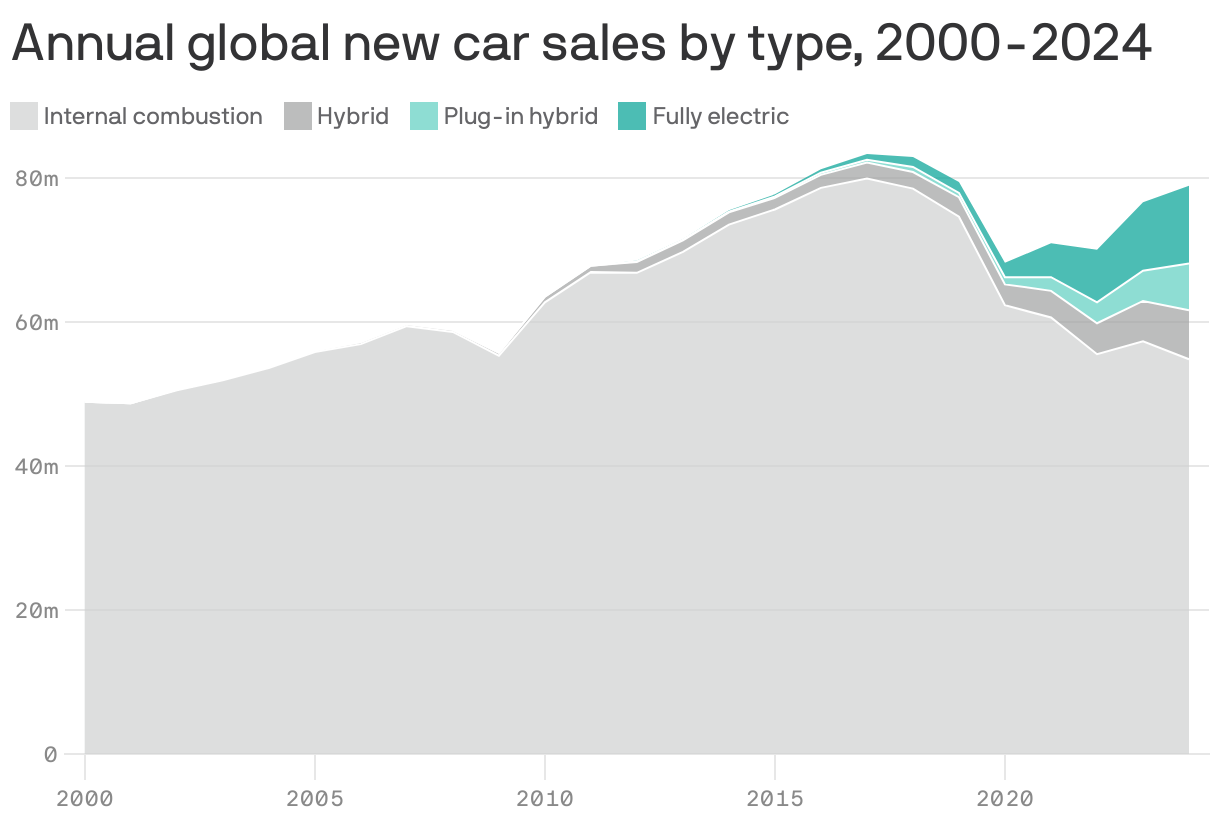
Sales of purely internal-combustion cars have fallen 30% globally from their 2017 peak, per a new IEA report on the global auto industry.
Why it matters: EVs are rising in more countries even amid U.S. policy headwinds, though they remain heavily concentrated in China, the EU and U.S.
- The shift has "significant implications for economies around the world and for the energy sector," IEA boss Fatih Birol said in a statement.
What's next: IEA's report offers a "competitiveness toolbox" for nations seeking viable auto industries in the 2030s.
6. 😮 Number of the day: 166 gigawatts
That's the firm Grid Strategies' upwardly revised — waaaaay upward — estimate of growth in peak U.S. power demand in 2030.
‼️ Stunning stat: "The 166 GW forecast is equivalent to adding 15 times the peak load of New York City," it states.
🙏 Thanks to Chuck McCutcheon and Chris Speckhard for edits to today's edition, along with the brilliant Axios Visuals team.
Sign up for Axios Future of Energy