Axios Future of Energy

October 01, 2026

🗺️ Hi! We've got a whirlwind tour this morning, starting with Capitol Hill's permitting future and then moving to the Middle East to check in on oil flows.
- Plus, we explore shale patch spending and Patagonia's voting initiative, all in 1,180 words, 4.5 minutes.
🚨 Situational awareness: "The EU Commission, France, Italy, Ireland and Britain are holding a call on the possible need to release diesel stocks," Reuters reports.
🎶 This week in 1998, hip hop virtuosos Outkast released Aquemini, which provides today's intro tune...
1 big thing: The rocky road to a new permitting law
If you get this newsletter, you're aware of the big bipartisan Senate deal that backers hope to steer through the lame-duck Congress.
Why it matters: Cutting hurdles for energy projects is a top priority for fossil fuels and renewables sectors, but some green groups fear erosion of safeguards.
- Powerful business groups want to make building all sorts of infrastructure easier.
Catch up quick: Top Republicans and Democrats on the Senate's energy and environment panels yesterday dropped the 417-page bill that includes (not a complete list!)...
- New limits on the duration of lawsuits, and the scope and length of reviews under the Clean Water Act and National Environmental Policy Act.
- A stronger federal hand in siting and approval of large transmission projects.
- Protections for previously issued permits, a priority for renewables groups and Dems upset with Trump administration barriers.
State of play: A who's who of major business and energy industry groups — representing oil and gas, renewables and coal, a rarity! — cheered the bill.
- The White House backs the deal and wants quick passage, an official said.
A few dynamics on our radar...
🥞 Abundance movement vs. the left. Center-left backers see a huge opening to help build out clean energy and grid upgrades to integrate it.
- But groups on the left flank of the climate movement panned it, calling it a giveaway to fossil fuel interests.
🔍 Watch groups with close ties to Dems. Some staked out a noncommittal-to-positive position, saying they need more time to study the bill.
- The Natural Resources Defense Council cheered transmission pieces while saying it's unclear if they outweigh "rollbacks" of environmental laws, and said it "must improve."
- Evergreen Action welcomed project certainty and transmission sections, but added that changes to key environmental laws demand "diligent scrutiny."
🛣️ The long road. Co-author Sen. Sheldon Whitehouse (D-R.I.) said at a press conference there will be revisions as backers seek input from colleagues.
- And there are "unresolved" questions about Trump officials returning to "regular order" for wind and solar projects.
- But he credited the administration with a "very reasonable opening proposal" on the matter.
- Rep. Jared Huffman (D-Calif.), the top Dem on the Natural Resources Committee, criticized it and said his party will have a stronger hand next year.
🃏Data centers are a wild card. It would prevent utility ratepayers from bearing the costs of new power and grid upgrades needed for AI data centers.
- Everyone's still digesting the intricate bill, but in principle, turning this bipartisan goal into firm requirements could ease political hurdles.
The bottom line: Two things are true — the odds of a big permitting deal are at their highest in a very long time, and many things could trip this up.
Go deeper: Climate scientist Zeke Hausfather has a useful graphic on which provisions aid fossil fuels, renewables, and cut both ways.
2. 🛢️ High flows, higher costs, and more petro-notes
A lot more oil seems to be flowing from the Middle East, but it's not cheap — and may not be sustainable without resolution of the Iran conflict or an open-ended U.S. military commitment.
State of play: Market intelligence firm Kpler sees crude exports from the Persian Gulf back around pre-war levels, excluding Iranian barrels the U.S. is blockading.
- That's from a combo of Strait of Hormuz tanker shipments and increasing workarounds.
Stunning stat: "40% of the region's crude now leaves without crossing Hormuz, against 17% before the war, through Saudi and United Arab Emirates (UAE) pipelines," Kpler states.
Yes, but: While there's agreement that the numbers are up substantially, barrel-trackers' estimates vary.
Threat level: "It is our understanding that the US escort operation requires a significant outlay of aerial and naval assets operating in close coordination," RBC Capital Markets' Helima Croft writes in a note.
- That includes "Apache helicopters, F-35s, and aerial refueling tankers to guided-missile destroyers and amphibious assault ships, with support from the carrier groups outside the Strait."
And the economics are daunting, whether it's tanker rates at record highs, as HSBC Global Investment Research analysts and others point out, or diesel markets that are tighter than crude markets.
- A large and growing share of Gulf crude is moving via "costly shuttle systems, [ship-to-ship] transfers and military-protected convoys," a new HSBC note states.
- Meanwhile, refined products "require a much larger number of smaller vessels, more complex logistics and a worse risk-reward for shipowners," it states.
What we're watching: U.S. officials think President Trump could order a return to major combat operations after the midterms, Axios' Barak Ravid reports.
The bottom line: "Total Middle East crude exports are indeed recovering, but this doesn't mean that the oil market is anything like back to 'normal,'" HSBC analysts write.
💵 Speaking of oil and gas, is South Korea really going to make a huge investment in the Alaska gas pipeline and LNG project?
- It's not so clear despite the White House touting the commitment, CNBC reports, citing South Korean President Lee Jae Myung's saying that it depends on "commercial viability."
3. 🛢️ What U.S. oil producers are doing with extra cash
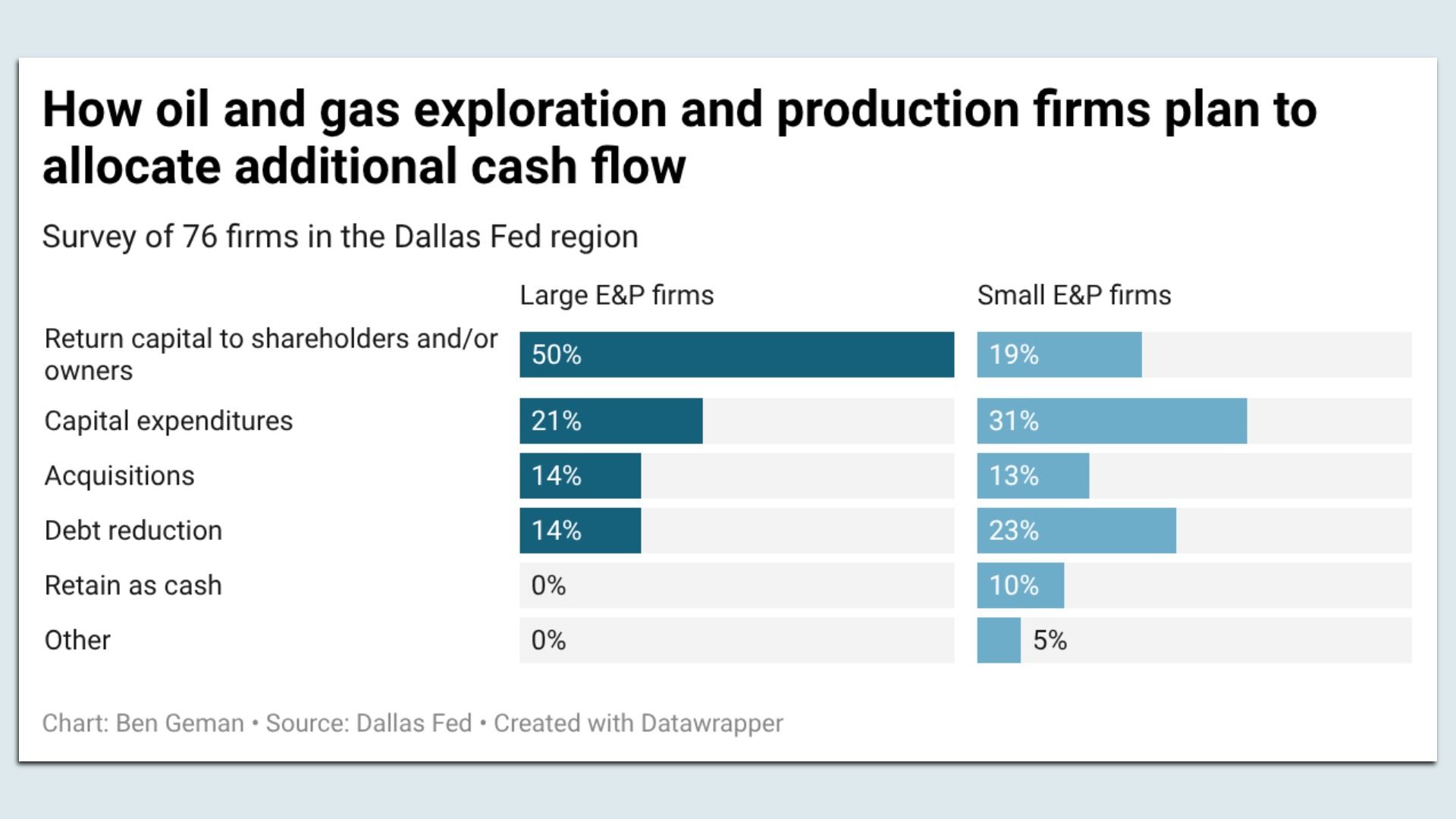
A fifth of large oil and gas producers plan to pour cash from higher prices into new capital expenditures, the Dallas Fed's latest survey of firms in its region finds.
Why it matters: It helps explain why U.S. oil production forecasts have risen during the Iran war, but the rise has not been gigantic.
- A lot of the additional free cash flow is going to other priorities, notably rewarding shareholders and owners.
4. ⛰️ Number of the day: $11.2 million
That's how much Patagonia expects to spend as its unusual get-out-the-vote campaign reaches its participation goal just four days after launching.
Why it matters: Patagonia set aside $11.2 million for the campaign — matching the 11.2 million environmentally minded registered voters who sat out the last election, according to the nonprofit Environmental Voter Project.
How it works: Announced last week and launched Saturday, Patagonia offered $100 credits to 112,000 people who each helped three friends make a plan to vote. Participants could instead donate the money to a voter project group or the League of Conservation Voters.
The bottom line: Patagonia hit its goal in four days, faster than expected. It isn't issuing more credits but will continue its voter outreach through Election Day.
5. 😜 Quote du jour: Permitting humor edition
"The permitting reform press conference will begin as soon as the venue clears environmental review, local zoning, and the statute of limitations for someone to sue over whether the 'no press conference' alternative was adequately considered."— Columbia climate economist Noah Kaufman, who served in the Biden White House
His X post landed when yesterday's agreement was briefly on ice.
🙏 Thanks to Mackenzie Weinger and Chris Speckhard for editing, and to our brilliant Axios visuals team.
📫 Did a friend send you this newsletter? Welcome, please sign up.
Sign up for Axios Future of Energy